


Marvell Strikes Custom Chip Deal With Google: Why Broadcom Fell and Why Goldman Sachs Thinks Market May Be Overly Worried
TradingKey - On August 19, Eastern Time, Broadcom (AVGO) fell for a fourth consecutive trading day, dropping to near the key support level of $360.
It is reported that Marvell Technology and Google announced a custom chip partnership today, issuing warrants to Google to purchase up to 58.97 million shares of stock at an exercise price of $206.58 per share, corresponding to a value of approximately $12.18 billion. The two parties signed a commercial agreement on July 29, under which Marvell will provide custom chip products to Google; subsequent warrant vesting will also be linked to revenue from the partnership products.
This partnership strengthens Google's long-term tie with Marvell and has also prompted the market to reassess Broadcom's position in Google's AI chip supply chain. For a long time, Google has primarily relied on Broadcom to assist in designing its self-developed TPUs. Both Marvell and Broadcom can convert customer chip solutions into mass-producible products and provide backend support before entering foundries like TSMC.
Therefore, Broadcom's stock price fell over 5%, reflecting not a market belief that its existing orders will be lost immediately, but rather concerns that Google might introduce more custom chip partners, altering the allocation of future incremental orders. As cloud vendors accelerate in-house AI chip development, Broadcom's original "core supplier scarcity" is facing a repricing.
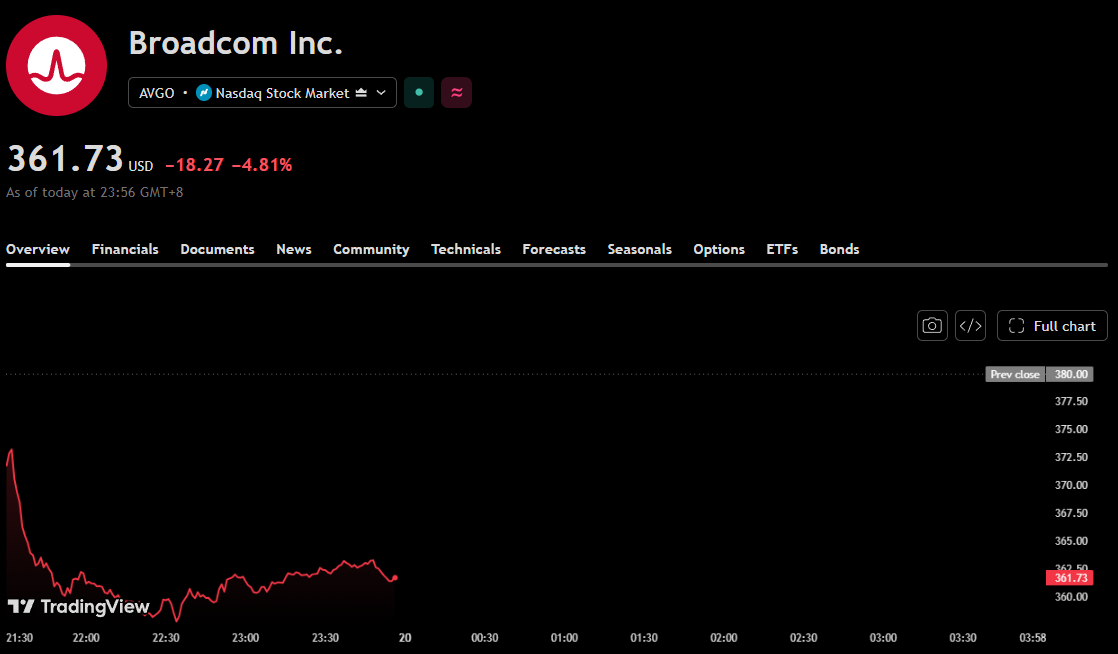
Broadcom stock price chart, Source: TradingView
It is worth noting that Goldman Sachs maintained a "Buy" rating and a $525 price target for Broadcom in its Q2 earnings preview, believing that market concerns over ASIC competition are overblown and current expectations have fallen into a conservative range. Goldman Sachs projects that Broadcom's FY2026 AI revenue will reach approximately $57 billion, roughly in line with market consensus, while FY2027 AI revenue could reach $133 billion, 12% above consensus.
Goldman Sachs believes that while the entry of vendors such as MediaTek and AMD into the ASIC market has indeed heightened investor concerns over competition and market share loss, Broadcom's moat is not just chip design capability, but also large-scale mass production, reliable delivery, and long-term collaboration with hyperscalers. For custom XPUs, once a customer selects a partner and enters the mass production phase, the cost of switching suppliers is high; the impact of competitors is more likely to be reflected first in new orders rather than rapidly replacing existing business.
In addition, Goldman Sachs emphasized that the market may be underestimating the growth of Broadcom's networking business. As AI clusters expand from thousands of chips to tens of thousands of chips, networking accounts for a rising proportion of AI infrastructure costs, and switch chips such as Tomahawk 6 are expected to benefit. Another key constraint on AI infrastructure expansion is not demand, but physical capacity such as land, power, and facilities for data centers, which makes suppliers with mature delivery capabilities and customer relationships all the more valuable.
For Broadcom, key observation points after earnings will be its FY2027 AI revenue guidance, the ASIC competitive landscape, and customers' data center deployment readiness. Marvell's partnership with Google has changed the market narrative on the supply chain landscape, but Goldman Sachs' view is that Broadcom's advantages in mass production capabilities, networking business, and customer relationships have not been fundamentally shaken.
Recommended Articles


