


Tesla Stock Price Prediction: SpaceX Thruster-Equipped Roadster May Debut This Month, Could It Boost TSLA Stock?
TradingKey - After waiting nearly a decade, Tesla's (TSLA) next-generation Roadster may finally be set for an official debut.
According to a new report from The Information, Tesla is preparing an unveiling event for the new Roadster, which could take place as early as August 2026. Unlike typical new vehicle launches, Tesla is planning a dramatic demonstration this time: a limited-edition Roadster equipped with SpaceX (SPCX) cold-gas thrusters will perform an off-ground hovering demonstration at SpaceX's testing facility in McGregor, Texas.
The so-called "flying" does not mean the Roadster actually turns into an aircraft, but rather that a cold-gas propulsion system driven by high-pressure gas generates thrust to briefly lift the vehicle off the ground. Because the thrusters produce immense noise and thrust during operation, the demonstration vehicle will be remotely controlled with no driver inside, and on-site spectators will also need to maintain a considerable distance from the vehicle.
According to the report, Tesla is internally aware of the high difficulty of the demonstration, and related plans have been adjusted multiple times previously. However, even if it ultimately achieves only a brief hover, this visually striking presentation could still become another event for Tesla to attract market attention.
From Supercars to the "Flying" Roadster
The Roadster project itself has undergone a long and iterative R&D process.
In 2017, Tesla unexpectedly unveiled the next-generation Roadster during the launch of its Semi electric truck, presenting highly appealing specifications such as 0 to 60 mph in about 1.9 seconds and a range exceeding 1,000 kilometers, while promising deliveries around 2020. However, this plan has been delayed multiple times since then, with mass production never truly materializing. Reuters also recently pointed out that nearly a decade has passed since the initial announcement of the new-generation model, yet Tesla still has not provided a clear delivery timeline for consumers.
During the R&D process, the positioning of the Roadster also underwent significant changes. Tesla had considered developing the new car based on existing Model S Plaid technology, but ultimately pivoted to building a more extreme supercar from scratch, utilizing a lightweight carbon-fiber structure. As Musk continuously raised requirements for performance and innovation, the Roadster gradually evolved from a high-performance EV into Tesla's "flagship project" for showcasing cutting-edge technology.
The "flying" concept is a concentrated reflection of this shift.
According to reports, early demonstration concepts were even more radical than current ones, conceiving the vehicle driving along a magnetized, roller-coaster-like ramp to perform an inversion before hovering. As the project progressed, these complex elements were canceled one after another, and the current, more realistic approach focuses primarily on the effect of the vehicle briefly leaving the ground.
Meanwhile, Tesla has also collaborated with SpaceX's engineering team to jointly advance cold-gas thruster technology. For a car originally designed for ground travel, maintaining stability after leaving the ground while managing weight, noise, and safety are key issues that must be addressed to bring this technology to fruition.
Beyond AI and Robotics, Tesla Needs a New Car Story
The Roadster's return to the spotlight this time may signify more than just launching a new car.
In recent years, Tesla has increasingly emphasized AI, autonomous driving, robotics, and other new businesses. Meanwhile, the growth pressure facing the company's automotive business has also drawn market attention. Against this backdrop, re-introducing the Roadster helps Tesla emphasize to investors that the company still retains the capability to build high-performance vehicles and drive automotive technological innovation.
Particularly noteworthy is that this time, the Roadster is directly integrated with SpaceX technology, giving it a very distinctive Musk touch. Previously, Musk had proposed adding unconventional technologies such as thrusters to the Roadster on multiple occasions, and the latest reports indicate that this concept has now entered the practical demonstration phase.
However, for a Tesla that relies increasingly on narratives around AI, autonomous driving, and robotics, a "flying" Roadster is certainly eye-catching, but what the market ultimately needs to see remains a Roadster that can actually be mass-produced and delivered.
Tesla Stock Technical Analysis
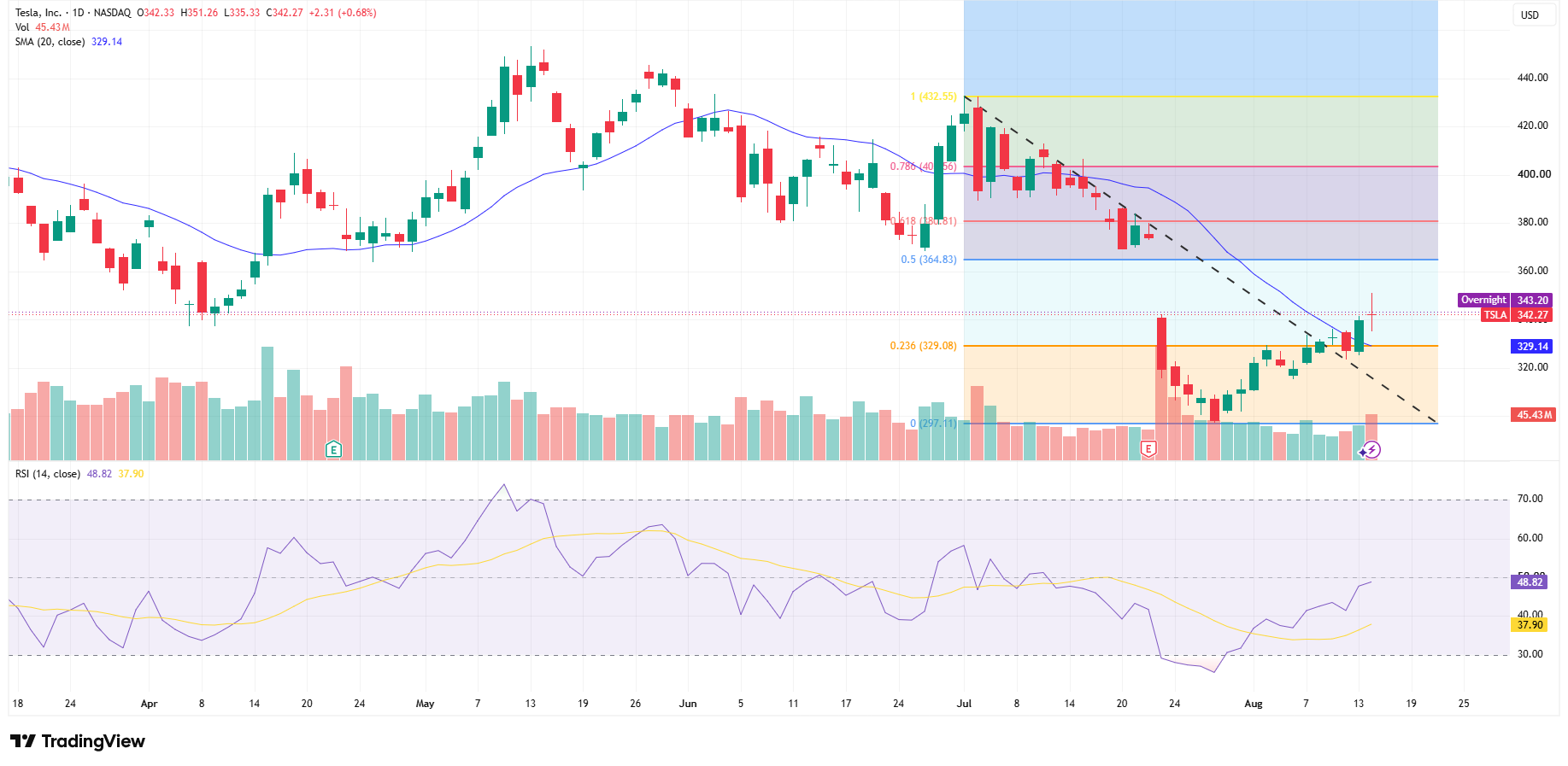
Source: TradingView
From the daily chart, Tesla's stock price has continued to rebound from a phase low of $297.11, breaking above the downward trendline extending from the high of $432.55. It has also reclaimed the 20-day moving average at $329.14 and the 0.236 Fibonacci retracement level at $329.08, indicating that the short-term downtrend has eased and the market is attempting to build a rebound structure.
However, TSLA recently touched a high of $351.26 before closing at $342.27, leaving a notable upper shadow that indicates selling pressure remains in the $348–$352 range. Among these, $348.85 corresponds to the 0.382 Fibonacci retracement level, while $352 represents a recent intraday high, together forming the first key resistance for the current rebound.
The RSI recovered from the oversold territory to 48.82, well above its signal moving average of 37.90, suggesting that downward momentum has weakened. However, with the RSI yet to firmly hold above 50, this can currently only be confirmed as a technical rebound rather than a strong bullish trend.
If the SpaceX thruster-equipped Roadster debuts as scheduled and improves market sentiment, driving TSLA to firmly hold above $352 on heavy volume, the next target would be $364.83. A further breakthrough could see the stock challenge $381.81.
On the downside, initial support lies around $329, where the 20-day moving average and the 0.236 Fibonacci level converge. Holding above this region keeps the rebound structure intact; a breakdown below it could trigger a retest of $318–$320. Meanwhile, $297.11 marks the bottom of this phase and serves as a vital line of defense that bulls must hold.
Recommended Articles


