


Home Depot's Customer Transactions Have Fallen for 5 Straight Quarters
Key Points
Comparable customer transactions fell 1.3% in the fiscal first quarter, a fifth consecutive quarterly decline.
Average ticket rose 2.3% year over year to $92.76.
Home Depot reports second-quarter results on Tuesday, Aug. 18.
- 10 stocks we like better than Home Depot ›
On the surface, Home Depot (NYSE: HD) looks steady. The home improvement giant grew fiscal first-quarter sales 4.8% year over year to $41.8 billion, held onto its full-year guidance, and pays a dividend yielding about 2.7% as of this writing.
Underneath, though, one number has been moving the wrong way for more than a year. Comparable customer transactions, the count of purchases at stores and websites open at least a year, fell 1.3% in the fiscal first quarter (the period ended May 3). That marked the fifth consecutive quarterly decline. Total transactions came to 391.1 million for the quarter, down from 394.8 million a year earlier.
Missed Nvidia in 2009? This Rare Signal Is Flashing Again. In 2009, a "Double Down" signal flashed for a little-known chipmaker called Nvidia. For the first time in years, that same "Total Conviction" signal is flashing for a company 1/100th the size of Nvidia. Continue »
Home Depot's revenue growth, in other words, isn't coming from more transactions. It's coming from bigger receipts, and from acquisitions.
The company reports its fiscal second-quarter results on Tuesday, Aug. 18.
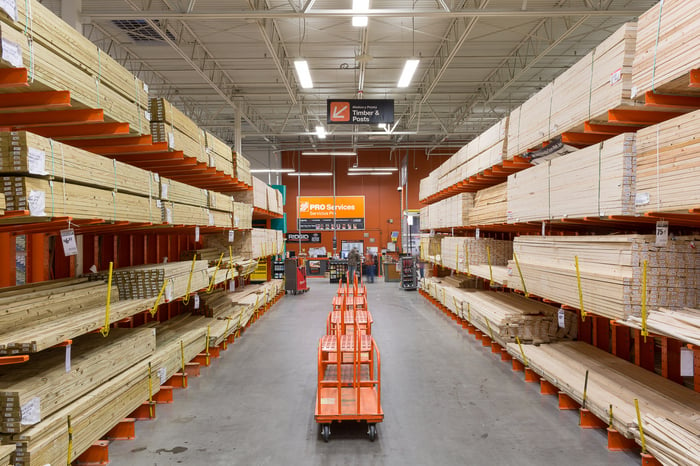
Image source: Home Depot.
Fewer transactions, bigger receipts
Comparable transactions fell 0.5% in the first quarter of fiscal 2025, 0.4% in the second, 1.6% in the third, 1.6% in the fourth, and 1.3% in the most recent quarter. The declines deepened in the back half of last year and have moderated somewhat since. But they haven't stopped.
The average ticket, meanwhile, has gone the other way, with comparable-ticket growth accelerating from flat a year ago to gains of 1.4%, 1.8%, 2.4%, and 2.2% over the following four quarters. Customers spent an average of $92.76 per transaction in the most recent quarter, up 2.3% from a year earlier.
But five straight declines is a different signal than one soft quarter. It suggests transactions have stopped growing, even as each one rings up a little more. Bigger receipts can come from higher prices, from customers choosing pricier items, or both.
The result is comparable sales that have barely moved: up 0.2%, 0.4%, and 0.6% over the past three quarters, with U.S. comparable sales up just 0.4% in the latest period. Home Depot is ringing up slightly fewer transactions at a slightly higher average ticket, and the two nearly cancel out.
The pro business is filling the gap
If comparable sales grew just 0.6% last quarter, how did total sales grow 4.8%? Mostly through acquisitions. Home Depot bought SRS Distribution, a supplier to professional contractors, in June 2024. And last year it added building-products distributor GMS. Home Depot's transaction and ticket figures exclude these businesses entirely, so the pro-distribution deals are boosting sales without touching the numbers above.
Management, of course, isn't promising a traffic turn this year. Guidance, reaffirmed in May, calls for total sales growth of 2.5% to 4.5%, comparable sales growth of roughly flat to 2%, and diluted earnings per share roughly flat to up 4% from last year's $14.23. First-quarter net earnings slipped to $3.30 per diluted share from $3.45 a year earlier. And the plan still calls for about 15 new store openings this year.
"The underlying demand in our business was relatively similar to what we saw throughout fiscal 2025, despite greater consumer uncertainty and housing affordability pressure," CEO Ted Decker said in the first-quarter release.
That last phrase is the one I keep coming back to. Home Depot's customers aren't defecting to a competitor. They appear to be putting off projects that require a loan or a home sale, and a turn in traffic probably requires help from housing (cheaper borrowing, more homes changing hands) that the company can't provide on its own.
Tuesday's test
The report on Aug. 18 covers the spring selling season, which was Home Depot's biggest sales quarter last year, when the period's sales reached $45.3 billion, up 4.9% year over year. It's the stretch of the year that gives traffic its best shot at turning. If comparable transactions fall again, the streak reaches six quarters, or a year and a half without transaction growth.
The stock trades around $339 as of this writing, about 21% below its 52-week high, at about 24 times earnings.
The business itself looks steady. It generated roughly $13 billion of free cash flow last fiscal year, and the dividend is well covered.
However, earnings per share are guided flat to up 4% this year, and a price-to-earnings multiple in the mid-20s only makes sense if the transaction declines eventually end. For now, the company is offsetting them with bigger tickets and acquisitions, and that can work for a while. Tuesday's report shows whether the streak breaks, or reaches six.
Should you buy stock in Home Depot right now?
Before you buy stock in Home Depot, consider this:
The Motley Fool Stock Advisor analyst team just identified what they believe are the 10 best stocks for investors to buy now… and Home Depot wasn’t one of them. The 10 stocks that made the cut could produce monster returns in the coming years.
Consider when Netflix made this list on December 17, 2004... if you invested $1,000 at the time of our recommendation, you’d have $421,511!* Or when Nvidia made this list on April 15, 2005... if you invested $1,000 at the time of our recommendation, you’d have $1,381,960!*
Now, it’s worth noting Stock Advisor’s total average return is 981% — a market-crushing outperformance compared to 216% for the S&P 500. Don't miss the latest top 10 list, available with Stock Advisor, and join an investing community built by individual investors for individual investors.
See the 10 stocks »
*Stock Advisor returns as of August 16, 2026.
Daniel Sparks and his clients do not have positions in any of the stocks mentioned. The Motley Fool has positions in and recommends Home Depot. The Motley Fool has a disclosure policy.
Recommended Articles


