


Applied Materials Trades More Than 25% Below Its High With Revenue at a Record
Key Points
Applied Materials reported record fiscal third-quarter revenue of $9.1 billion, up 25% year over year.
Management guided fiscal fourth-quarter revenue to $10.25 billion, which would be up 51% year over year.
Shares fell about 5% in after-hours trading Thursday despite the results.
- 10 stocks we like better than Applied Materials ›
Applied Materials (NASDAQ: AMAT) came into Thursday's fiscal third-quarter report about 28% beneath its 52-week high of $739.67, closing the session at $534.54.
The chip-equipment maker then posted records on nearly every line. Revenue came in at $9.1 billion, up 25% year over year. Non-GAAP (adjusted) earnings per share rose 41% to a record $3.50. Operating income and operating cash flow set records, too, with the latter topping $3 billion.
Missed Nvidia in 2009? This Rare Signal Is Flashing Again. In 2009, a "Double Down" signal flashed for a little-known chipmaker called Nvidia. For the first time in years, that same "Total Conviction" signal is flashing for a company 1/100th the size of Nvidia. Continue »
Management then guided fiscal fourth-quarter revenue to $10.25 billion, plus or minus $500 million, good for 51% year-over-year growth at the midpoint. The stock fell about 5% in after-hours trading anyway.
A company reporting records while its shares sit more than a quarter below their high makes for a disagreement worth taking seriously. What is the market discounting that the income statement isn't showing?
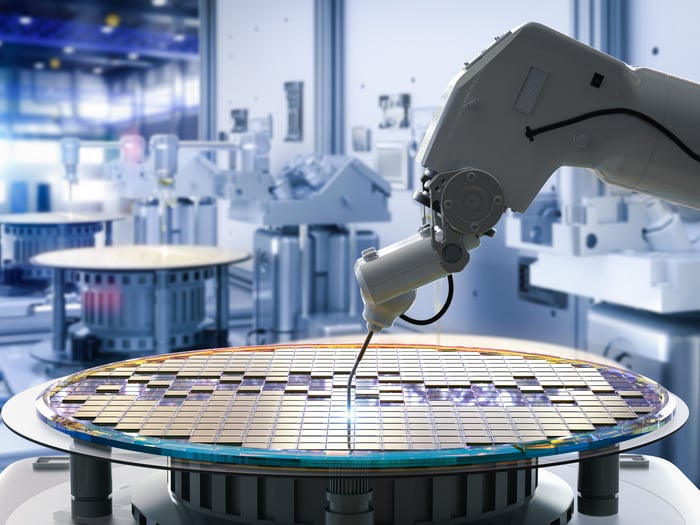
Image source: Getty Images.
Accelerating growth
Not only is the growth strong, but it's also speeding up. Revenue rose 15% sequentially -- growth that CEO Gary Dickerson called "the highest quarter-on-quarter revenue growth in the company's history" on the earnings call -- on top of the 25% year-over-year gain. Non-GAAP gross margin reached 50.4%, the 13th consecutive quarter of year-over-year expansion, and non-GAAP operating margin hit a record 34%. DRAM revenue, which includes high-bandwidth memory (HBM) packaging, grew 52% year over year to record levels.
And the fiscal fourth-quarter guide points the same direction: 25% year-over-year growth in fiscal Q3 becomes 51% at the fiscal Q4 midpoint, with non-GAAP earnings per share guided to $4.02, up 85% -- a comparison helped by a soft year-ago quarter, when revenue had dipped.
The demand behind those numbers is the artificial intelligence (AI) build-out. Management said leading-edge chipmaking, DRAM, and advanced packaging should represent about 80% of the growth in the wafer fab equipment market in 2026 and 2027. Those are the areas it calls most important to AI computing, and where it says it holds leadership positions. It also expects a very significant increase in DRAM revenue in the second half of the calendar year as memory makers expand cleanroom capacity.
Even the familiar overhang softened. The company said it now expects its China revenue to increase this calendar year, led by investments in 28-nanometer chipmaking, where it has strong market positions. And shareholders get a large share of the cash. Management said it expects to distribute 80% to 100% of free cash flow, with $12.8 billion remaining on its buyback authorization.
Why is the stock down, then?
Semiconductor equipment is a cyclical business, and the spending boom driving these records is also the reason for the market's caution. Applied's customers are racing to add AI capacity, and when capacity races end, equipment orders are among the first things cut.
The guided quarter would put revenue about 50% above a year earlier. The bigger the step up, the further orders could fall if spending normalizes.
The stock's own path shows how much optimism came and went. Shares ran from a 52-week low of $154.47 to a high of $739.67 inside a year. Even after the pullback since, the stock has more than tripled off that low as of Thursday's close.
And the price still assumes a lot. At Thursday's close, the multiple on Applied's last 12 months of earnings is about 50. On analysts' estimates for the next 12, it is about 31. A price like that already pays for the guided surge -- the forecast 85% earnings jump for fiscal Q4 is baked in.
A high bar either way
Sure, 31 times forward earnings is a high bar for a cyclical company. But shares this far below their high are not priced with euphoria, either. The market appears to be paying up for next year while refusing to pay for the years after it.
I'd argue that split is about duration, and duration is the honest uncertainty here. Applied's records say nothing about how many quarters of 50% growth remain, and no guide can say much beyond the quarter it covers.
What Thursday's report did establish is that the current stretch of demand keeps strengthening -- the two strongest quarters in the company's history are this one and, if guidance holds, the next one.
The gap between record results and a stock more than a quarter below its high comes down to how long the AI equipment cycle runs. The report added one more quarter of evidence that demand is still building. It couldn't add more than that.
Should you buy stock in Applied Materials right now?
Before you buy stock in Applied Materials, consider this:
The Motley Fool Stock Advisor analyst team just identified what they believe are the 10 best stocks for investors to buy now… and Applied Materials wasn’t one of them. The 10 stocks that made the cut could produce monster returns in the coming years.
Consider when Netflix made this list on December 17, 2004... if you invested $1,000 at the time of our recommendation, you’d have $421,511!* Or when Nvidia made this list on April 15, 2005... if you invested $1,000 at the time of our recommendation, you’d have $1,381,960!*
Now, it’s worth noting Stock Advisor’s total average return is 981% — a market-crushing outperformance compared to 216% for the S&P 500. Don't miss the latest top 10 list, available with Stock Advisor, and join an investing community built by individual investors for individual investors.
See the 10 stocks »
*Stock Advisor returns as of August 16, 2026.
Daniel Sparks and his clients do not have positions in any of the stocks mentioned. The Motley Fool has positions in and recommends Applied Materials. The Motley Fool has a disclosure policy.
Recommended Articles


