


Warren Buffett Recently Called the Stock Market "A Church With a Casino Attached." Is He Right?
Key Points
Berkshire Hathaway’s former CEO and chief stock picker says the stock market has turned dangerously speculative again.
In fact, he and current Berkshire chief executive Greg Abel are keeping the vast majority of the company’s idle cash on the sidelines.
Even Berkshire Hathaway has been deploying some of its money in this gambling-minded environment.
- 10 stocks we like better than Berkshire Hathaway ›
Echoing an observation he's made more than once as one of the world's most-heralded stock pickers, in an interview given at Berkshire Hathaway's (NYSE: BRKA) (NYSE: BRKB) annual shareholder meeting held in May, retired CEO Warren Buffett likened the current stock market to "a church with a casino attached."
In other words, the foundation for sound and solid investing is still in place, but "we've never had people in a more gambling mood than now."
Missed Nvidia in 2009? This Rare Signal Is Flashing Again. In 2009, a "Double Down" signal flashed for a little-known chipmaker called Nvidia. For the first time in years, that same "Total Conviction" signal is flashing for a company 1/100th the size of Nvidia. Continue »
It's getting in the way of Berkshire's performance, too. As he recently told CNBC's Becky Quick, "It's tough to find values when everybody is preferring gambling." And Berkshire Hathaway's current cash hoard of $397 billion confirms that both he and current Berkshire CEO Greg Abel believe what Buffett's saying.
The question is, is the Oracle of Omaha just prompting another cleverly worded thought exercise, or is he actually right?
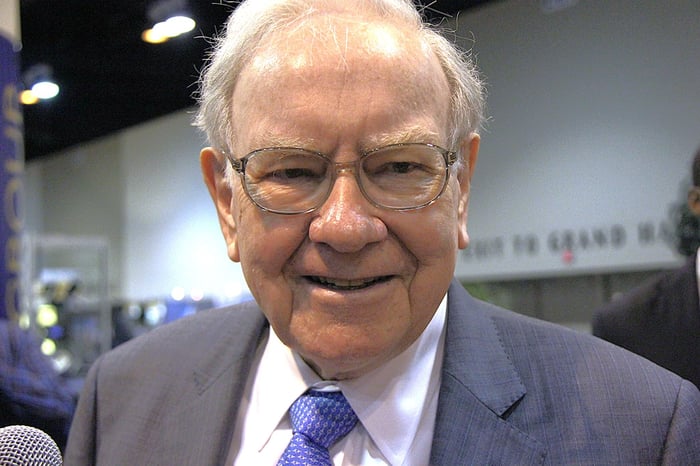
Image source: The Motley Fool.
The data affirms his opinion
Don't misread the message. Simply avoiding stocks altogether because of the unhealthy market environment isn't necessarily the right call either. Overbought stocks can and do climb even higher. There are also plenty of undervalued names outside of the richly valued technology sector to consider right now.
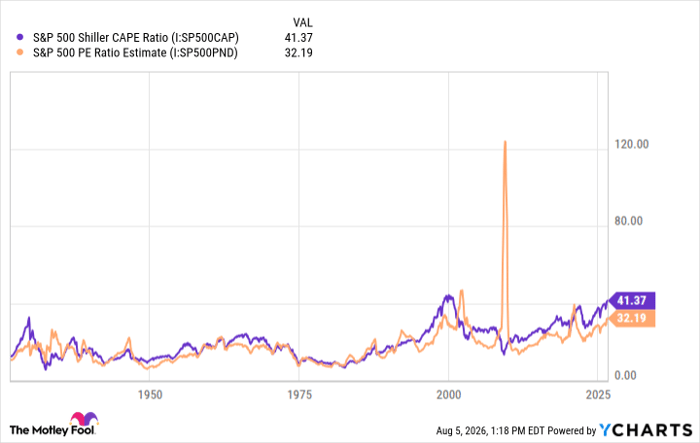
Still, Buffett's got a fair overall point. The S&P 500's (SNPINDEX: ^GSPC) forward-looking price/earnings ratio currently stands near a record high of just over 32. In contrast, its longer-term, inflation-adjusted CAPE (Case-Shiller P/E) ratio of over 41 nearly matches its all-time peak following the rapid rise of dot-com stocks in the late 1990s.
Data by YCharts.
Both valuation measures got here, of course, because investors are expecting -- or at least hoping for -- big-time profit growth in the very near future, largely driven by the artificial intelligence industry. Indeed, they're so confident it's coming that they'll pay rarely seen prices to own the stocks expected to deliver these profits.
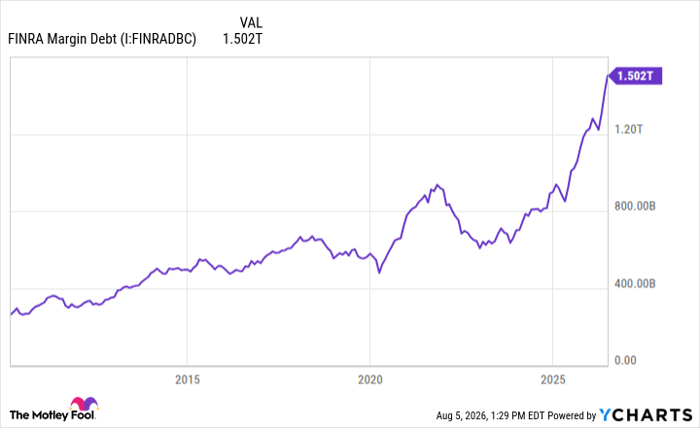
It's not just a matter of valuation, though. U.S. investors' margin balances -- money investors borrow from their broker to purchase stocks with -- have also soared just since 2025 to a record-breaking $1.5 trillion.
Data by YCharts.
The rapid pace of this recent rise is a worry in and of itself, as it suggests a bunch of people simply raced into buying as much of the rising stock as they're allowed to own as quickly as they could, ignoring factors like valuation or sustainability.
No immediate action is needed, but knowing it should guide future decisions
So in practical terms, what are investors supposed to do about it? There's no particular action to be taken. The key is simply understanding how this dynamic can -- and will -- eventually impact stocks' prices. It's going to weigh them down. It's just not clear when, or by how much, but it's coming.
But not necessarily for every stock. Some tickers are worth buying right now, even if Buffett and/or Greg Abel are keeping most of their powder dry for the time being. As a reminder, Berkshire Hathaway still acquired a bunch of Alphabet shares in the first quarter of this year, and it's arguably one of the stock market's most popular "casino" names at this time.
Should you buy stock in Berkshire Hathaway right now?
Before you buy stock in Berkshire Hathaway, consider this:
The Motley Fool Stock Advisor analyst team just identified what they believe are the 10 best stocks for investors to buy now… and Berkshire Hathaway wasn’t one of them. The 10 stocks that made the cut could produce monster returns in the coming years.
Consider when Netflix made this list on December 17, 2004... if you invested $1,000 at the time of our recommendation, you’d have $399,724!* Or when Nvidia made this list on April 15, 2005... if you invested $1,000 at the time of our recommendation, you’d have $1,374,595!*
Now, it’s worth noting Stock Advisor’s total average return is 967% — a market-crushing outperformance compared to 215% for the S&P 500. Don't miss the latest top 10 list, available with Stock Advisor, and join an investing community built by individual investors for individual investors.
See the 10 stocks »
*Stock Advisor returns as of August 9, 2026.
James Brumley has positions in Alphabet. The Motley Fool has positions in and recommends Alphabet and Berkshire Hathaway. The Motley Fool has a disclosure policy.
Recommended Articles


