


Fed Chair Kevin Warsh Just Doubled Down on His Promise to Change How the Central Bank Thinks About Inflation
Key Points
A new era has arrived for Wall Street, with Kevin Warsh attempting to reform one of the central bank's fundamental mandates: price stability.
The new Fed chair is leaning heavily on the past in formulating his present-day definition of inflation.
Kevin Warsh's ideological overhaul is opening up a can of worms for Wall Street.
- 10 stocks we like better than S&P 500 Index ›
Since the beginning of June, investors have watched the time-honored Dow Jones Industrial Average (DJINDICES: ^DJI), broad-based S&P 500 (SNPINDEX: ^GSPC), and growth-propelled Nasdaq Composite (NASDAQINDEX: ^IXIC) climb a wall of worry and launch to new highs.
But a new era has arrived for Wall Street's major stock indexes, courtesy of newly sworn-in Fed Chair Kevin Warsh. President Donald Trump's handpicked successor to Jerome Powell is undertaking an ideological overhaul of the central bank and attempting to reform one of its most fundamental mandates: price stability.
Where to invest $1,000 right now? Our analyst team just revealed what they believe are the 10 best stocks to buy right now, when you join Stock Advisor. See the stocks »
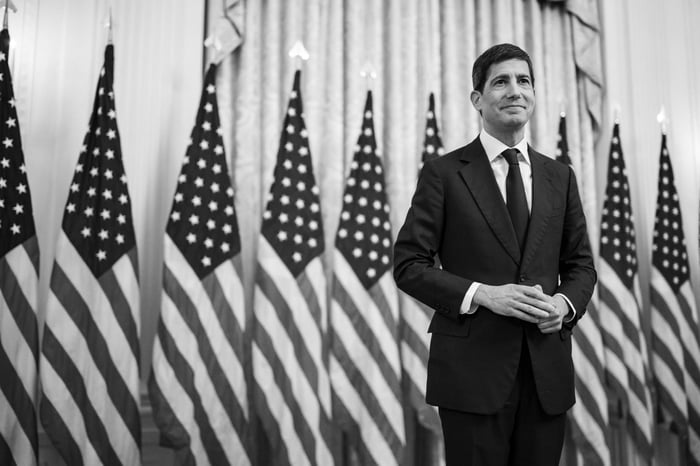
Fed Chair Kevin Warsh is overseeing a reform-oriented Fed. Image source: Official White House Photo by Daniel Torok.
Out with the old and in with the older
During Warsh's confirmation testimony before the Senate Banking Committee on April 21, he laid out several reforms he'd like to see made at the central bank. For instance, he criticized the Fed's bloated balance sheet and expressed his dislike for forward-looking guidance in the context of policymaking.
However, the stand-out reform proposed by Warsh during his testimony was to alter the very definition of inflation. Warsh opined that:
[P]rice stability should be a change in prices such that no one's talking about it.
If this sounds familiar, it's because former Fed Chairs Paul Volcker and Alan Greenspan shared similar views on inflation. Volcker, who chaired the Fed from August 1979 to August 1987, referred to price stability (one-half of the Fed's dual mandate) as "a situation in which expectations of generally rising (or falling) prices over a considerable period are not a pervasive influence on economic and financial behavior."
Meanwhile, Greenspan, who succeeded Volcker, claimed we'd "be at price stability when households and businesses need not factor expectations of changes in the average level of prices into their decisions."
Federal Reserve Chairman Kevin Warsh says he is focused on the central bank's 2% inflation target during testimony before the House Financial Services Committee https://t.co/4K76Yj7kzw pic.twitter.com/0tLZJwxvTS
-- Bloomberg TV (@BloombergTV) July 14, 2026
On July 14, while testifying before the House Financial Services Committee, Warsh doubled down on returning to his predecessors' definition of inflation:
My broader definition of price stability is a change in prices such that households and businesses don't have to worry about it, don't have to think about it.
Image source: Getty Images.
Kevin Warsh is opening up a can of worms for Wall Street
While a return to this old-school approach to thinking about inflation would afford the Federal Open Market Committee (FOMC) added flexibility in adjusting monetary policy, it would also open a can of worms for the second-priciest stock market in history.
Firstly, it introduces uncertainty into the bond market. Even though Warsh has vowed to maintain the Fed's long-term inflation target of 2%, a vague definition that simply involves households not talking about or worrying about inflation makes it virtually impossible for financial markets to predict what FOMC policymakers may do next. The removal of transparency and predictability will likely make Treasury yields more volatile.
Additionally, almost everyone is talking about inflation right now. Even with headline inflation pulling back to 3.5% in June from 4.2% in May on the heels of a notable decline in fuel prices, Core Personal Consumption Expenditures (PCE), which excludes energy and food costs, has remained stubbornly high.
BREAKING: June CPI inflation falls to 3.5%, below expectations of 3.8%
-- The Kobeissi Letter (@KobeissiLetter) July 14, 2026
Core CPI inflation falls to 2.6%, below expectations of 2.8%.
Month-over-month CPI inflation fell -0.4%, the biggest monthly drop since May 2020.
US stock market futures are surging on the news.
By Warsh's own definition of price stability, pulled from a mix of Volcker and Greenspan, and based on his historically hawkish stance on monetary policy, the likelihood of FOMC rate hikes remains incredibly high.
For an expensive stock market that's been powered by the partially debt-financed artificial intelligence data center build-out, Warsh's attempt to alter the very definition of inflation is the type of news that could halt a historic rally in its tracks.
Should you buy stock in S&P 500 Index right now?
Before you buy stock in S&P 500 Index, consider this:
The Motley Fool Stock Advisor analyst team just identified what they believe are the 10 best stocks for investors to buy now… and S&P 500 Index wasn’t one of them. The 10 stocks that made the cut could produce monster returns in the coming years.
Consider when Netflix made this list on December 17, 2004... if you invested $1,000 at the time of our recommendation, you’d have $397,351!* Or when Nvidia made this list on April 15, 2005... if you invested $1,000 at the time of our recommendation, you’d have $1,304,257!*
Now, it’s worth noting Stock Advisor’s total average return is 934% — a market-crushing outperformance compared to 210% for the S&P 500. Don't miss the latest top 10 list, available with Stock Advisor, and join an investing community built by individual investors for individual investors.
See the 10 stocks »
*Stock Advisor returns as of July 17, 2026.
Sean Williams has no position in any of the stocks mentioned. The Motley Fool has no position in any of the stocks mentioned. The Motley Fool has a disclosure policy.
Recommended Articles


