


OpenAI cuts GPT-6 Sol and Luna prices by 50% to defend developer share
On Tuesday, OpenAI introduced the GPT-6 Sol and the GPT-6 Luna, and they are both priced to be at least 50% lower than the rates of the GPT-5.6 models they supersede. OpenAI’s price cuts are aimed at developers and enterprises that have begun selecting models on the basis of the cost of completed tasks instead of just benchmark scores.
Interestingly enough, this news coincided with Anthropic’s announcement of the reduced price of its flagship model.
Half the price of the GPT-5.6 models
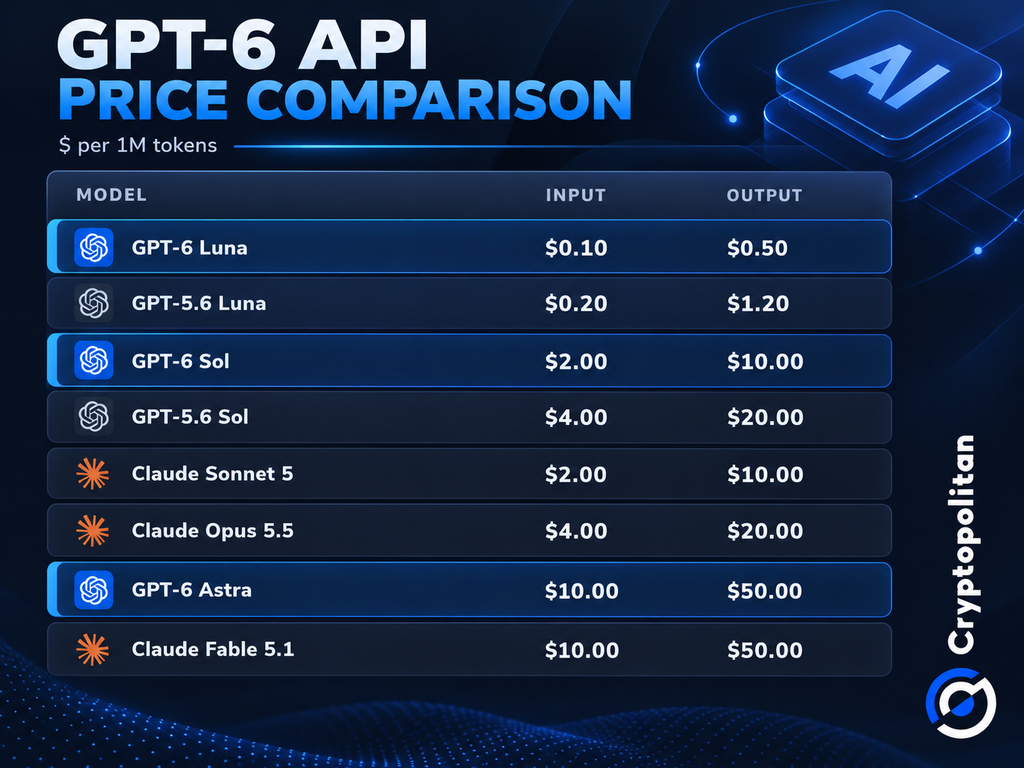
The cost of GPT-6 Sol is $2 per million input tokens and $10 per million output tokens. This is compared to the prices for GPT-5.6 Sol which are $4 and $20, respectively. The cost for GPT-6 Luna is $0.10 for input and $0.50 for output, compared to $0.20 for input and $1.20 for output for GPT-5.6 Luna. Overall, this means that the costs for Sol have been halved in both cases, while the costs for Luna have been halved for input and reduced by 58.3% for output.
OpenAI credits improved inference and caching as factors that allowed it to make the reductions. According to its launch post, the prices for using GPT-5.6 are promotional, while a representative of OpenAI has told VentureBeat that the new GPT-6 rates are here to stay. The GPT-6 Astra tier remains the most expensive version at $10 for input and $50 for output.
According to Cryptopolitan, OpenAI has reduced the price of GPT-5.6 Luna by 80% and GPT-5.6 Terra by 20%, indicating that pricing is becoming a central issue in the AI model competition.
Selling cost per completed task, not benchmark wins
OpenAI’s strategy has become more economics-based than technical. The startup’s performance at AutomationBench, a site that measures business processes across 47 different tools, reveals that GPT-6 Sol at max effort has scored 32.0% while costing $0.34 per task to complete. Claude Opus 5.5 has scored 40.0% at max effort while costing $1.28 per task. Opus 5.5 delivered an eight-percentage-point higher completion score, but at about 3.8 times the cost per task compared to GPT-6 Sol.
In the most recent Agents’ exam, according to OpenAI, Sol at max effort surpassed Opus 5’s maximum performance at 60% lower cost per task.
Independent data supplied by Artificial Analysis assigns GPT-6 Sol at maximum with an Intelligence Index score of 48 and Xiaomi MiMo-V2.6-Pro to 46, but the latter is considerably cheaper than the former.
Anthropic answers with Opus 5.5 the same day
Claude Opus 5.5 was launched by Anthropic on September 22 at a price of $4 per million tokens for input and $20 for output, reducing the cost per token by 20% versus Opus 5. Anthropic has claimed that with the new model, users will spend about 40% less due to lower token usage.
The net result of this is that GPT-6 Sol has a rate of $2, putting it at half of the rate of $4 for Opus 5.5 and matching Claude Sonnet 5. On the other hand, both GPT-6 Astra and Claude Fable 5.1 are on the same level and charging $10 for input and $50 for output services as per VentureBeat’s analysis.
Cheaper rivals keep closing the gap
OpenRouter says DeepSeek doubled its token share on the platform from 9% in January to 18% in June, while Chinese models collectively surpassed US models in token share in early June. Xiaomi has also released its MiMo models under an MIT license, giving companies the option to self-host instead of paying per token.
According to the Ramp AI Index, which is based on spending statistics from over 70,000 companies, the adoption rate of Anthropic is 43.8% while that of OpenAI is 39.8%. The statistics are not indicative of any global market share, but rather they show how easily corporate spending transfers from one provider to another.
Furthermore, the Global AI Diffusion Report published by Microsoft offers a more extensive perspective on the situation: AI is becoming more popular around the globe while open-weight models may lead to decreased access costs, especially in the Global South, despite the obstacles posed by infrastructure, connectivity, and skills.
Why cheaper tokens may not mean cheaper AI
Gartner predicted on August 17 that inference costs per agentic workflow will rise more than fivefold through 2028. It calls this the “inference paradox”: cheaper unit economics can still increase overall spending as AI workflows grow more complex.
“Each successive generation of AI capability will necessitate more, and often more expensive, tokens.” — Will Sommer, Senior Director Analyst, Gartner
A University of Oxford preprint, “The Price of Intelligence”, found quality-adjusted inference prices fell about 0.73 log points a year—more than seven times faster than conventional measures capture. But measured per completed task, buyer costs stopped falling as reasoning models consumed more tokens.
In other words, cheaper tokens may not shrink AI bills. They may make it economical to use far more AI.
The smartest crypto minds already read our newsletter. Want in? Join them.
Recommended Articles


