


EU set to propose social media and AI chatbot ban for under-15s
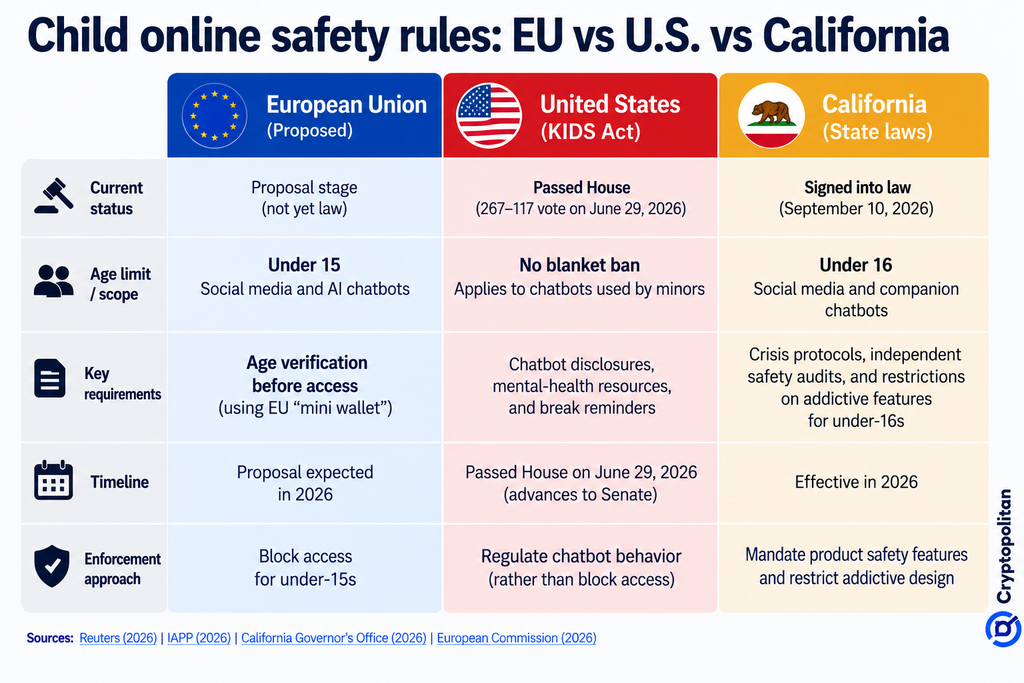
The European Union is putting together a proposal to establish guidelines under which children below the age of 15 would be prohibited from using social media, video-sharing platforms, AI chat services, and online games. If this proposal becomes law, its provisions will be set out in the EU Kids Act and will require the verification of users’ ages by tech companies as a condition of granting users access to their services. However, this is only a proposal at the moment and needs to be approved first by EU member countries and the European Parliament.
For AI businesses, the next step is uncertain. In Europe, the countries will likely start promoting services based on the age issue, making consumer AI companies invest in age verification, parental control options, and keeping the services for minors separate from those for adults. However, it is expected that larger companies will be able to absorb these costs more easily than their smaller competitors.
Why the panel report matters now
The foundation for this policy comes from a report dated July that was released by Prof. Dr. Jörg M. Fegert and Dr. Maria Melchior, Co-Chairs of the European Commission’s Special Panel on Online Child Safety. Their appointments came in March after Ursula von der Leyen first raised the matter during her State of the Union speech of 2025.
The panel conducted three meetings from March to June and used information received from academics, representatives of young people and parents, and institutions from EU and other nations, such as Australia and Brazil.
In their report, the panel classifies risky AI systems, such as AI companions, into a larger group of products that they call “social media+,” which includes services that have unlimited scrolling, autoplay, and recommendation algorithm features. Through this larger classification, it is easier to understand why the panel sees age restriction as a potential safety measure even though the safety issues have yet to be resolved.
According to Fegert and Melchior, age restrictions “may be a necessary precautionary step” until it is established that social media+ spaces are effective and do not pose a risk for children.
Their recommendation does not mean banning access to the products. It solely transfers the responsibility to the companies that have to prove the safety of their products for young clients before access restrictions can be loosened.
Age assurance is the lever that makes it work
It’s hard to enforce an age limit when reliable age-verification methods are unavailable. The Commission published a document on July 14, 2025, to provide its age-verification solution. The solution reached full working condition by April 15, 2026.
The privacy-preserving “mini wallet” doesn’t require users to reveal themselves or disclose any personal information when they want to show that they meet a certain age limit. It is designed to verify age for users aged 18+, but it can also be adapted for age limits of 13+.
Member states are expected to have the necessary tools by the end of 2026. The Commission plans to launch an EU Age Verification Scheme that will connect reliable service providers and solutions which will create a new compliance market for identity, privacy, and assurance services.
Minors already lean on AI
Any restriction on AI usage will have an impact on the youth audience that has already been developed. According to the 2026 census of Common Sense Media, which was conducted on 1,204 U.S. children in the age range of 9 to 17, 86% have used or interacted with AI solutions, while more than 20% of them use AI solutions almost every day.
Regular users report their feelings of higher loneliness and lower happiness but the researchers underline that, due to the design of the survey, it is impossible to identify if the use of AI brings about these consequences.
Companies producing AI solutions are already going in the direction of developing age-restricted products. For example, as it was reported by Cryptopolitan, OpenAI has already launched ChatGPT for Teens, which is designed for people aged 13-17, while restricting children under 13.
Block access, or police the chatbot
Europe is not the only one taking action. The U.S. and California are also developing child safety regulations, but they are focusing more on the behavior of platforms and chatbots than on outright blocking access.
On June 29, 2026, the U.S. House passed the KIDS Act with a vote of 267 to 117. This will force chatbots to identify themselves as non-human entities while providing mental-health resources and prompting users to take breaks.
California has gone even further since on September 10 Governor Gavin Newsom signed a set of laws related to child safety. These laws will force chatbots to use crisis response guidelines as well as submit to independent audits on the subject of child safety and control mechanisms for social media for users under the age of 16.
However, the EU approach is more stringent in that rather than relying mainly on the safety of products, it also makes age verification mandatory.
Who absorbs the cost
The market itself is still expanding. Gartner expects worldwide spending on AI models and platforms to reach $64 billion in 2026, up 63.4% from 2025. Sensor Tower projects time spent on generative AI apps to more than double from 17.2 billion hours in H1 2025 to 36 billion in H1 2026.
That makes regulation less a brake on AI demand than a redistribution of costs. Large platforms are better positioned to fund age checks, audits and youth-specific product design. Smaller consumer AI firms face steeper compliance barriers, while age-verification, AI-safety and compliance providers could emerge as beneficiaries.
If you're reading this, you’re already ahead. Stay there with our newsletter.
Recommended Articles


