


Best Robot Dogs in 2026: Real Prices From $319 to $100,000
If you search for a robot dog in 2026, you are likely to get lost in comparing backflipping quadrupeds patrolling factories and a $319 kit that fits in your hand. Since robodogs look similar, it is not uncommon for them to be grouped. However, such a comparison will lead to the wrong decision.
Some robots are just interactive pets, while others may be research-based robots designed for developers and research teams. They serve different purposes. For instance, parents may be more concerned about ease of use and need a fun pet robot for their kid. A developer or a research student, however, would need more programmability. Similarly, industrial buyers care more about the payload, endurance, and autonomous behavior of the robot for specific tasks. There’s also a separate category of industrial machines.
Hence, the buying decisions are completely different for each category.
This guide covers a range of robodogs with prices ranging from $319 for Petoi Bittle X to $100,000 for Unitree’s industrial platform. We have separated the categories into three tiers to guide the buyer to the right tier and pick the best quadruped robot dog as per their needs. Readers looking for bipedal systems can use our separate guide to humanoid robots.
Quick Comparison
| Model | Tier | Price (source + date) | Programmability | Runtime | Support reality | Best for |
| Petoi Bittle X | Companion / Coding | From $319 (Petoi, Aug. 9) | Blocks, C++, Python, ROS | ~1h walking | Direct; 1yr warranty; parts available | Robotics learning and coding |
| KEYi Loona | Companion / Coding | $499 sale / $529 regular (KEYi, Aug. 9) | Blockly app; no official SDK | Up to 2h claimed; ~60–90m active | Direct; 1yr warranty; cloud-linked features | Interactive robot pet |
| Sony aibo ERS-1000 | Companion / Coding | $3,199.99 incl. 3-year cloud plan (Sony US, Aug. 9) | Visual Programming, Web API | ~2h | Sony repair/parts; cloud-dependent | Premium robot companion |
| Unitree Go2 | Developer / Prosumer | Air $1,600/$1,850; Pro $2,800/$3,050; X $4,500; EDU quote (Unitree, Aug. 9) | Air/Pro graphical; X partial dev; EDU SDK2/Python/ROS2 | Air/Pro/X 1–2h; EDU 2–4h | Direct; Air 6mo, Pro/X/EDU 12mo | Affordable legged robotics |
| Unitree Go1 | Developer / Prosumer | Air $2,700; Pro $3,500; EDU quote (Unitree, Aug. 9) | EDU: C++, Python, ROS1 | Not officially specified | Direct; legacy platform; checkout unavailable | Existing Go1 workflows |
| DEEP Robotics Lite3 | Developer / Prosumer | Basic $2,890; Basic AI $4,968; Venture $6,480; Pro $12,510; LiDAR $18,270 (official US partner, Aug. 9) | SDK/API, C++, Python, ROS1/ROS2 | 1.5–2h; Basic AI not specified | Official US partner; 3–12mo component coverage | ROS-ready research |
| Unitree Aliengo | Industrial / Inspection | $50,000 displayed/reference (Unitree, Aug. 9) | Legacy SDK, C++, Python, ROS1 | 2.5–4.6h | Direct industrial; warranty term not public | Industrial R&D |
| Unitree B2 / B2-W / A2 | Industrial / Inspection | $100,000 displayed/reference each (Unitree, Aug. 9) | C++, Python, ROS2 | B2/A2 >5h unloaded; B2-W distance-rated | Direct industrial; A2 12mo warranty | Heavy-duty payload and inspection |
| Boston Dynamics Spot | Industrial / Inspection | Quote only (Boston Dynamics, Aug. 9) | Python/C++ SDK, gRPC, ROS2 | ~90m; ~60m with powered payloads | Enterprise; 1yr warranty + Spot Care | Enterprise inspection |
How to Choose a Robot Dog
One may think the robot dogs are all similar, even if they differ in their hardware and specifications. Before you begin searching for one, you should know why you want it and what purpose you want it to serve. That’s where it becomes important to know about the tiers and which one suits you.
The Three Tiers
Companion: As the name suggests, this tier is for people who are looking for a pet-like experience and entertainment. They don’t want to dig much into the technical setup. Such robot dogs mostly come pre-programmed with easy-to-use functions and handling. The buyers for such robot dogs are curious hobbyists, parents who want to keep their children busy with an interactive and learning-based toy, or elderly people who need someone to talk to.
Developer: This tier is suitable for tech geeks who are interested in the know-how of things. They want to modify it for their own needs and have coding and programming knowledge. Mostly university research students who write code, engineer gathering real-time sensory data are interested in them. In short, it’s for research purposes.
Industrial: These robots are made for specific tasks needed for a regular industrial job. They can be used for taking daily rounds at an oil refinery for any gas leaks, dangerous mine inspections where humans can’t go, and logging data for longer hours
What you’re paying for
The price jumps between the three tiers as they differ in the actuators, sensing, onboard compute, autonomy, and the amount of hardware the robot can carry.
A lower-cost Tier 1 robot has basic cameras, touch sensors, or basic obstacle detection for the interactive functions it is needed for. Developer platforms, Tier 2, add LiDAR, depth cameras, expansion ports, and more computing power.
Industrial models, Tier 3, go further with heavier-duty joints, larger batteries, environmental protection, payload interfaces, and sensors designed for inspection or navigation. Payload also matters. Smaller developer robots are generally built to carry a few kilograms at most, while Unitree’s B2 and B2-W are designed to move more than 40 kg. That difference changes both the hardware and the price.
Programmability: SDK, ROS support, and community size
Programmability is not limited to robot dogs with complex functions. Even the simplest companion robot dogs have some extent of programmability in them, which only requires tapping buttons in an app or dragging visual blocks around a screen without expert coding knowledge. Programmability preference increases with expertise, which requires writing full software to control every movement, sensor, and decision the robot makes.
Two things worth checking are SDK and ROS support. An SDK is basically a toolkit that comes along with the product for the developer to build their own programs for the robot. ROS is a widely used robotics software standard that lets developers use community-built tools rather than starting from scratch. If a robot supports both, it opens up far more possibilities.
Community size also matters here. An active community means more shared code, tutorials, and fixes already exist online, which makes development faster and less frustrating.
Cloud dependency and its risks
Some robot dogs can operate largely on local hardware, while others depend heavily on the manufacturer’s software and cloud services.
Bittle X can function without a network connection. Loona can still perform many basic interactions offline, but setup, voice recognition, firmware updates, and connected features rely on online services. aibo goes further. Its full experience is tied closely to Sony’s A.I. Cloud Plan and My aibo ecosystem.
Sony’s aibo shows why this matters in practice. Japan sales are ending, and Sony has continued repairs, parts, and cloud service for owners, but a robot whose personality lives on a subscription is only as durable as the vendor’s commitment to it.
Runtime, noise, terrain, and other things that demo videos hide
Demo videos are made to impress, not inform. Battery life is almost always shown at its best, However real use drains faster, and capacity quietly shrinks after months of regular charging. Noise is also easy to hide with background music, but motors hum every time the robot moves. Terrain looks effortless on camera if filmed on ideal surfaces, not rugs, thresholds, or slight slopes. Recharge time and long-term wear never make it into a two-minute product video either. These are the things worth checking before buying, because they are what actually shape the experience of owning the robot week after week.
Tier 1: Companion and Coding Robot Dogs ($319–$3,199.99)
1. Petoi Bittle X
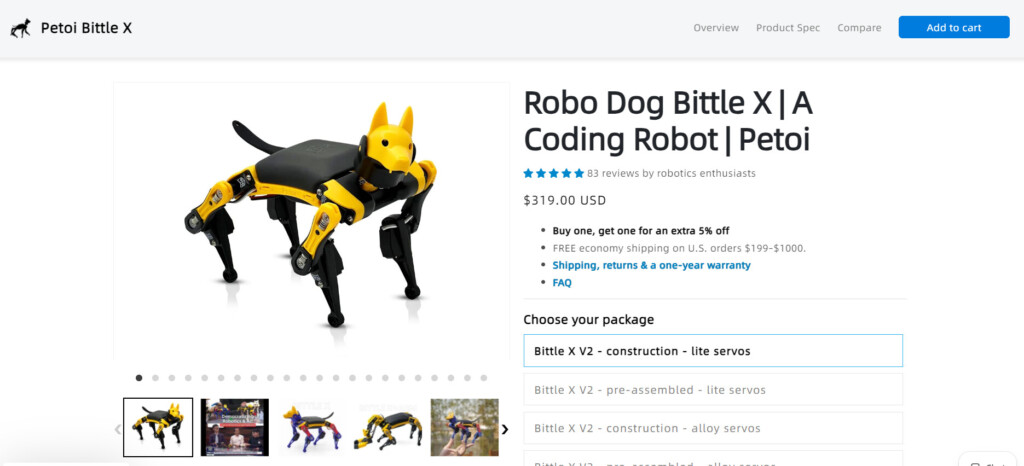
Petoi’s Bittle X is the entry point for buyers who want to learn how a quadruped works rather than simply watch one perform tricks. It is a small nine-degree-of-freedom robot dog built around Petoi’s ESP32-based platform, and it is available either as a construction kit or pre-assembled. The construction version takes roughly 40 to 90 minutes to put together, which is part of the appeal for students and hobbyists but less useful for someone looking for a plug-and-play robotic pet.
Petoi’s direct store (as of Aug. 9, 2026), lists the Bittle X from $319 for the construction version with lite servos. A pre-assembled lite-servo version costs $339, while alloy-servo configurations cost $379 assembled as a kit or $399 pre-assembled. Petoi’s original Bittle is now marked Final Stock, so Bittle X is the more relevant model for a new buyer in 2026.
Programming is where Bittle X stands out. Beginners can start with block coding, while Python, C++, and ROS give more experienced users room to build deeper projects. It can also work without a network connection, and Petoi provides replacement parts, repair guidance, and support through email, chat, and remote video calls.
Runtime is modest at about one hour of continuous walking, with sustained running capable of cutting that below 30 minutes.
Pros
- Low-cost entry into real quadruped programming
- Broad path from block coding to Python, C++, and ROS
- Repairable, expandable, and not dependent on cloud services
Cons
- Limited battery life under active use
- Best suited to indoor, relatively flat surfaces
- The construction version requires assembly and setup
2. KEYi Tech Loona
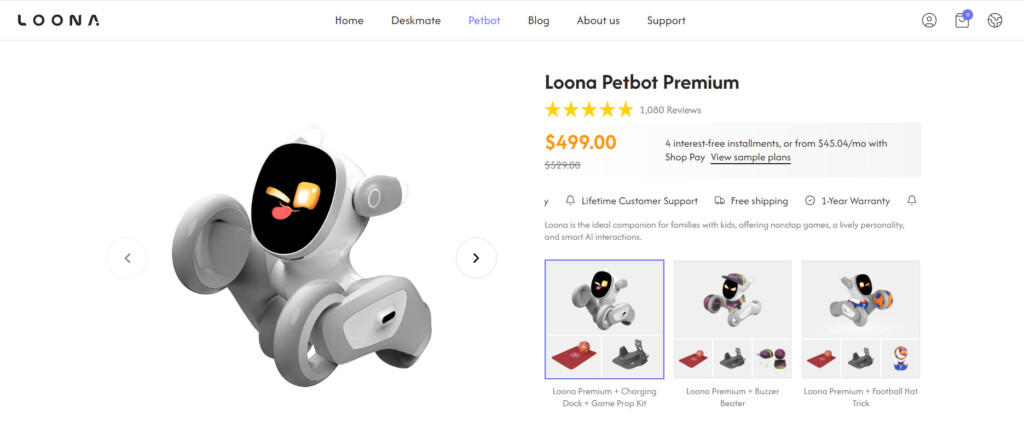
Loona takes a different approach from Bittle X. It is designed first as an interactive robot pet, with coding added as a secondary feature. It is also not truly a “legged” quadruped because Loona moves on four wheels.
It uses its body movements with ears, head, and wheels for actions to create much of its personality. The most expressive part is the eyes, which are incorporated in the 2.4-inch LCD on its head. The same screen is also used to show visuals and animations. Moreover, it has a camera, microphones, and touch sensors for better interaction. Loona’s voice conversations are powered by GPT-4o. According to KEYi, it gives its spoken interactions a noticeably more natural, open-ended feel.
KEYi’s direct store (checked Aug. 9, 2026) lists Loona at a $499 sale price, down from a regular price of $529. It is aimed mainly at families and buyers who want games, expressive interaction, voice features, and a robot that can move around the home without requiring much setup.
Programming is available through Google Blockly inside the Hello Loona app. That makes basic behavior programming approachable for children and beginners, but the ceiling is much lower than on Bittle X. KEYi currently provides no official standalone SDK or Python development environment.
Battery life also needs some context. KEYi advertises up to two hours of continuous play, but its own 2026 material puts more active use at roughly 60 to 90 minutes. Loona can return to its charging dock automatically.
Support includes a one-year warranty and advertised lifetime customer service. Many basic interactions work offline, but initial setup, voice recognition, firmware updates, and some connected features depend on internet services.
Pros
- Stronger companion and entertainment experience than a coding-focused kit
- Beginner-friendly Blockly programming
- Automatic charging-dock behavior
Cons
- No official standalone SDK for deeper development
- Several important features depend on cloud services
- Wheeled design limits its value for true quadruped locomotion or terrain work
3. Sony aibo ERS-1000
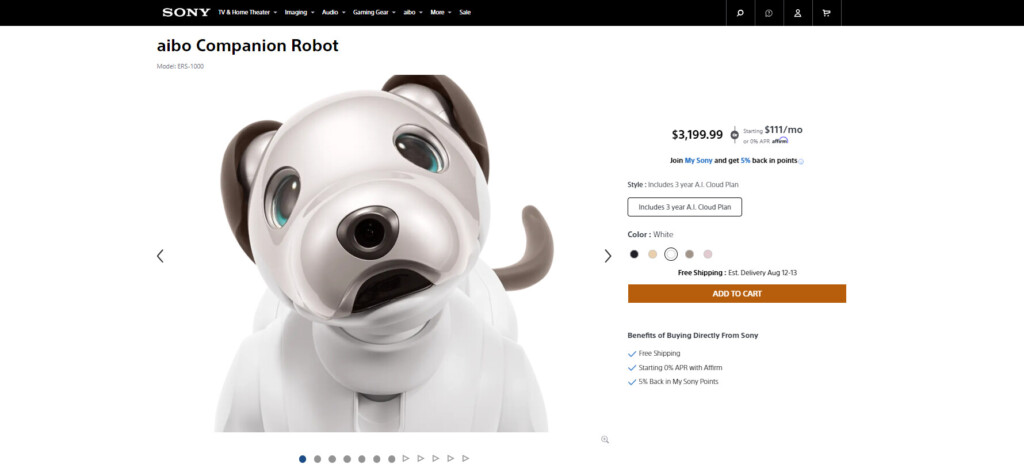
Sony’s aibo is the premium companion option in this tier. At its launch in 2018, the sales reached 20,000 in the first six months. It is built around interaction rather than robotics development, using 22 movable axes, animated OLED eyes, cameras, microphones, touch sensors, and other onboard sensors to create more natural movement and responses around the home.
Sony’s US store (checked Aug. 9, 2026) lists aibo at $3,199.99, including a three-year A.I. Cloud Plan. That cloud connection is an important part of the product. aibo’s memories, learning, My aibo features, and parts of its evolving behavior depend on Sony continuing to maintain the service. aibo is still programmable, but in a much more controlled way than Bittle X. Sony provides Visual Programming for simpler behavior creation and a Web API for developers, rather than a low-level robotics or ROS environment.
Runtime is about two hours in standard operation, with roughly three hours needed for a full recharge. aibo can return to its charging station automatically when the battery runs low.
There is also a lifecycle point buyers should know. Sony ended ERS-1000 sales in Japan in June 2026, but US sales continue. However, Sony has also said it will keep providing technical support, replacement parts, repairs, cloud plans, and My aibo services for existing owners. Sony has not announced a successor model, so buyers are getting three years of committed cloud access with nothing published about what comes after.
Pros
- Highly developed companion behavior and physical expressiveness
- Automatic charging and mature home interaction
- Continuing Sony repair, parts, and software support
Cons
- Expensive at more than $3,000
- Full experience depends heavily on Sony’s cloud ecosystem
- Limited compared with open robotics platforms for deeper development
Tier 2: Developer and Prosumer Quadrupeds ($1,600–$18,270)
4. Unitree Go2
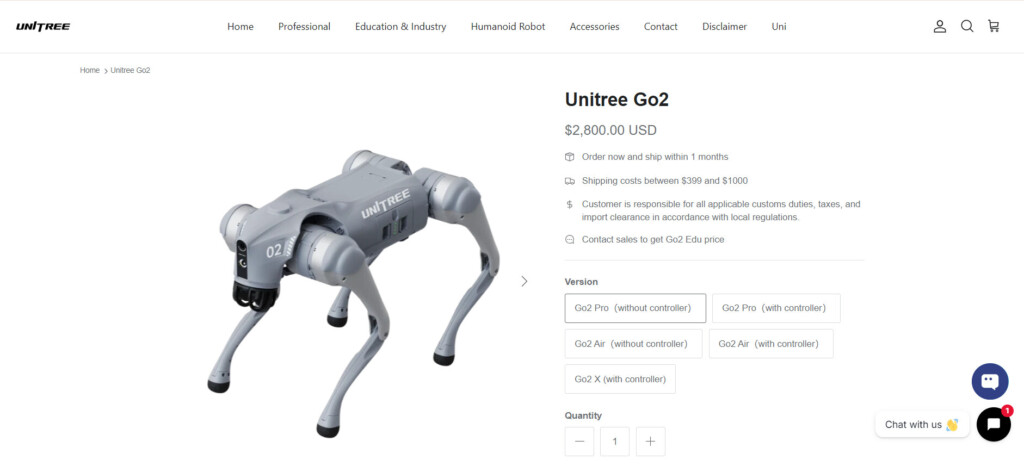
Unitree’s Go2 is where the category starts to look less like a robot pet and more like a compact robotics platform. Go2 made LiDAR-equipped, programmable robot dogs affordable for university-level research students under $2000. It is also a part of a much wider product expansion at Unitree, which has been moving toward an IPO, as reported earlier by Cryptopolitan.
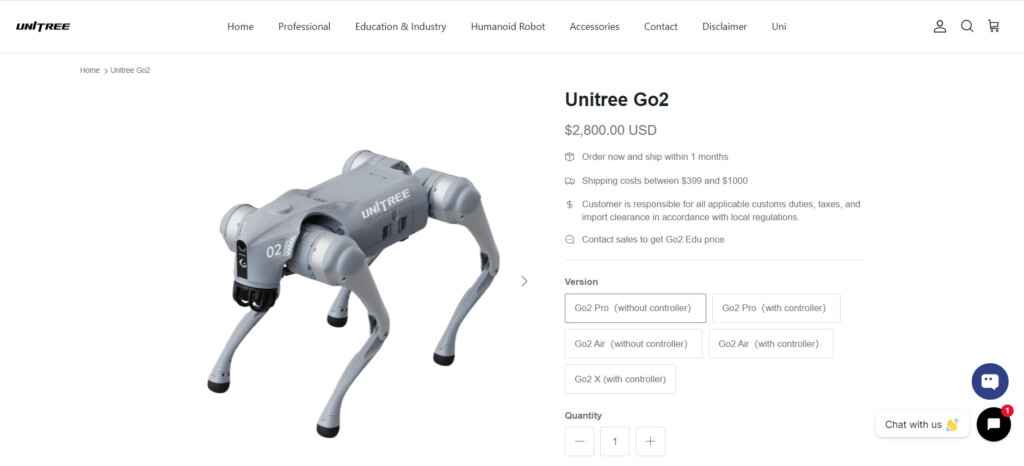
The Go2 weighs about 15 kg and comes with 4D ultra-wide LiDAR and an HD camera across the current range, but what you can actually do with it depends heavily on the configuration.
Unitree’s direct store (checked Aug. 9, 2026), lists the Go2 Air from $1,600 without a controller or $1,850 with one. The Pro costs $2,800 without a controller or $3,050 with one, while the X is $4,500 with a controller. However, the EDU version is quote-only.
That price ladder also changes the development access. Air and Pro support graphical programming but do not provide Unitree’s secondary-development interface. X adds partial secondary development, while EDU is the version with full SDK2, Python, and ROS2 access. For developers, that distinction matters more than the headline starting price.
Runtime is one to two hours on Air, Pro, and X. EDU uses the larger 15,000mAh battery and is rated for two to four hours.
Support is direct from Unitree. Air carries a six-month warranty, while Pro, X, and EDU get 12 months. Buyers should also account for international shipping, customs, and the fact that Unitree does not offer standard returns on direct purchases.
Pros
- Very low entry price for a LiDAR-equipped legged robot
- Multiple configurations covering prosumers through research use
- Full SDK2, Python, and ROS2 support on EDU
Cons
- $1,600 Air does not include full developer access
- Standard configurations still run for only one to two hours
- China-direct buying can add shipping, customs, and support friction
5. Unitree Go1
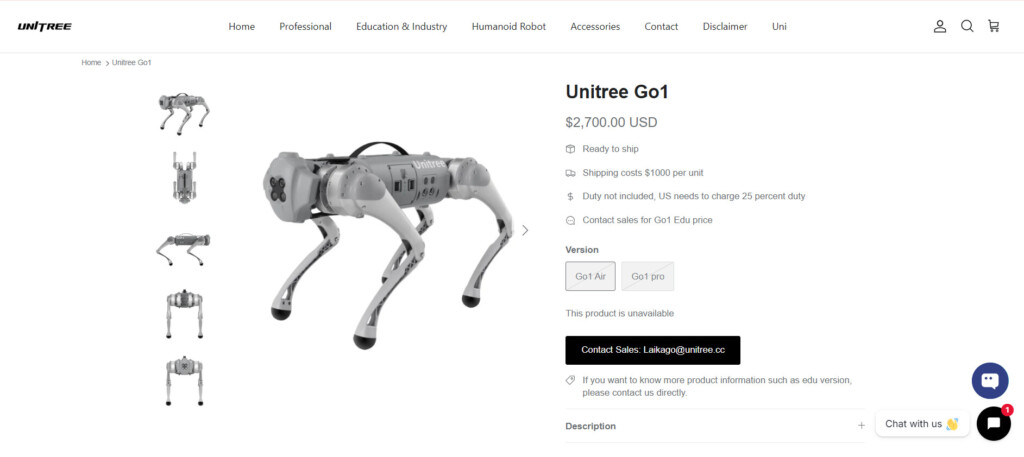
The Go1 is Unitree’s previous-generation quadruped, and in 2026 its main appeal is for buyers who already have a reason to stay with the platform. It weighs about 12 kg and was built as a compact consumer and research robot, but the newer Go2 now starts at a lower price and uses Unitree’s more current development ecosystem.
Unitree’s direct listings (checked Aug. 9, 2026), show $2,700 for the Go1 Air and $3,500 for the Pro, while the EDU version is quote-only. However, the robot is currently unavailable through Unitree’s normal online checkout. Unitree has not announced that the Go1 is permanently discontinued, so it remains a currently listed product with uncertain direct availability rather than a formally retired model.
Programming access also depends on the version. Air and Pro do not include Unitree’s scientific or Python programming interfaces. The EDU model is the developer-focused option, with C++, Python, and ROS1 support through Unitree’s older software stack.
Unitree does not currently publish a verified hour-based runtime for Air, Pro, or EDU, so battery capacity alone should not be used to estimate it.
Support continues through Unitree, although warranty coverage is shortest on Air: six months for core components and three months for non-core parts. Pro gets 12 and six months, respectively, while EDU carries 12 months.
Pros
- Established SDK and ROS1 ecosystem for EDU users
- Compact 12 kg platform
- Still supported and not officially discontinued
Cons
- Currently unavailable through normal direct checkout
- Older software stack than Go2
- New buyers get a stronger price proposition from the newer Go2
6. DEEP Robotics Lite3
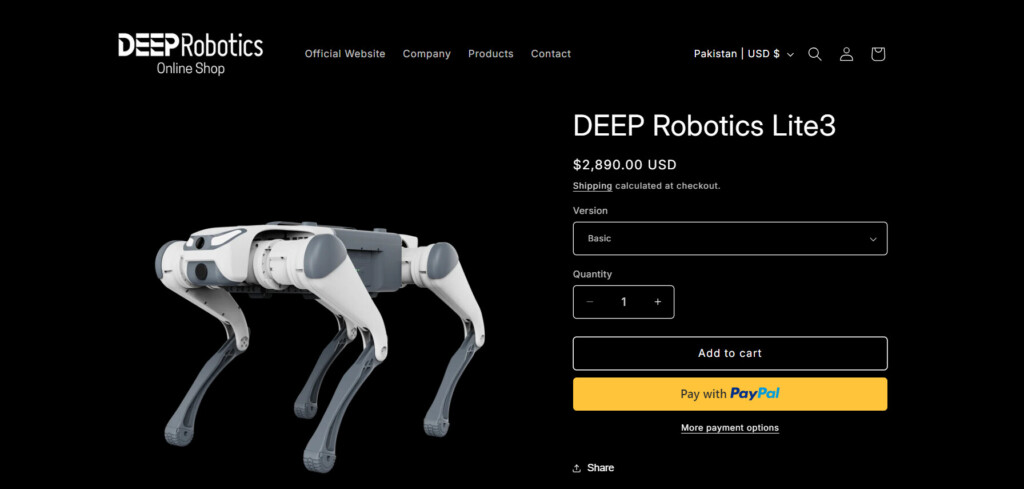
The Lite3 is the main non-Unitree option in this tier. DEEP Robotics sells it as a research and secondary-development quadruped, with five versions that add more onboard compute, sensing, and navigation capability as the price rises.
DEEP Robotics’ official US partner store (checked Aug. 9, 2026) lists Lite3 Basic at $2,890. Basic AI is $4,968, Venture is $6,480, Pro is $12,510, and the LiDAR version is $18,270. That gives research teams a much wider configuration range than a single fixed platform.
Programming support is one of Lite3’s strongest points. The platform supports SDK and API development with C++, Python, ROS1, and ROS2. Unlike the lower-priced Go2 Air and Pro, developer access is central to the product rather than reserved for a top research configuration.
Runtime is 1.5 to 2 hours on Basic, Venture, Pro, and LiDAR. DEEP Robotics does not publish a separate runtime figure for Basic AI. Payload also falls as more hardware is added, from about 5 kg on Basic to 2.5 kg on LiDAR.
Support in the US comes through DEEP Robotics’ official partner channel, with technical support and after-sales service. Warranty coverage is shorter on wear components, and Basic AI’s joint warranty is only three months.
Pros
- Strong C++, Python, ROS1, and ROS2 development support
- Five configurations covering basic research through LiDAR navigation
- Credible alternative for labs that do not want to standardize on Unitree
Cons
- Higher configurations become expensive quickly
- Payload drops as more sensing hardware is added
- Short warranty coverage on joints and other wear components
Tier 3: Industrial and Inspection Platforms ($50,000+; Spot quote-only)
7. Unitree Aliengo
Aliengo sits between Unitree’s smaller developer robots and its newer heavy-duty industrial platforms. It weighs about 21.5 kg without the battery and is rated to carry around 13 kg, which gives it substantially more payload capacity than Go2 or Lite3 without moving into the size and weight of B2.
Unitree’s direct store (checked Aug. 9, 2026) displays Aliengo at $50,000, although that should be treated as a reference price rather than a normal retail checkout figure. The actual purchase process is sales-led.
The robot is built for industrial R&D and field work, with depth cameras, visual odometry, optional LiDAR, and expansion interfaces for equipment such as additional cameras, GPS, robotic arms, and other payloads. Runtime is also stronger than the smaller developer platforms, at 2.5 to 4.6 hours.
Aliengo is programmable through Unitree’s older legged-robot software stack, with C++, Python, and ROS1 support. That remains useful for existing projects, but it is not the same as the current SDK2/ROS2 environment used by newer Unitree platforms.
Support is handled directly through Unitree’s industrial and after-sales channels, although a current public Aliengo-specific warranty duration has not been verified.
Pros
- 13 kg payload is a clear step up from developer-tier robots
- 2.5 to 4.6 hours of endurance
- Designed for external sensors and payload integration
Cons
- Uses Unitree’s older SDK and ROS1 stack
- $50,000 is only a displayed reference price
- Current public warranty duration is unclear
8. Unitree B2 / B2-W / A2
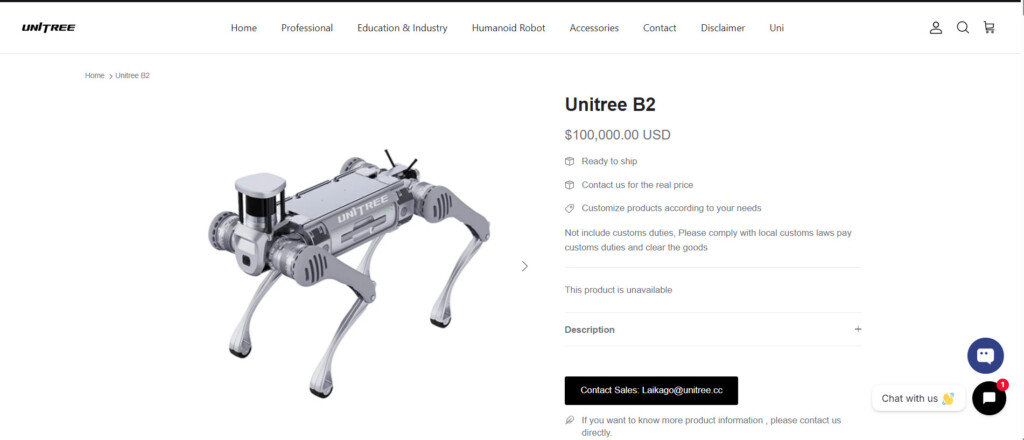
Unitree’s B2, B2-W, and A2 move into a much heavier class of industrial robots. These are built around payload, endurance, and inspection work rather than portability.
Unitree’s direct store (checked Aug. 9, 2026) displays $100,000 for each platform, although the final purchase process is sales-led and the displayed figure should be treated as a reference price.
The B2 weighs about 60 kg and is rated to carry more than 40 kg while walking, with at least 120 kg of standing load capacity. It can operate for more than five hours unloaded and more than four hours with a 20 kg payload. The B2-W uses a wheel-legged design and weighs about 85 kg, combining rough-terrain movement with longer travel distances of around 30 km unloaded or 25 km carrying 40 kg.
The A2 is lighter at about 42 kg with its battery and is rated for around 25 kg of continuous walking payload. It can run for more than five hours unloaded or more than three hours with 25 kg, and its dual hot-swappable batteries are better suited to longer industrial deployments.
All three support secondary development with C++, Python, and ROS2 interfaces. Unitree also provides direct industrial and after-sales support. A2 has a confirmed 12-month warranty, while current public warranty durations for B2 and B2-W have not been verified.
Pros
- Much higher payload capacity than developer-tier quadrupeds
- Longer endurance for inspection and field work
- ROS2-based development and industrial sensing support
Cons
- $100,000 displayed pricing puts them firmly in enterprise territory
- Large and heavy compared with developer robots
- Exact capabilities and warranty terms vary by model and configuration
9. Boston Dynamics Spot
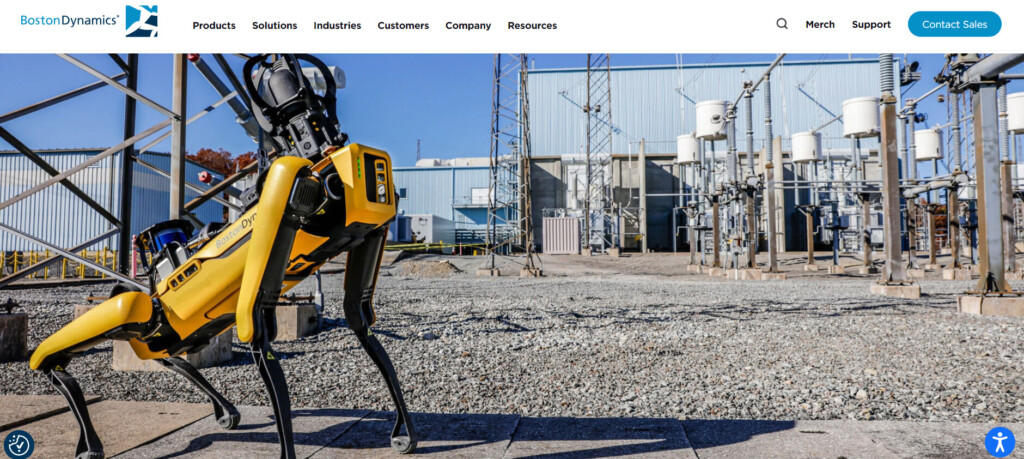
Spots’ position in 2026 is less about having the biggest raw specifications and more about the ecosystem around it. The robot weighs about 33.8 kg, can carry up to 14 kg, and is built for repeatable inspection, sensing, and autonomous missions rather than heavy payload work.
The idea that Chinese platforms are simply cheaper comes from comparing across tiers. At the industrial level, they do not undercut what Spot historically sold for, which is why it remains the benchmark for Western buyers.
Boston Dynamics’ site (checked Aug. 9, 2026) does not publish a current public price for Spot. . The widely quoted $74,500 to $75,000 figure is historical, so current buyers have to go through the company’s enterprise sales process. Payloads, software, and support can also add to the final deployment cost.
Spot supports autonomous route-based inspection through Boston Dynamics’ software stack, while developers can work with Python, a beta C++ SDK, gRPC APIs, and ROS2. It is also compatible with a range of inspection payloads for visual, thermal, acoustic, and other sensing tasks.
Typical runtime is about 90 minutes, falling to roughly an hour when powered payloads are in use. Support is considerably more mature than on most competing quadrupeds, with a one-year limited warranty, optional Spot Care, training, and certified repair infrastructure in the US, Germany, and Korea.
Pros
- Mature autonomous inspection and deployment ecosystem
- Strong developer, payload, and integration support
- Enterprise-grade repair, training, and service infrastructure
Cons
- No transparent current public price
- Shorter runtime than some newer industrial competitors
- Lower payload and environmental protection than Unitree’s heavier B2-class systems
What Actually Breaks
Owning a robot dog gets more complicated as the battery, joints, and software begin to age. Battery capacity declines over repeated charge cycles, which gradually reduces usable runtime even when the robot itself is still functioning normally. Replacement availability, therefore, matters alongside the original battery specification. Petoi and Unitree sell replacement batteries for several models, while some industrial systems use spare or hot-swappable packs to reduce downtime.
Mechanical wear is harder to avoid. Quadrupeds put repeated loads through their joints and actuators, and warranty terms show how differently manufacturers handle that risk. Lite3 joints are covered for six months on most versions and only three months on Basic AI, while Go2 Air carries a six-month warranty compared with 12 months for Pro, X, and EDU. Mechanical wear is only one part of the safety question, as robot demo safety incidents covered by Cryptopolitan have also shown.
Repairs are where support differences become more obvious. Petoi provides replacement parts and repair guidance; DEEP Robotics has an official US support channel, and Spot comes with access to formal training and regional repair infrastructure. Unitree provides direct after-sales support, but international shipping, customs, and repair logistics can still complicate ownership. That friction could also become more important as scrutiny of Chinese robotics imports increases, as reported earlier by Cryptopolitan.
Developers also have to think about software aging. Go1 and Aliengo still use older Unitree development stacks, while newer platforms have moved to SDK2 and ROS2. A robot can remain physically functional long after its software ecosystem stops being the one developers want to build around.
Final Verdict: Buy the Tier, Not the Video
The best robot dog depends much more on the job than on the most impressive demo. A buyer looking for a coding platform should not be comparing Bittle X with Spot, just as an inspection team should not be judging an industrial robot by how entertaining it looks at home.
For learning and hands-on programming, Bittle X is the clearest starting point. Loona and aibo make more sense for buyers who want interaction and companionship. Go2 and Lite3 are better suited to developers who need a programmable quadruped, while Go1 is mainly relevant to buyers already tied to that older platform. Aliengo, B2, B2-W, A2, and Spot belong in industrial discussions where payload, endurance, support, and deployment matter more than novelty.
The useful comparison is therefore within each tier. Start with the work the robot needs to do, then compare price, software access, runtime, and support around that requirement.
Recommended Articles


