


EUR/USD Price Forecast: Multiple headwinds for Euro backs downside bias
- EUR/USD rises to near 1.1230 at the expense of the US Dollar.
- Investors keenly await Meta Q3 earnings.
- French fiscal woes and Russia-Ukraine tensions keep the Euro under pressure.
The Euro (EUR) is up 0.15% at around 1.1230 against the US Dollar (USD) during the Asian trading session on Tuesday. The major currency pair gains as the US Dollar is under pressure ahead of Meta Q3 earnings on Wednesday.
As of writing, the US Dollar Index (DXY), which gauges the Greenback’s value against six major currencies, trades 0.16% lower to near 101.80. The DXY has been under pressure for a week amid concerns regarding the continuation of Artificial Intelligence (AI) spending by United States (US) hyperscalers.
US Dollar Price Last 7 Days
The table below shows the percentage change of US Dollar (USD) against listed major currencies last 7 days. US Dollar was the weakest against the New Zealand Dollar.
| USD | EUR | GBP | JPY | CAD | AUD | NZD | CHF | |
|---|---|---|---|---|---|---|---|---|
| USD | -0.68% | -0.94% | -0.25% | -1.41% | -0.33% | -1.55% | -1.23% | |
| EUR | 0.68% | -0.23% | 0.44% | -0.75% | 0.37% | -0.85% | -0.54% | |
| GBP | 0.94% | 0.23% | 0.70% | -0.46% | 0.61% | -0.62% | -0.25% | |
| JPY | 0.25% | -0.44% | -0.70% | -1.13% | -0.00% | -1.28% | -0.85% | |
| CAD | 1.41% | 0.75% | 0.46% | 1.13% | 1.09% | -0.18% | 0.22% | |
| AUD | 0.33% | -0.37% | -0.61% | 0.00% | -1.09% | -1.22% | -0.86% | |
| NZD | 1.55% | 0.85% | 0.62% | 1.28% | 0.18% | 1.22% | 0.44% | |
| CHF | 1.23% | 0.54% | 0.25% | 0.85% | -0.22% | 0.86% | -0.44% |
The heat map shows percentage changes of major currencies against each other. The base currency is picked from the left column, while the quote currency is picked from the top row. For example, if you pick the US Dollar from the left column and move along the horizontal line to the Japanese Yen, the percentage change displayed in the box will represent USD (base)/JPY (quote).
The third quarter earnings report by Meta would reflect whether hyperscalers are stick to their investment agenda what they committed in previous quarters.
According to Goldman Sachs, Meta is one of five AI hyperscalers expected to increase combined capital expenditure to about $1.2 trillion next year, Reuters reported.
Meanwhile, the Euro is broadly under pressure due to continued tensions between Russia and Ukraine, and French fiscal risks.
Euro underperforms as French assets lag and geopolitical worries build
Strategists at Scotiabank highlight that the Euro is underperforming, pointing to “widespread and violent protests across France against poor conditions in schools and hospitals and broader concerns about affordability” as a key drag on sentiment. They add that French equities and fixed income have come under particular pressure, noting that “French stocks and bonds are underperforming and bond spreads versus Germany have widened to 145bps, sitting at the top of the (recent) historic range.”
Geopolitical risk is also feeding into the cautious tone. Scotiabank flags comments from President Zelenskyy, who said “the US is pushing Ukraine, not Russia to concede,” which the bank suggests is adding to broader geopolitical concerns around the Euro complex.
EUR/USD Technical Analysis
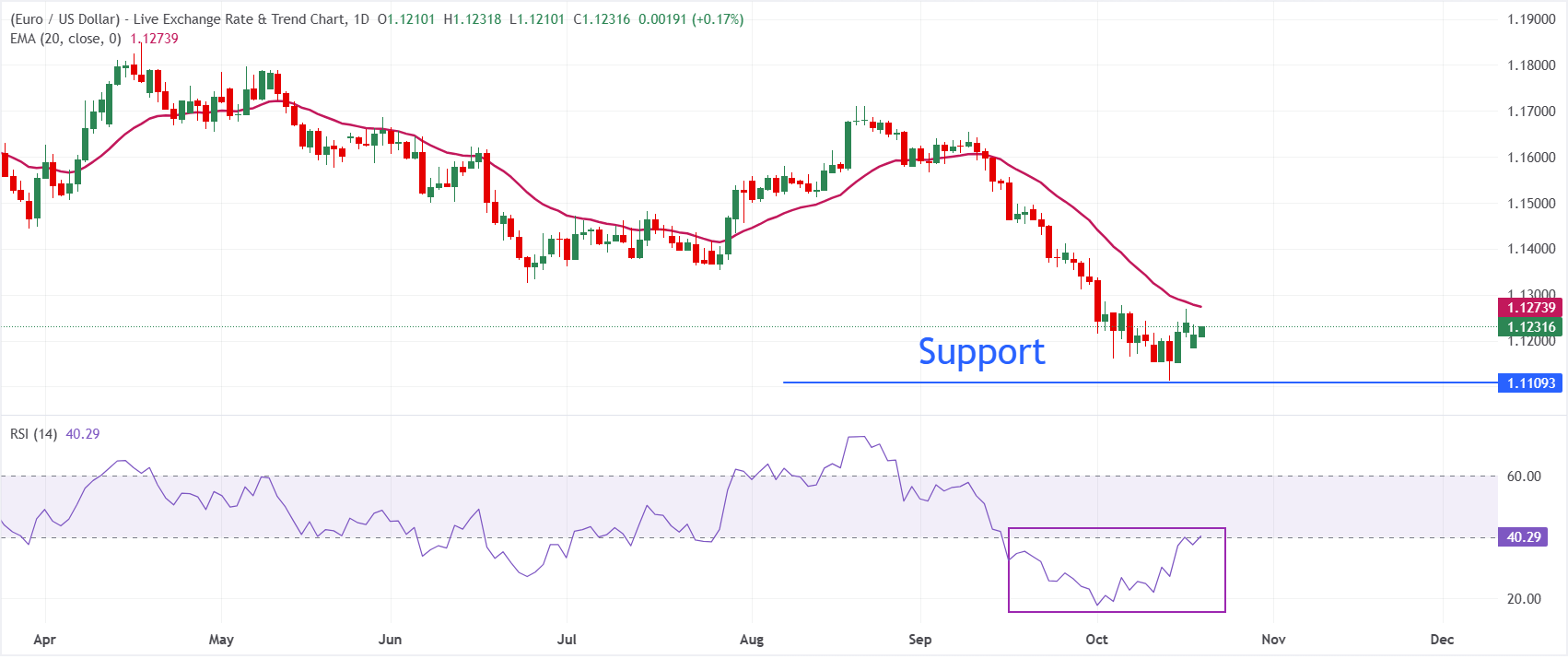
In the daily chart, EUR/USD trades at 1.1232, keeping a bearish near-term tone as spot remains below the 20-period exponential moving average (EMA) at 1.1274. The pair’s inability to reclaim this EMA suggests that recent bounces are still capped by overhead supply, while the Relative Strength Index (14) at 40.28 recovers from oversold territory but stays below the midline, hinting at only modest improvement in downside momentum rather than a clear bullish shift.
On the topside, immediate resistance is located at the 20-period EMA at 1.1274, which acts as the first barrier that bulls would need to overcome to ease the current downside bias and open the way for a more sustained corrective phase. On the downside, the October 14 low at 1.1113 is the key support level.
(The technical analysis of this story was written with the help of an AI tool. Know more.)
Euro FAQs
The Euro is the currency for the 20 European Union countries that belong to the Eurozone. It is the second most heavily traded currency in the world behind the US Dollar. In 2022, it accounted for 31% of all foreign exchange transactions, with an average daily turnover of over $2.2 trillion a day. EUR/USD is the most heavily traded currency pair in the world, accounting for an estimated 30% off all transactions, followed by EUR/JPY (4%), EUR/GBP (3%) and EUR/AUD (2%).
The European Central Bank (ECB) in Frankfurt, Germany, is the reserve bank for the Eurozone. The ECB sets interest rates and manages monetary policy. The ECB’s primary mandate is to maintain price stability, which means either controlling inflation or stimulating growth. Its primary tool is the raising or lowering of interest rates. Relatively high interest rates – or the expectation of higher rates – will usually benefit the Euro and vice versa. The ECB Governing Council makes monetary policy decisions at meetings held eight times a year. Decisions are made by heads of the Eurozone national banks and six permanent members, including the President of the ECB, Christine Lagarde.
Eurozone inflation data, measured by the Harmonized Index of Consumer Prices (HICP), is an important econometric for the Euro. If inflation rises more than expected, especially if above the ECB’s 2% target, it obliges the ECB to raise interest rates to bring it back under control. Relatively high interest rates compared to its counterparts will usually benefit the Euro, as it makes the region more attractive as a place for global investors to park their money.
Data releases gauge the health of the economy and can impact on the Euro. Indicators such as GDP, Manufacturing and Services PMIs, employment, and consumer sentiment surveys can all influence the direction of the single currency. A strong economy is good for the Euro. Not only does it attract more foreign investment but it may encourage the ECB to put up interest rates, which will directly strengthen the Euro. Otherwise, if economic data is weak, the Euro is likely to fall. Economic data for the four largest economies in the euro area (Germany, France, Italy and Spain) are especially significant, as they account for 75% of the Eurozone’s economy.
Another significant data release for the Euro is the Trade Balance. This indicator measures the difference between what a country earns from its exports and what it spends on imports over a given period. If a country produces highly sought after exports then its currency will gain in value purely from the extra demand created from foreign buyers seeking to purchase these goods. Therefore, a positive net Trade Balance strengthens a currency and vice versa for a negative balance.
Recommended Articles


