


Euro recovers against US Dollar, German CPI accelerates
- EUR/USD rises to near 1.1600 as the US Dollar corrects after a fantastic Friday.
- Fed Chair Warsh warns of upside inflation risks and added that the central bank has work to do to bring it down.
- Inflation in six states of Germany accelerated in August.
The Euro (EUR) is up 0.15% to near 1.1600 against the US Dollar (USD) during the European trading session on Monday. The major currency pair gains as the US Dollar corrects after a strong Friday.
At press time, the US Dollar Index (DXY), which gauges the Greenback’s value against six major currencies, trades 0.15% lower to near 99.50.
On Friday, the US Dollar gained sharply after comments from Federal Reserve (Fed) Chair Kevin Warsh at the Jackson Hole Symposium where he warned of upside inflation risks.
Fed’s Warsh leans hawkish at Jackson Hole as inflation concerns resurface
Analysts at Rabobank note that Fed Chair Kevin Warsh “appeared to rebuild some of his credibility as an inflation fighter” in his first speech at the annual Jackson Hole Symposium, stressing that the central bank still has “work to do” to return inflation to its 2% target. They argue the tone marked “an important shift from the communication strategy he had followed since taking office,” with Warsh, for the first time as Chair, explicitly voicing dissatisfaction with recent inflation developments and signalling that he was open to further rate hikes unless underlying inflation began to improve convincingly.
As Rabobank highlights, Warsh underscored that “we must be convinced that underlying inflation is moving toward our target clearly and at a sufficient pace. Otherwise, we still have work to do.” In their view, his prepared remarks “seemed designed to lift rate-hike expectations, rebalance the September debate towards the hawks and rebuild his inflation-fighting credibility after July’s ‘all talk, no action’ criticism.” However, they caution that this sets up “a difficult balancing act, as the White House may oppose a hike so close to November’s midterms.”
This led to a sharp repricing of Fed interest rate expectations. According to the CME FedWatch tool, the odds of the Fed leaving interest rates again in the September meeting have diminished to 39.4% from almost 60% seen a week ago.
Meanwhile, financial experts believe that the upcoming Nonfarm Payrolls (NFP) and the inflation data would be key triggers for Fed interest rate expectations.
Even so, Rabobank judges that Warsh “delivered an important signal: the Fed is not relying on tighter financial conditions alone and remains willing to tighten further if underlying inflation stalls.” Against that backdrop, they suggest the next round of data – “especially the 4 September employment report and 11 September CPI” – could prove crucial for the FOMC’s swing voters as they weigh the case for additional tightening.
On the Euro front, inflation data FOR August from six states of Germany has come in higher than its previous readings. This is expected to be supportive of European Central Bank (ECB) interest rate hike expectations.
EUR/USD Technical Analysis
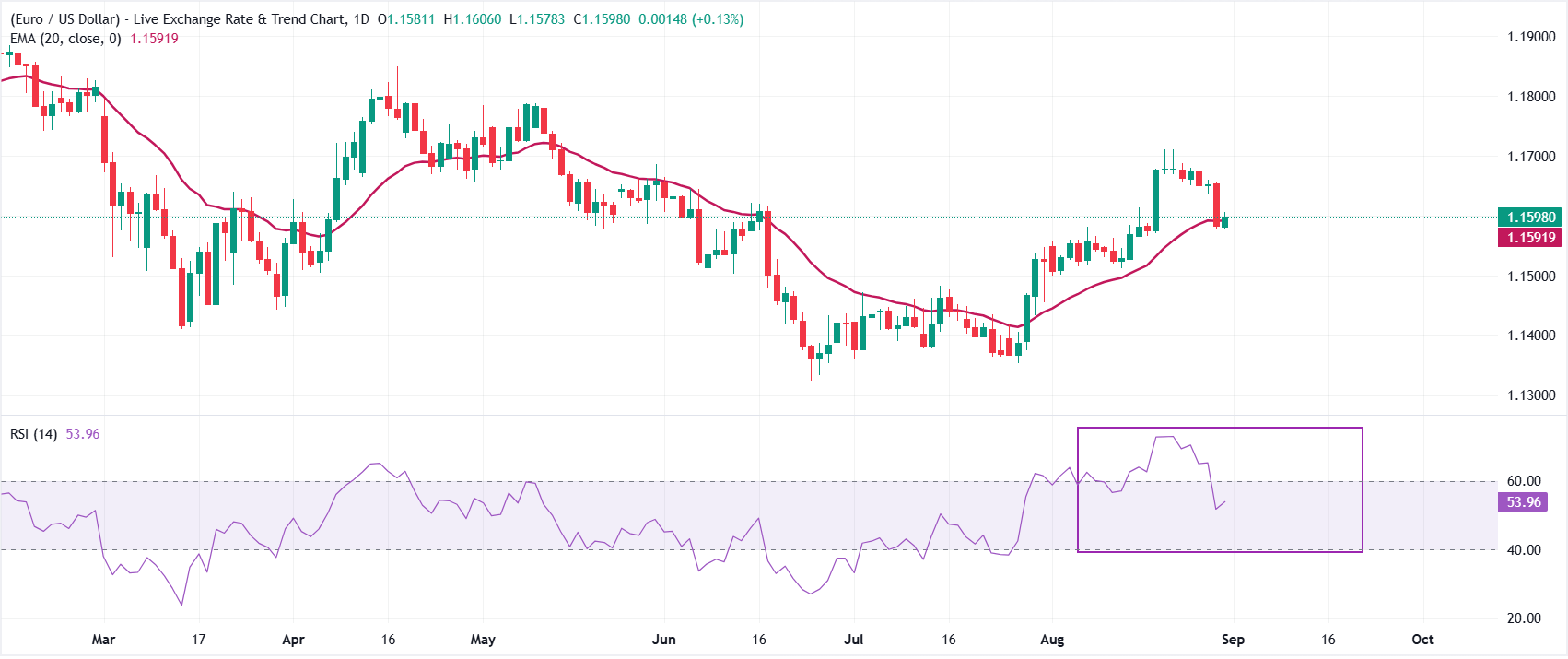
In the daily chart, EUR/USD trades at 1.1598. The pair holds just above the 20-day exponential moving average (EMA) at 1.1592, keeping the near-term bias mildly bullish as price respects this dynamic support. The Relative Strength Index (RSI) at 53.9 is neutral-to-positive, hinting that buying pressure remains in place without reaching overstretched conditions.
On the downside, immediate support is located at the 20-day EMA around 1.1592, and a decisive break beneath this floor would suggest a deeper corrective phase toward lower recent lows. With no notable resistance levels immediately overhead in this dataset, continuation higher would likely depend on whether bulls can maintain price above the EMA, allowing momentum to gradually build while RSI stays in its current constructive range.
(The technical analysis of this story was written with the help of an AI tool. Know more.)
Euro FAQs
The Euro is the currency for the 20 European Union countries that belong to the Eurozone. It is the second most heavily traded currency in the world behind the US Dollar. In 2022, it accounted for 31% of all foreign exchange transactions, with an average daily turnover of over $2.2 trillion a day. EUR/USD is the most heavily traded currency pair in the world, accounting for an estimated 30% off all transactions, followed by EUR/JPY (4%), EUR/GBP (3%) and EUR/AUD (2%).
The European Central Bank (ECB) in Frankfurt, Germany, is the reserve bank for the Eurozone. The ECB sets interest rates and manages monetary policy. The ECB’s primary mandate is to maintain price stability, which means either controlling inflation or stimulating growth. Its primary tool is the raising or lowering of interest rates. Relatively high interest rates – or the expectation of higher rates – will usually benefit the Euro and vice versa. The ECB Governing Council makes monetary policy decisions at meetings held eight times a year. Decisions are made by heads of the Eurozone national banks and six permanent members, including the President of the ECB, Christine Lagarde.
Eurozone inflation data, measured by the Harmonized Index of Consumer Prices (HICP), is an important econometric for the Euro. If inflation rises more than expected, especially if above the ECB’s 2% target, it obliges the ECB to raise interest rates to bring it back under control. Relatively high interest rates compared to its counterparts will usually benefit the Euro, as it makes the region more attractive as a place for global investors to park their money.
Data releases gauge the health of the economy and can impact on the Euro. Indicators such as GDP, Manufacturing and Services PMIs, employment, and consumer sentiment surveys can all influence the direction of the single currency. A strong economy is good for the Euro. Not only does it attract more foreign investment but it may encourage the ECB to put up interest rates, which will directly strengthen the Euro. Otherwise, if economic data is weak, the Euro is likely to fall. Economic data for the four largest economies in the euro area (Germany, France, Italy and Spain) are especially significant, as they account for 75% of the Eurozone’s economy.
Another significant data release for the Euro is the Trade Balance. This indicator measures the difference between what a country earns from its exports and what it spends on imports over a given period. If a country produces highly sought after exports then its currency will gain in value purely from the extra demand created from foreign buyers seeking to purchase these goods. Therefore, a positive net Trade Balance strengthens a currency and vice versa for a negative balance.
Recommended Articles


