


TradingKey Daily Market Brief: Three Major US Indexes Tumble, Broadcom and Arm Buck Trend, Nvidia Earnings Beat Expectations
Tracking Market Trends
TradingKey - The three major U.S. stock indices fell across the board. The Dow Jones Industrial Average (DJIA) fell 1.64% to close at 50,759.42; the Nasdaq Composite Index (IXIC) dropped 0.74% to end at 24,328.38; and the S&P 500 Index (SPX) slipped 1.03% to finish at 7,340.53. Influenced by multiple macroeconomic variables and sector rotation, the broader market experienced a broad-based pullback as investor sentiment turned cautious.
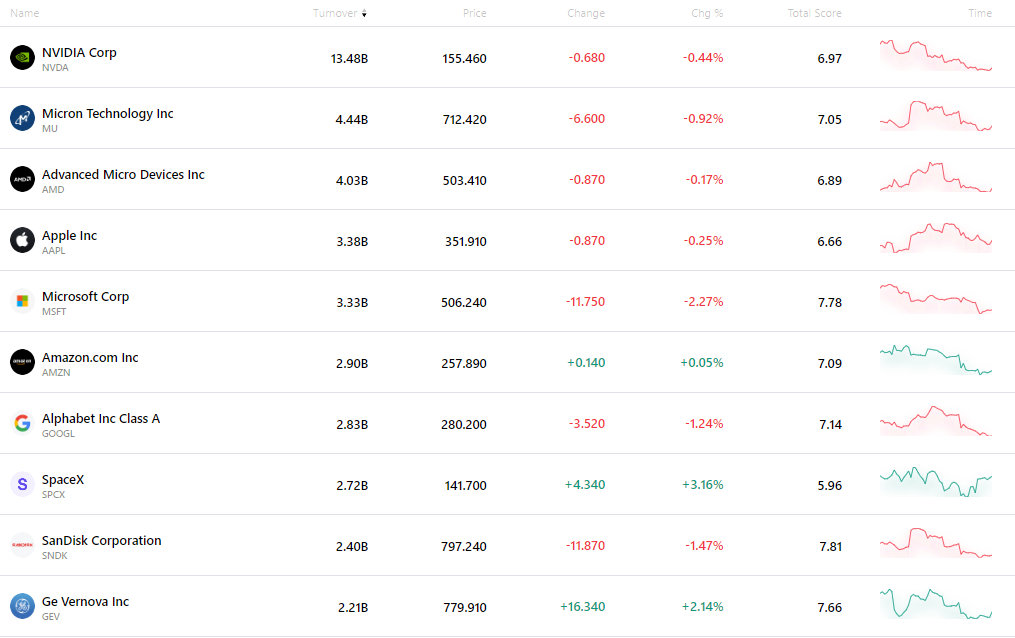
U.S. AI and semiconductor stocks diverged, with Advanced Micro Devices (AMD) edging down 0.17% to close at $503.41, while Broadcom (AVGO) bucked the trend to climb 2.46%, closing at $341.60, reflecting the market's mixed and divergent sentiment toward the AI chip sector.
Other major chip and semiconductor equipment supply chain stocks also broadly traded mixed. Arm Holdings (ARM) surged 4.76%, posting the standout performance; by contrast, lithography giant ASML came under pressure, dropping 1.68%, while memory maker Micron Technology (MU) fell 0.92%, and Intel (INTC) also slipped 0.54%, indicating that capital allocation within the semiconductor supply chain is turning cautious and rotational.
International crude oil prices diverged, with WTI crude (USOIL) falling 0.34% to $84.397 per barrel, while Brent crude (UKOIL) rose 0.4% to $91.160 per barrel. Spot gold (XAUUSD) fell 0.72% to $3,819.570 per ounce, and spot silver (XAGUSD) dropped 0.63% to $46.935 per ounce.
Cryptocurrencies rebounded slightly, with Bitcoin (BTC) rising 0.24% to $64,670; Ethereum (ETH) gaining 0.37% to trade at $1,814; Ripple (XRP) rising 2.83% to trade at $0.97; and Binance Coin (BNB) climbing 1.08% to $595.
Market News
Russian President Vladimir Putin arrived in Shenzhen in the early hours of November 18 to attend the APEC Economic Leaders' Meeting on November 18–19 and participate in the first-ever summit among the leaders of China, Russia, and the US; the White House revealed that Donald Trump has departed for Asia and may meet with Kim Jong Un in China this week, while senior executives from Chinese and US companies, including BYD and Google, are also attending the APEC CEO Summit in Shenzhen.
The US Department of Commerce issued new rules on the 16th restricting remote access to advanced AI chips and requiring companies across several Southeast Asian nations and Brazil to apply for import licenses; China's Ministry of Commerce voiced strong opposition on the 17th, warning that it would take countermeasures.
US retail sales rose 0.2% month-over-month and 6.8% year-over-year in October, hitting a four-year high, driven primarily by gas station spending, while bank card spending by low-income households climbed 7.3% year-over-year, outpacing affluent groups for the first time.
Elon Musk confirmed that he would be in China on November 18 to attend APEC events in Shenzhen, while his "digital avatar" would attend the DealBook Summit held in New York on the same day.
Nvidia (NVDA) reported third-quarter revenue of $115.8 billion, topping $100 billion for the first time, doubling year-over-year and beating expectations, alongside strong fourth-quarter guidance; this marked the first earnings report since Jensen Huang's departure and Colette Kress became interim CEO, with the stock rising over 4% at one point in after-hours trading.
Nike (NKE) unveiled a five-year turnaround plan, projecting that it will not return to the industry average growth rate until fiscal 2029; dragged down by a 26% decline in first-quarter revenue in Greater China on a currency-neutral basis, its shares tumbled more than 6% on the day.
Top 10 Most Active Stocks
The table below lists the ten most actively traded stocks in the latest market. Supported by massive trading volume and excellent liquidity, these assets have become key benchmarks for tracking global market dynamics.
Recommended Articles


