

Intel Drops Over 5% Pre-Market as Company, CEO and CFO Sued by Shareholders With Weak PC Demand in Focus

Source Tradingkey

TradingKey - Intel (INTC) fell about 5% in US premarket trading on Monday. Following a historic sell-off in late October triggered by weaker-than-expected guidance, the company and two key executives now face a shareholder class-action lawsuit, further escalating market concerns over its disclosures, capital operations, and turnaround prospects.
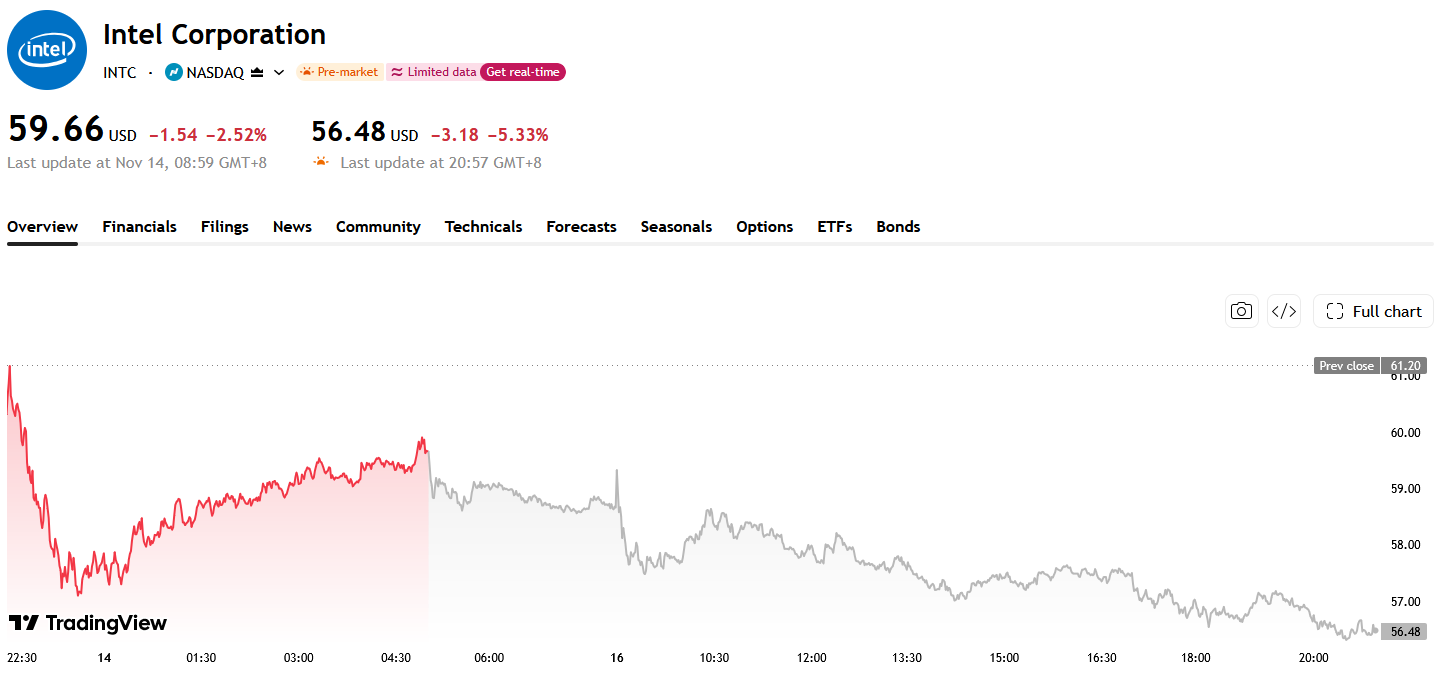
intc-d113cc634d414efcb19a90b67a5014d9

Source: TradingView

The proposed securities class action was filed on November 13 in the San Jose Division of the U.S. District Court for the Northern District of California, led by the City of Southfield Fire & Police Retirement System in Michigan. In addition to Intel, Chief Executive Officer Lip-Bu Tan and Chief Financial Officer David Zinsner were named as defendants. The plaintiffs seek to recover damages on behalf of investors who purchased Intel stock between July 23 and October 29, 2026, though no specific damages amount has been specified yet. At this stage, the claims remain allegations, and the court has not found Intel or its executives liable.

Shareholders allege that Intel failed to timely and adequately disclose the impact of the cooling PC market and channel inventory buildup on its operating performance. The complaint states that rising prices for components such as memory pushed up computer manufacturing costs, dampened end-user demand, and caused OEMs and distribution channels to accumulate large amounts of unabsorbed inventory. Under these conditions, the pressure on Intel's client business exceeded what the company had previously communicated to investors, with the negative impact even outweighing the growth brought to its data center business by the AI investment boom.

The lawsuit also targets Intel's August fundraising as a focal point of contention. The plaintiffs claim that midway through the third quarter, the company sold roughly $23 billion in stock at $95 per share, at a time when management may have already known that PC business and inventory issues were worsening. Consequently, shareholders argue that Intel had an incentive to downplay operational risks to complete the financing at a higher price. The proceeds were primarily used to support the expansion of its foundry and manufacturing operations, with the foundry transition being a key component of Lip-Bu Tan's strategy.

Intel shares plunged 28.6% on October 30, wiping out about $140 billion in market value in a single day. This followed the company's fourth-quarter revenue and earnings guidance that fell short of market expectations, alongside forecasts that PC market weakness would persist at least into 2027. Earnings results showed that third-quarter revenue from the Client Computing and Physical AI business dropped by approximately $800 million sequentially, as rising memory prices, tightening IT budgets, and customer inventory adjustments combined to depress processor demand.

The company's own regulatory filings also acknowledged that demand for PC products weakened in the third quarter compared with the first half of the year, projecting that this trend would worsen in the fourth quarter and persist into 2027. Meanwhile, tight supplies of substrates, memory, and other critical components also constrained Intel's ability to ramp up data center CPU production, preventing it from fully capitalizing on opportunities driven by growing server chip demand.

Intel has not yet officially responded to the lawsuit. Because the case was only recently filed, it will still proceed through subsequent stages, including the appointment of a lead plaintiff, the filing of an amended complaint, and motions to dismiss by the defendants.

Disclaimer: For information purposes only. Past performance is not indicative of future results.
placeholder
Nvidia slid 7.7% after hours while AMD and Broadcom rose — the AI trade changed hands, it didn't breakNvidia closed Wednesday at 173.73, up 2.87%, then fell as much as 8.1% to 159.44 after reports that its board was preparing for a possible leadership change. The same session, the Philadelphia Semiconductor Index rose 5.7% with all 30 components higher, CoreWeave jumped 24.7% on 168% revenue growth, and Micron added 11.9%. If AI demand were being repriced, AMD and Broadcom would not be bid. This is a governance discount on one name, and 204.54 — the 200-day average — is the level that settles it.
Author  Irene Q.
Nov 12, Thu
Nvidia closed Wednesday at 173.73, up 2.87%, then fell as much as 8.1% to 159.44 after reports that its board was preparing for a possible leadership change. The same session, the Philadelphia Semiconductor Index rose 5.7% with all 30 components higher, CoreWeave jumped 24.7% on 168% revenue growth, and Micron added 11.9%. If AI demand were being repriced, AMD and Broadcom would not be bid. This is a governance discount on one name, and 204.54 — the 200-day average — is the level that settles it.
placeholder
Gold hit a one-year low while central banks bought 321 tonnes — the sellers were never the ones you thinkSpot gold closed at 3,876 on Thursday, down 2.8% and its lowest close in more than a year, with an intraday low near 3,852. The dollar is at a 19-month high of 103.21 and the 10-year yield is at 5.10%, so the price move is easy to explain. What is harder to explain is who sold: central banks bought 321 tonnes in Q3, the PBoC added for a 24th straight month, ETF holdings are near a record 4,256 tonnes, and roughly 95% of the futures selling came from non-reportable and sovereign-type accounts rather than hedge funds. This piece separates the two books that have to balance.
Author  Irene Q.
Nov 13, Fri
Spot gold closed at 3,876 on Thursday, down 2.8% and its lowest close in more than a year, with an intraday low near 3,852. The dollar is at a 19-month high of 103.21 and the 10-year yield is at 5.10%, so the price move is easy to explain. What is harder to explain is who sold: central banks bought 321 tonnes in Q3, the PBoC added for a 24th straight month, ETF holdings are near a record 4,256 tonnes, and roughly 95% of the futures selling came from non-reportable and sovereign-type accounts rather than hedge funds. This piece separates the two books that have to balance.
placeholder
Nvidia reports tomorrow with an interim CEO — $108 billion is the easy numberNvidia closed at 162.85 on Friday, down 12.75% on the week and 32% below its 6 October record, with market value down to $3.92 trillion. The Q3 bar is $108 billion ±2%, and consensus already sits at $108.7 ~ 108.8 billion, so the revenue line is not where the surprise lives. The number that decides the reaction is the 71 ~ 72% Q4 gross-margin trough, followed by a Q4 guide against a $124.9 billion consensus. This piece prices the print, marks the 158.39 line and lays out the three scenarios in a table.
Author  Irene Q.
11 hours ago
Nvidia closed at 162.85 on Friday, down 12.75% on the week and 32% below its 6 October record, with market value down to $3.92 trillion. The Q3 bar is $108 billion ±2%, and consensus already sits at $108.7 ~ 108.8 billion, so the revenue line is not where the surprise lives. The number that decides the reaction is the 71 ~ 72% Q4 gross-margin trough, followed by a Q4 guide against a $124.9 billion consensus. This piece prices the print, marks the 158.39 line and lays out the three scenarios in a table.
placeholder
Anthropic is six times oversubscribed at $1.4 trillion while Nvidia is down 32% — the AI trade has two pricesAnthropic lists on Nasdaq as ANT on Thursday at $70 ~ $78 a share, raising up to $64.4 billion at a target valuation near $1.4 trillion, and the book is reportedly six times covered. In the same six weeks, Nvidia has fallen 32% and the QQQ is 10.9% below its October peak. Private capital and public markets are marking the same AI complex at two very different prices. This piece separates the two books: what the S-1 shows, who is anchoring the $26 billion private placement, and what Thursday's debut would have to do to change the public tape.
Author  Irene Q.
11 hours ago
Anthropic lists on Nasdaq as ANT on Thursday at $70 ~ $78 a share, raising up to $64.4 billion at a target valuation near $1.4 trillion, and the book is reportedly six times covered. In the same six weeks, Nvidia has fallen 32% and the QQQ is 10.9% below its October peak. Private capital and public markets are marking the same AI complex at two very different prices. This piece separates the two books: what the S-1 shows, who is anchoring the $26 billion private placement, and what Thursday's debut would have to do to change the public tape.
placeholder
Gold Price Analysis Today | Forex Gold Analysis | XAU/USD Analysis - November 16, 2026Get the latest gold price analysis, forex gold insights, and XAU/USD analysis for November 16, 2026. Read on for the details.
Author  Mitrade
10 hours ago
Get the latest gold price analysis, forex gold insights, and XAU/USD analysis for November 16, 2026. Read on for the details.
goTop
quote