


The Nasdaq Fell Into Correction Territory Recently. Should You Buy the Dip?
Key Points
History suggests all markets exhibit volatility, and the current market is no different.
The recent tightening in credit markets and the fall in equity markets imply a repricing of risk around AI, which might be a good thing over the long term.
Focusing on companies with solid balance sheets is a sensible strategy when buying on a dip.
- 10 stocks we like better than Alphabet ›
Recent sharp volatility in the Nasdaq Composite (NASDAQINDEX: ^IXIC) index shouldn't surprise experienced investors, because the stock market doesn't move in a perfectly straight line over the long term. Markets will always be volatile.
Missed AI’s "Act 1"? Act 2 Could Be 15x Bigger. Most investors think they missed the AI boat because they didn't buy Nvidia in 2005. But according to our analysts, we’re only at the end of "Act 1"—the R&D phase. "Act 2" is the global rollout. Continue »
The key question is whether downside moves, such as a recent one-day dip of 5.5% that sent the Nasdaq briefly into correction territory, signal an extended period of weakness or a buying opportunity. I think the answer is the latter, but with qualifications.
Buy the dip?
First, try to discern the reasons for the dip. As ever, multiple causes are likely, but history and human nature suggest a consistent theme. Simply put, rapidly rising prices push investors to misallocate resources, leading to unproductive investment, which then triggers a correction when reality kicks in.

Image source: Getty Images.
These "rising prices" can be a general increase in the price level (inflation), or they can be in asset classes (equities in the dot-com boom of the late 1990s, or commodities in the 2000s, or subprime mortgages in the great financial crisis).
And now, we are in an artificial intelligence infrastructure boom.
The AI investment boom
It's no secret that hyperscaler investment in AI data center infrastructure has soared, as has investment in AI applications. In other words, the "rapidly rising prices" I referred to have induced me-too entrants into markets that they might not otherwise be comfortable in.
But don't take my word as gospel; here's what Warren Buffett said when asked about hyperscalers and Alphabet's (NASDAQ: GOOG) (NASDAQ: GOOGL) competitors. "They're now playing a game, in many cases, or in some cases, where they're playing a game they don't want to play," he said. For reference, Buffett initiated Berkshire Hathaway's position in Google's owner, Alphabet.
The me-too game doesn't just extend to companies overextending themselves with AI investment; it also comes from capital markets issuing credit to companies with questionable business models, and some that are struggling to cover their investments with cash flow. As you can see below, Alphabet can cover its capital investments with cash from operations; Oracle (NYSE: ORCL) and CoreWeave (NASDAQ: CRWV) can not.
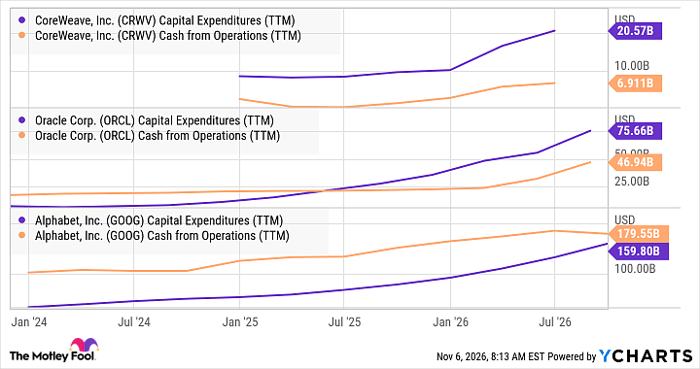
CRWV Capital Expenditures (TTM) data by YCharts
The good news/bad news
The recent news is arguably both bad and good. As Elon Musk recently argued, "debt markets have almost entirely shut off access to money for any company that doesn't have substantial revenue independent of AI data centers." And now equity markets are punishing overextended AI participants.
These conditions represent exactly the kind of risk pricing that will curtail the excesses of investment in AI by the me-too players and the new game players Buffett alluded to.

Image source: Getty Images.
That's bad news in the near term, as it will shake up the market. However, it's good news over the long term because it will likely lead to the market consolidation Musk referenced and ensure AI investment can continue on a more secure basis. In other words, the market needs this correction to flush out weaker AI players and allow it to move higher on a solid basis.
While it's impossible to know when to pick the bottom, it is possible to look at the lessons of history and stay invested in companies with sound balance sheets that can ride through volatility, and that means Alphabet, not Oracle or CoreWeave. In other words, selectively buy shares of strong companies during corrections, and avoid those facing challenging financing conditions. History suggests the market will reward the former over the long term.
Should you buy stock in Alphabet right now?
Before you buy stock in Alphabet, consider this:
The Motley Fool Stock Advisor analyst team just identified what they believe are the 10 best stocks for investors to buy now… and Alphabet wasn’t one of them. The 10 stocks that made the cut could produce monster returns in the coming years.
Consider when Netflix made this list on December 17, 2004... if you invested $1,000 at the time of our recommendation, you’d have $341,966!* Or when Nvidia made this list on April 15, 2005... if you invested $1,000 at the time of our recommendation, you’d have $1,146,819!*
Now, it’s worth noting Stock Advisor’s total average return is 852% — a market-crushing outperformance compared to 203% for the S&P 500. Don't miss the latest top 10 list, available with Stock Advisor, and join an investing community built by individual investors for individual investors.
See the 10 stocks »
*Stock Advisor returns as of November 9, 2026.
Lee Samaha has no position in any of the stocks mentioned. The Motley Fool has positions in and recommends Alphabet, Berkshire Hathaway, and Oracle. The Motley Fool has a disclosure policy.
Recommended Articles


