


Mastercard vs. S&P Global: Which Financial Stock Is a Better Buy for 2027?
Key Points
Mastercard operates a global payments network with nearly 40,000 employees and reaches more than 220 countries.
S&P Global serves as a critical infrastructure provider by offering credit ratings and benchmarks for the global capital markets.
Which of these financial giants offers the better balance of growth and value for your portfolio through 2027?
- Motley Fool Issues Rare "Total Conviction" Buy Alert ›
Should investors bet on the expansion of global digital payments or the steady demand for essential financial intelligence? Deciding between Mastercard (NYSE:MA) and S&P Global (NYSE:SPGI) involves choosing between two market leaders.
Mastercard maintains a massive electronic network that facilitates commerce across hundreds of currencies and territories. S&P Global provides the data analytics and credit ratings that corporations and investors rely on for transparency. Both companies occupy dominant positions, yet they play very different roles in the modern financial system.
The case for Mastercard
In its latest annual report, filed for the fiscal year ended Dec. 31, 2025, Mastercard described its role as a technology company connecting a vast ecosystem. It provides virtual card technology and payment solutions for financial institutions, merchants, and governments. Key partners include issuing and acquiring banks, which manage the direct relationships with account holders worldwide.
In fiscal 2025, revenue reached nearly $32.8 billion, representing growth of approximately 16.4% over the previous year. Net income was close to $15 billion, demonstrating the company's ability to turn high volumes into profit. This resulted in a net margin of roughly 45.6%, highlighting the efficiency inherent in its scalable network business model.
As of Mastercard's December 2025 balance sheet, the current ratio -- which measures the ability to cover short-term debts with current assets -- is approximately 1. The debt-to-equity ratio of nearly 2.5 compares total debt, including short-term and long-term liabilities, to the value of shareholder equity. Free cash flow, which equals cash from operations minus capital expenditures, was roughly $16.4 billion.
The case for S&P Global
S&P Global provides credit ratings, benchmarks, and data analytics to the global capital and commodity markets. As a prominent name among financial stocks, the company offers benchmarks that investors use to track performance and risk. In its latest annual report, filed for fiscal 2025, it noted its mobility segment provides specialized data to automotive manufacturers and suppliers.
For fiscal 2025, the company reported revenue of nearly $15.3 billion, an increase of approximately 7.9% from the prior year. Net income for the year reached $4.5 billion, supporting a net margin of roughly 29.2%. While Mastercard's growth is steady, it remains sensitive to the total volume of debt issuance in global markets.
According to its December 2025 balance sheet, the debt-to-equity ratio is approximately 0.5, indicating the company uses less debt relative to its equity. The current ratio is roughly 0.8. Free cash flow for fiscal 2025 was nearly $5.5 billion.
Risk profile comparison
Mastercard faces intense competition from traditional networks like Visa (NYSE:V) and American Express (NYSE:AXP), alongside fintechs and government-backed digital infrastructure. It also deals with legal risks regarding interchange fees and regulations on cross-border payments. The company must defend against cybersecurity threats that could disrupt its transaction switching systems or compromise proprietary data.
S&P Global is heavily dependent on the health of capital markets, as a slowdown in debt issuance reduces demand for its ratings business. It also faces risks from the planned separation of its mobility business and the need for constant innovation in artificial intelligence. The company competes with other global data and analytics providers while managing complex international regulations and legal oversight.
Valuation comparison
S&P Global trades at a lower forward P/E than its peer, while the P/S ratio for Mastercard reflects its significantly higher net margin.
| Metric | Mastercard | S&P Global |
|---|---|---|
| Forward P/E | 31.9 | 26.0 |
| P/S ratio | 15.4 | 8.5 |
Valuation metrics include sourcing from Financial Modeling Prep (FMP) and may differ from other data providers.
Which stock would I buy for 2027?
I view these companies as bets on two areas: consumers and markets. Mastercard benefits when people are spending more freely, because it helps boost the fees the payments giant charges financial institutions. If consumer spending slows, Mastercard could be affected, but spending won't disappear altogether.
S&P Global relies very heavily on the markets. Participants in the global capital and commodities markets turn to the company for its credit ratings, benchmarks, and data analytics. That reliance puts S&P Global in a tight spot if there's a slowdown in any of the segments it serves. And market downturns can persist -- sometimes not recovering for years. Additionally, S&P Global's net margin isn't nearly as high as Mastercard's.
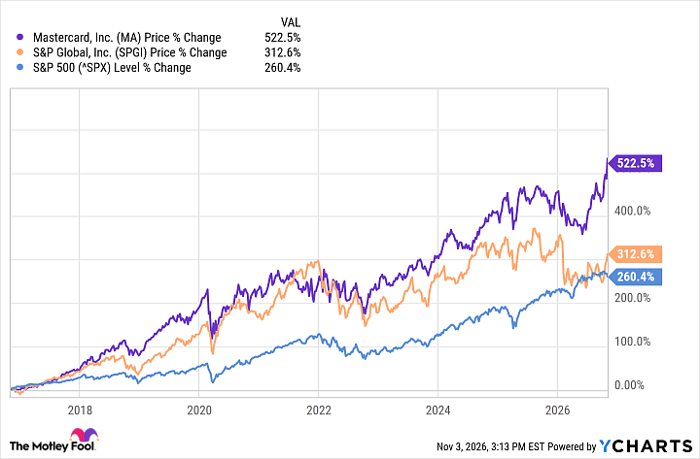
Mastercard's valuation is more expensive than S&P Global’s, but I think it's for a good reason:
MA data by YCharts
Over the past decade, Mastercard has outperformed S&P Global by more than 200 percentage points. Of course, we can't know whether that pattern will continue, but that chart speaks for itself. I think Mastercard is the more attractive stock here.
Should you buy stock in Mastercard right now?
Before you buy stock in Mastercard, consider this:
The Motley Fool Stock Advisor analyst team just identified what they believe are the 10 best stocks for investors to buy now… and Mastercard wasn’t one of them. The 10 stocks that made the cut could produce monster returns in the coming years.
Consider when Netflix made this list on December 17, 2004... if you invested $1,000 at the time of our recommendation, you’d have $336,195!* Or when Nvidia made this list on April 15, 2005... if you invested $1,000 at the time of our recommendation, you’d have $1,241,567!*
Now, it’s worth noting Stock Advisor’s total average return is 875% — a market-crushing outperformance compared to 208% for the S&P 500. Don't miss the latest top 10 list, available with Stock Advisor, and join an investing community built by individual investors for individual investors.
See the 10 stocks »
*Stock Advisor returns as of November 4, 2026.
American Express is an advertising partner of Motley Fool Money. Erin Kennedy has positions in Mastercard and Visa. The Motley Fool has positions in and recommends American Express, Mastercard, S&P Global, and Visa. The Motley Fool has a disclosure policy.
Recommended Articles


