


Inflation for Urban Wage Earners Hit 3.9% in September. Here's What That Means for Social Security and Your Portfolio.
Key Points
Headline inflation (CPI) came in at 3.7% for September 2026 -- but CPI-W inflation came in even higher.
The CPI-W inflation number affects urban wage earners and clerical workers, as well as Social Security.
At 3.9% for September, it tipped the Social Security cost of living adjustment (COLA) to 3.6% for 2027.
- 10 stocks we like better than Vanguard S&P 500 ETF ›
Inflation went up in September, but the headlines about 3.7% inflation from the Consumer Price Index (CPI) aren't the only inflation data that people need to know about. A special variety of inflation that gets measured as part of the work of the Bureau of Labor Statistics (BLS) is the CPI-W, or the Consumer Price Index for Urban Wage Earners and Clerical Workers.
According to the latest BLS inflation report on Oct. 14, the CPI-W for September rose 3.9% from a year ago. This means prices for urban wage earners went up even more than the overall national average of inflation. The CPI-W is important because it's used for calculating the annual cost-of-living adjustment (COLA) that Social Security beneficiaries receive.
Missed AI’s "Act 1"? Act 2 Could Be 15x Bigger. Most investors think they missed the AI boat because they didn't buy Nvidia in 2005. But according to our analysts, we’re only at the end of "Act 1"—the R&D phase. "Act 2" is the global rollout. Continue »
Let's look at what the higher inflation for urban wage earners means for Social Security, and what higher inflation in general might mean for your investment portfolio.

Image source: Getty Images.
Higher urban wage earner inflation: 3.6% Social Security COLA for 2027
You might wonder, what does the average price inflation experienced by urban wage earners and clerical workers have to do with Social Security? After all, people who are still working and living in cities might not have anything in common with, for example, retired people who live in a small town.
It's kind of a strange accident of history that "urban wage earners" are used as the benchmark for helping Social Security benefits keep up with the rising cost of living. But it's the law. Until 1973, Social Security didn't come with built-in annual cost-of-living adjustments. Then, in 1973, when Congress first enacted Social Security COLAs, the "CPI" as we know it today didn't exist. The CPI-W for urban wage earners and clerical workers was, at that time, the only consumer price index that the government used to measure and track inflation.
Here's how the CPI-W affects the Social Security COLA. Each year, CPI-W readings from July, August, and September are used to compare this year's price data with the data from one year ago. In July 2026, the CPI-W increased by 3.4%. In August 2026, the increase was 3.5%. Now that September 2026 CPI-W has come in at 3.9%, those three numbers have been added up and divided by three to give us 3.6%. That average will be the new COLA for Social Security in 2027.
The average retired worker who receives Social Security benefits in 2026 is getting a monthly benefit of about $2,088. And 3.6% of that amount is $75. So the 2027 Social Security COLA will be about $75 per month, or $902 per year, for an average retired worker.
What CPI-W inflation of 3.9% means for your investments
Many Americans are fed up with inflation at the grocery store and gas pump. But inflation is a fact of life at this moment in the U.S. economy. Unless some of the various "Trumpflation" policies that have driven up energy prices and added tariff costs to imported products go away, prices might remain higher than consumers prefer.
From a big-picture economic viewpoint, inflation isn't all bad. Some inflation is healthy for the economy because it's a sign of growth and it gives people an incentive to spend and invest. Deflation from a shrinking economy -- such as a prolonged recession, high levels of unemployment, or a declining population -- is a worse problem to have.
On the one hand, the latest 3.9% CPI-W inflation reading doesn't have to cause big changes in your stock investments. Inflation is higher than many people would like, but we're nowhere near the extreme levels that it reached in 2022, or the even higher levels of the late 1970s to early 1980s. Today's CPI inflation of 3.7% is just slightly above the past 50-year average, as this chart shows:
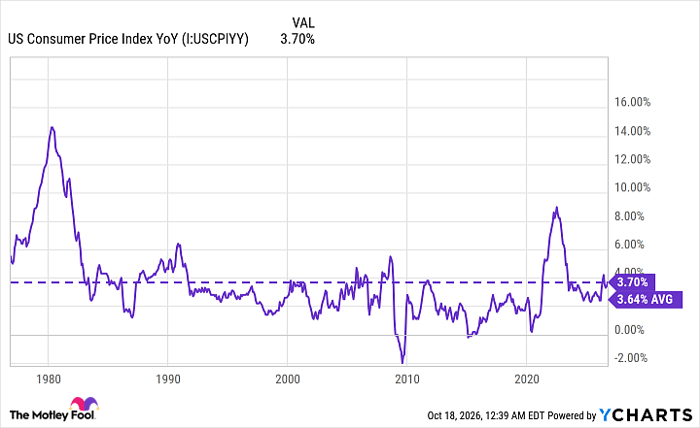
US Consumer Price Index YoY data by YCharts
You might want to just keep investing in your usual mix of stocks, especially if you own low-cost index funds like the Vanguard S&P 500 ETF (NYSEMKT: VOO). Stocks of strong companies with high market share and pricing power tend to do well during high inflation. Just owning the 500 major companies of the S&P 500 might be enough to keep your portfolio ahead of inflation.
Or if you're worried about inflation and want to diversify beyond large caps, you might consider some so-called "inflation-proof investments." These can include short-term bonds (which are less sensitive to the risk of rising interest rates), commodities and energy stocks, financial stocks, and real estate investment trusts (REITs).
Should you buy stock in Vanguard S&P 500 ETF right now?
Before you buy stock in Vanguard S&P 500 ETF, consider this:
The Motley Fool Stock Advisor analyst team just identified what they believe are the 10 best stocks for investors to buy now… and Vanguard S&P 500 ETF wasn’t one of them. The 10 stocks that made the cut could produce monster returns in the coming years.
Consider when Netflix made this list on December 17, 2004... if you invested $1,000 at the time of our recommendation, you’d have $370,440!* Or when Nvidia made this list on April 15, 2005... if you invested $1,000 at the time of our recommendation, you’d have $1,330,110!*
Now, it’s worth noting Stock Advisor’s total average return is 924% — a market-crushing outperformance compared to 212% for the S&P 500. Don't miss the latest top 10 list, available with Stock Advisor, and join an investing community built by individual investors for individual investors.
See the 10 stocks »
*Stock Advisor returns as of October 21, 2026.
Ben Gran has no position in any of the stocks mentioned. The Motley Fool has positions in and recommends Vanguard S&P 500 ETF. The Motley Fool has a disclosure policy.
Recommended Articles


