


Meta vs. Alphabet: Meta Is Better Built for AGI
Key Points
Once AI assistants start "running" errands for people, Meta's social apps protect ad revenue better than Alphabet's search results do.
Alphabet edges ahead on how much the industry relies on it, because other companies rent its custom AI chips or have them installed on-site.
Meta is better placed for AGI, unless demand for Alphabet's custom AI chips grows big enough to outweigh the pressure on its search ads.
- Motley Fool Issues Rare "Total Conviction" Buy Alert ›
An AI assistant now answers a shopper's question right at the top of Google's search results, above the paid links. Google put it there because it wants to be people's go-to AI assistant, ahead of rivals like ChatGPT. That's a trade-off, since a good answer can mean fewer clicks on its own ads. Alphabet (NASDAQ:GOOGL) (NASDAQ:GOOG) makes money from search and YouTube ads, and from cloud computing. Meta Platforms (NASDAQ:META), its rival in this matchup, sells digital ads across Facebook, Instagram, and WhatsApp.
AGI is artificial intelligence (AI) that's as capable as a skilled worker at most jobs. The closer machines get to that level, the more both companies need an answer to one question: Does either ad business hold up once AI agents start making choices for people?
Missed AI’s "Act 1"? Act 2 Could Be 15x Bigger. Most investors think they missed the AI boat because they didn't buy Nvidia in 2005. But according to our analysts, we’re only at the end of "Act 1"—the R&D phase. "Act 2" is the global rollout. Continue »
How Alphabet and Meta Score on AIball
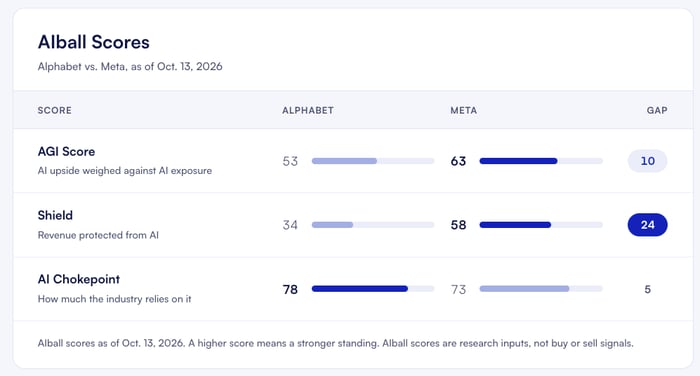
AIball is The Motley Fool's proprietary scoring system for how well a company is positioned for the changes AI brings to its industry. It rates each company from 0 to 100 on a set of separate measures. We then combine them into one number, the AGI Score. That score weighs a company's best AI upside against how exposed its business is to AI.
Meta's Edge: Shield
The Shield score measures how much of a company's revenue is protected from AI. Alphabet and Meta lean on the same kind of revenue: digital ad auctions.
Even so, Meta holds a clear lead thanks to differing advertiser goals. Advertisers pay Alphabet to reach people who are searching for something. Ask an AI agent to book you a table for dinner, and it can handle the whole thing without ever looking at a page of search results or the ads on it.
On Meta, advertisers pay to reach people scrolling Facebook and Instagram or chatting on WhatsApp. People open those apps to see what friends are up to, watch videos, and pass the time. Nobody hands that off to an AI agent, so Meta's ads keep reaching real people. That's crucial for a company that got roughly 98% of its revenue from ads in 2025.
More than 3.5 billion people used Meta's apps each day as of late 2025, and that audience gives Meta real pricing power. In the second quarter of 2026, the average price per ad across its apps rose 12% from a year earlier.
Where Alphabet Holds Up: AI Chokepoint
The AI Chokepoint score measures how much the rest of the industry relies on a company. Power and memory supplies are staying tight, and Alphabet and Meta are each building massive data centers and custom chips to run AI models. Alphabet comes out slightly ahead because of who uses its chips.
Meta has a largely internal focus, building giant computing clusters like Prometheus and Hyperion and designing custom Iris chips, mainly for its own apps. However, outside customers pay Alphabet to rent its custom chips, called Tensor Processing Units (TPUs), along with the software that runs them. Nine of the top 10 AI labs use Google Cloud. Google Cloud brought in $20 billion in revenue in the first quarter of 2026.
Alphabet is now taking its chips beyond its own data centers. In the second quarter of 2026, it began shipping TPU systems straight into customers' facilities. It also teamed up with investment giant Blackstone on a cloud venture built on TPUs.
A customer that wants to move its AI work to other chips has to retune its software first. Investors call that extra work a switching cost. High switching costs make for sticky customers. That gives Alphabet's chip business a moat against rivals.
Why Meta Is Better Built for AGI
Meta is ahead on the AGI Score, so our call comes down to how each company balances its AI upside against its AI exposure. Meta is better built for AGI because its ads reach people while they keep up with friends and family. People want to do that themselves, so no AI agent stands between them and the ads.
Alphabet, by contrast, relies on searches that AI assistants can answer and act on by themselves. A case for Alphabet would rest on its AI Chokepoint score. If the outside developers who pay it for TPUs and cloud capacity can't get enough rival chips and power, its cloud gains could outweigh the pressure on search ads.
Should you buy stock in Alphabet right now?
Before you buy stock in Alphabet, consider this:
The Motley Fool Stock Advisor analyst team just identified what they believe are the 10 best stocks for investors to buy now… and Alphabet wasn’t one of them. The 10 stocks that made the cut could produce monster returns in the coming years.
Consider when Netflix made this list on December 17, 2004... if you invested $1,000 at the time of our recommendation, you’d have $376,696!* Or when Nvidia made this list on April 15, 2005... if you invested $1,000 at the time of our recommendation, you’d have $1,333,920!*
Now, it’s worth noting Stock Advisor’s total average return is 925% — a market-crushing outperformance compared to 212% for the S&P 500. Don't miss the latest top 10 list, available with Stock Advisor, and join an investing community built by individual investors for individual investors.
See the 10 stocks »
*Stock Advisor returns as of October 20, 2026.
The Motley Fool has positions in and recommends Alphabet and Meta Platforms. The Motley Fool has a disclosure policy.
Recommended Articles


