


SpaceX Wants a 32-Mile Pipeline Tied Into Energy Transfer's and Kinder Morgan's Florida System. Does It Matter for Either Pipeline Stock?
Key Points
SpaceX plans to build and own a 32-mile pipeline connecting its Cape Canaveral facilities to the shared natural gas network of Kinder Morgan and Energy Transfer.
The connection should reduce SpaceX’s reliance on LNG truck deliveries as Starship launches increase.
It highlights the growing demand for natural gas, but it is a small deal relative to Kinder Morgan's and Energy Transfer's scale.
- 10 stocks we like better than Energy Transfer ›
On Oct. 6, the Florida Public Service Commission approved a transportation tariff for Coastal Connect Services, a subsidiary of Space Exploration Technologies (NASDAQ: SPCX), aka SpaceX, to move forward with a pipeline to its Cape Canaveral site.
As part of this, SpaceX wants to build a 32-mile pipeline in Brevard County to tap into the Florida Gas Transmission Network (FGT), a roughly 5,300-mile interstate pipeline system jointly owned by pipeline operators Kinder Morgan (NYSE: KMI) and Energy Transfer (TXSE: ET).
Missed AI’s "Act 1"? Act 2 Could Be 15x Bigger. Most investors think they missed the AI boat because they didn't buy Nvidia in 2005. But according to our analysts, we’re only at the end of "Act 1"—the R&D phase. "Act 2" is the global rollout. Continue »
This will help the company secure fuel at its Cape Canaveral location as it looks to ramp up Starship launches. But what does it mean for Kinder Morgan and Energy Transfer? Let's dive into the details and put it in perspective.
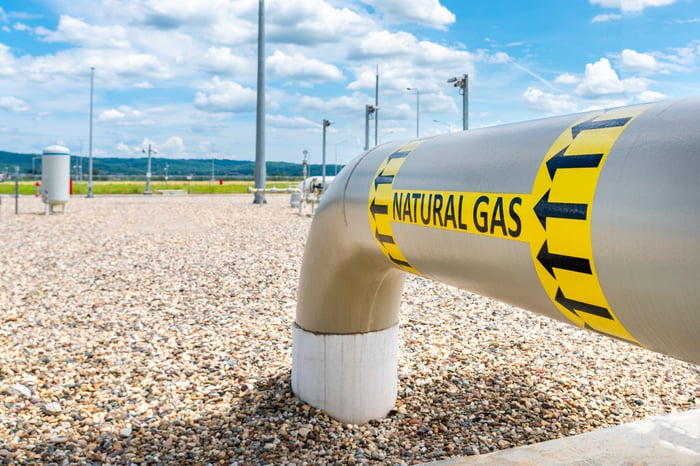
Image source: Getty Images.
SpaceX needs fuel for its new Starship rocket
SpaceX's new Starship rocket uses liquid methane and liquid oxygen for fuel in its Raptor engine. Right now, it relies on hundreds of truck deliveries for liquefied natural gas (LNG) -- which is largely comprised of methane -- for its launches.
As SpaceX intends to ramp up its launch requency, it wants to tap Florida's existing natural gas pipeline network rather than rely on convoys of trucks constantly bringing in LNG.
The move will help feed natural gas directly into its on-site chillers and liquefaction facilities and lock in the volume SpaceX needs to secure regular Starship flights out of Cape Canaveral. As part of this agreement, SpaceX will construct and own the pipeline.
What does this deal mean to Kinder Morgan and Energy Transfer?
Kinder Morgan and Energy Transfer don't have to foot the bill; the deal is simply for interconnection and offtake. While the deal to connect to SpaceX's site in Cape Canaveral makes for good headlines, it's a relatively small deal for both companies, which serve large LNG export terminals and electric utilities.
For perspective, Energy Transfer operates 140,000 miles of energy infrastructure across 44 states. Of these, nearly 40,000 miles transport natural gas, and in the second quarter, the company moved nearly 32,000 billion British thermal units per day (BBtu/d) through its network, transporting roughly 30% of all natural gas consumed in the U.S.
Energy Transfer is constructing a 520-mile pipeline to deliver 2.3 billion cubic feet per day (Bcf/d) at a cost of up to $5.6 billion, and the 400-mile Hugh Brinson Pipeline will transport 2.2 Bcf/d at a cost of $2.7 billion. The company also has an agreement with Oracle for roughly 900,000 million cubic feet per say (Mcf/d) across its multiple data centers, a much bigger opportunity than this SpaceX deal.
Meanwhile, Kinder Morgan owns over 58,000 miles of natural gas pipelines and transported nearly 48,000 BBtu/d in the second quarter. The company transports roughly 40% of U.S. natural gas. Together, the two companies move roughly 70% of the U.S.'s total natural gas, making the SpaceX deal a tiny drop in the bucket.
Investors should know this before buying pipeline stocks
For investors seeking income, Kinder Morgan yields around 3.5%, while Energy Transfer yields nearly 6.8%.
One thing to note: Energy Transfer operates as a master limited partnership (MLP), which receives different tax treatment than most stocks. That could complicate filing come tax season. Kinder Morgan, on the other hand, operates as a C corporation and is taxed as a regular corporation, offering a lower yield but simpler returns.
Demand for U.S. natural gas continues to grow
Pipeline stocks like Energy Transfer and Kinder Morgan have a massive footprint and have benefited as U.S. natural gas production continues to reach all-time highs. Since 2010, U.S. natural gas supplies have risen 70%. Meanwhile, long-term forecasts project U.S. natural gas production could expand by another 45 Bcf/d (a 42% increase) through 2035.
For investors, the SpaceX deal is one of many, as Energy Transfer and Kinder Morgan continue to see strong domestic and international demand growth for natural gas (and other energy products).
Should you buy stock in Energy Transfer right now?
Before you buy stock in Energy Transfer, consider this:
The Motley Fool Stock Advisor analyst team just identified what they believe are the 10 best stocks for investors to buy now… and Energy Transfer wasn’t one of them. The 10 stocks that made the cut could produce monster returns in the coming years.
Consider when Netflix made this list on December 17, 2004... if you invested $1,000 at the time of our recommendation, you’d have $380,363!* Or when Nvidia made this list on April 15, 2005... if you invested $1,000 at the time of our recommendation, you’d have $1,315,732!*
Now, it’s worth noting Stock Advisor’s total average return is 919% — a market-crushing outperformance compared to 211% for the S&P 500. Don't miss the latest top 10 list, available with Stock Advisor, and join an investing community built by individual investors for individual investors.
See the 10 stocks »
*Stock Advisor returns as of October 19, 2026.
Courtney Carlsen has positions in Oracle. The Motley Fool has positions in and recommends Kinder Morgan and Oracle. The Motley Fool has a disclosure policy.
Recommended Articles


