


Not Nvidia. Not Micron. This Artificial Intelligence (AI) Chip Stock Has the Most Upside Through 2030.
Key Points
Semiconductor stocks have been some of the biggest beneficiaries of the artificial intelligence (AI) revolution.
Nvidia and Micro make the GPUs and high-bandwidth memory (HBM) for training generative AI models.
Regardless of whose chip architectures are in demand, Taiwan Semiconductor stands to benefit.
- 10 stocks we like better than Taiwan Semiconductor Manufacturing ›
As the artificial intelligence (AI) revolution evolves, investors face an increasingly difficult question: Which chipmakers stand to dominate five years from now?
Nvidia (NASDAQ: NVDA) faces growing competition from custom silicon developed by its own customers. Meanwhile, Micron Technology (NASDAQ: MU) could face less favorable memory market dynamics as manufacturers expand production.
Missed AI’s "Act 1"? Act 2 Could Be 15x Bigger. Most investors think they missed the AI boat because they didn't buy Nvidia in 2005. But according to our analysts, we’re only at the end of "Act 1"—the R&D phase. "Act 2" is the global rollout. Continue »
This is why I see Taiwan Semiconductor Manufacturing (NYSE: TSM), otherwise known as TSMC, as a more attractive long-term opportunity. Taiwan Semi's latest earnings report displayed how its business is becoming more valuable than ever to the AI infrastructure era.

Image source: Taiwan Semiconductor Manufacturing.
Nvidia and Micron face risks that Taiwan Semi can navigate
Nvidia is the undisputed king in the AI accelerator market thanks to its graphics processing units (GPUs), networking technology, and CUDA software ecosystem. However, the company's largest customers are developing alternatives. Alphabet, Amazon, Microsoft, and Meta Platforms are investing in application-specific integrated circuits (ASICs) optimized for their own AI workloads. While these chips won't replace Nvidia's GPUs entirely, they should reduce dependence on Nvidia while giving the hyperscalers more control over infrastructure costs and model performance.
Meanwhile, Nvidia is also exploring agentic AI, autonomous vehicles, and robotics. Indeed, these opportunities could be enormous. But commercial adoption may take longer than the next four years.
Micron is looking at a different challenge. The company's memory solutions are essential for AI computing, particularly high-bandwidth memory (HBM) and advanced DRAM. Memory manufacturing has historically been a cyclical industry, meaning today's shortages and elevated prices will lead producers to expand capacity. By next decade, more supply should come online, leading to pricing pressure and eroding profit margins.
Moreover, competition from China's ChangXin Memory Technologies (CXMT) also deserves attention. Although CXMT is not yet an equivalent competitor across every advanced memory category, its progress could affect the industry's supply dynamics over time.
Here's what makes TSMC different: Whether AI hyperscalers buy Nvidia GPUs, develop custom silicon, or adopt entirely new architectures, many of those chips will require Taiwan Semi's advanced foundry capabilities. In turn, Taiwan Semi doesn't need Nvidia to defeat Alphabet's custom chip strategy. It can manufacture chips for both companies.
Taiwan Semi's Q3 earnings were incredible
Taiwan Semi's third-quarter earnings report put the company's competitive position on full display. The company generated $46.7 billion in revenue, representing 41% growth year over year. Meanwhile, TSMC delivered a gross margin of 66.4% and an operating margin of 58.7%. This underscores the pricing power commanded by the company's advanced manufacturing technology.
Management expects AI-driven momentum to continue. For Q4, revenue is projected to reach between $52.3 billion and $54.3 billion as the company's next-generation, 2-nanometer technology continues ramping.
Why Taiwan Semi stock could surge
Building a semiconductor foundry requires significant upfront capital, years of engineering development, and the ability to manufacture complex chips at commercially viable yields. This creates substantial barriers to entry. As demand for AI compute grows, TSMC should benefit from higher production volumes, more sophisticated manufacturing processes, and additional opportunities in advanced packaging.
Furthermore, the company's opportunities extend beyond today's AI hardware. Consider what could happen between now and 2030. AI workloads are going to shift from training large language models (LLMs) toward inference deployments across autonomous systems, robotics, and applications that have not yet been commercialized at scale. Some of these will require more GPUs, while others will depend on custom accelerators, central processing units (CPUs), or specialized processors.
While TSMC doesn't manufacture DRAM or HBM, it does produce advanced logic chips that operate alongside these memory types. In other words, Taiwan Semi stands to benefit from the broader evolution of AI rather than relying on one particular semiconductor category.
That versatility potentially supports more valuation expansion for Taiwan Semi relative to other semiconductor stocks. Historically, chip manufacturers traded at discounts relative to other designers due to their capital-intensive business models. However, TSMC's dominant position in leading-edge manufacturing, growing profitability, and indispensable role in the AI infrastructure value chain could justify a higher earnings multiple in the long-run.
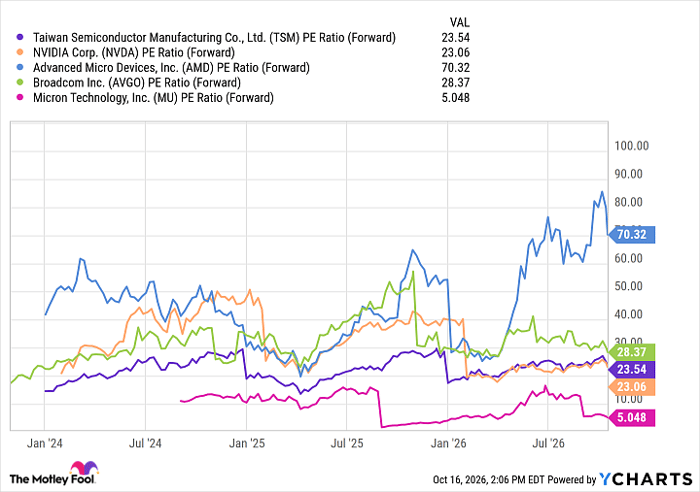
TSM PE Ratio (Forward) data by YCharts.
To me, Taiwan Semi offers a unique proposition: exposure to a broad range of advanced chip architectures regardless of which designers are in demand. Combined with its manufacturing capabilities, robust profitability, and potential for long-term upside, I see TSMC as a compelling buy-and-hold AI chip stock through 2030.
Should you buy stock in Taiwan Semiconductor Manufacturing right now?
Before you buy stock in Taiwan Semiconductor Manufacturing, consider this:
The Motley Fool Stock Advisor analyst team just identified what they believe are the 10 best stocks for investors to buy now… and Taiwan Semiconductor Manufacturing wasn’t one of them. The 10 stocks that made the cut could produce monster returns in the coming years.
Consider when Netflix made this list on December 17, 2004... if you invested $1,000 at the time of our recommendation, you’d have $380,363!* Or when Nvidia made this list on April 15, 2005... if you invested $1,000 at the time of our recommendation, you’d have $1,315,732!*
Now, it’s worth noting Stock Advisor’s total average return is 919% — a market-crushing outperformance compared to 211% for the S&P 500. Don't miss the latest top 10 list, available with Stock Advisor, and join an investing community built by individual investors for individual investors.
See the 10 stocks »
*Stock Advisor returns as of October 19, 2026.
Adam Spatacco has positions in Alphabet, Amazon, Microsoft, and Nvidia. The Motley Fool has positions in and recommends Advanced Micro Devices, Alphabet, Amazon, Broadcom, Meta Platforms, Micron Technology, Microsoft, Nvidia, and Taiwan Semiconductor Manufacturing. The Motley Fool has a disclosure policy.
Recommended Articles


