


Ranking America's 4 Biggest Banks From Best Buy to Worst
Key Points
The U.S.'s four largest money-center banks are JPMorgan Chase, Bank of America, Citigroup, and Wells Fargo.
Within this group, some trade at premium valuations, while others still look like value plays.
- Motley Fool Issues Rare "Total Conviction" Buy Alert ›
Since the Great Recession in 2008, banking has not exactly been the most attractive sector to invest in.
The blow-up in 2008 caused significant reputational damage, which has taken a long time to recover from. Banks have also faced heightened regulations and the constant need to invest in technology, while also trying to ward off competition from fintech companies.
Missed AI’s "Act 1"? Act 2 Could Be 15x Bigger. Most investors think they missed the AI boat because they didn't buy Nvidia in 2005. But according to our analysts, we’re only at the end of "Act 1"—the R&D phase. "Act 2" is the global rollout. Continue »
The four largest banks in the U.S. are JPMorgan Chase (NYSE: JPM), Bank of America (NYSE: BAC), Citigroup (NYSE: C), and Wells Fargo (NYSE: WFC). These money-center banks are essentially now too big to fail. They have also developed scale in many core banking businesses that will be difficult to replicate.
Here they are, ranked from best buy to worst.

Image source: Getty Images.
1. JPMorgan Chase
JPMorgan Chase is the largest bank by assets in the U.S., with nearly $5.1 trillion in assets at the end of the third quarter.
JPMorgan Chase is a best-in-breed large-bank stock, run by CEO Jamie Dimon, long regarded as the industry's best CEO. The bank excels in all facets of banking, including credit card lending, investment banking, trading, payments, commercial lending, and asset and wealth management.
The bank also generates returns on tangible common equity (ROTCE) at the top of its peer group. Management has guided for a long-term ROTCE of 17% through a full economic cycle. But the bank typically generates over a 20% ROTCE, and sometimes much higher.
This is no secret, and, as such, the bank has been awarded a premium valuation based on a price-to-tangible book value (TBV) per-share basis, a common way banks are valued.
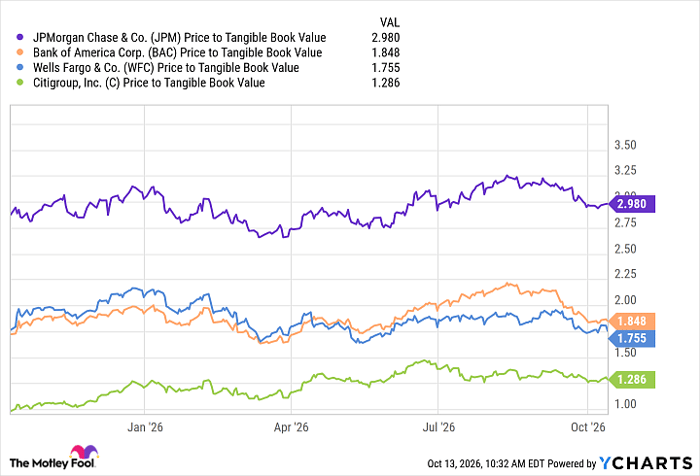
JPM Price-to-Tangible Book Value data by YCharts.
So, while JPMorgan Chase may have less near-term appreciation, I still like it best in the long term. It's going to consistently put up industry-leading returns and be the most consistent through the cycle.
2. Citigroup
After years of lagging returns, Jane Fraser took the reins at Citigroup in 2021 and implemented a massive turnaround effort that has paid off.
Fraser sold off international consumer banking divisions that lacked the scale to compete and focused on the bank's best-performing businesses, such as investment banking and payments.
In 2027, the bank will complete the lengthy effort to divest the consumer, small-business, and middle-market banking operations of its large division in Mexico, known as Banamex. Citigroup has already sold nearly half of this division, but will conduct an initial public offering for the rest in 2027, still retaining some ownership.
All these moves have freed up capital the bank can use to buy back stock and invest in the better-performing parts of the business. The strategy has worked, and Citigroup shareholders have been rewarded.
I think there is more room to run for the stock, which could have the most near-term upside within this group. In the near term, Citigroup is targeting an ROTCE of 11% to 13%. While there is more that goes into valuing bank stocks, a rule of thumb I like is typically that a 10% ROTCE values a bank at 1x TBV.
So the higher end of Citigroup's near-term target pretty much reflects the current valuation of nearly 1.3x TBV. However, Citigroup is aiming to achieve a 14% to 15% ROTCE between 2029 and 2031, so the valuation should reset to that level if there is clear evidence Citigroup can achieve this level of returns.
Remember, banks grow tangible book value with earnings each year. The market may never reward Citigroup with a premium like JPMorgan Chase's, but it's a more compelling TBV-growth, ROTCE-driven story right now.
3. Bank of America
Like JPMorgan Chase, Bank of America excels in most banking businesses, from investment banking to commercial lending. However, management made a critical mistake during the pandemic by investing heavily in long-term, low-yielding bonds.
Many of these bonds are classified as held-to-maturity (HTM), so they won't result in paper losses, or losses for that matter, as long as the bank holds them to maturity. The issue is that they have low yields and most won't mature for a while, so they are a drag on earnings.
At the end of the second quarter, Bank of America had an HTM portfolio of over half a trillion dollars (on an amortized cost basis) that yielded 1.94%, which is well below current market rates.
On the positive side, Bank of America has the most stable, lowest-cost deposit base among its peers, making it a beneficiary of rising interest rates. If rates keep rising, the bank may outperform, particularly in net interest income, a key driver of revenue for most banks.
4. Wells Fargo
There's certainly nothing wrong with Wells Fargo stock, and I could see it performing well in the long term. The problem is that the easy money has been made in the near term, as the stock has done quite well in recent years.
CEO Charlie Scharf did an excellent job of revamping the bank's regulatory infrastructure following Wells Fargo's phony-accounts scandal, in which employees opened credit card and deposit accounts for customers without their consent.
After getting an asset cap and numerous consent orders lifted last year, the bank can finally play offense. In fact, at the end of last year, management said it is targeting a 17% to 18% ROTCE in the medium term, which rivals JPMorgan Chase's guidance.
With the bank trading at 1.75x TBV, it's already nearly fully valued based on those returns. It would be interesting to see what returns the bank can deliver if it can scale its investment banking and credit card lending, but that remains to be seen.
Missed Nvidia in 2009? This Rare Signal Is Flashing Again
In 2009, a "Double Down" signal flashed for a little-known chipmaker called Nvidia. If you’d invested $5,000 then, you’d be sitting on $2,876,672 today.*
Now, for the first time in years, that same "Total Conviction" signal is flashing for a company 1/100th the size of Nvidia. It’s a key player in the $1.8 trillion space race, and with the stock recently sitting 20% off its highs, the window to get in early is closing fast.
Continue »
*Stock Advisor returns as of October 15, 2026.
Wells Fargo is an advertising partner of Motley Fool Money. JPMorgan Chase is an advertising partner of Motley Fool Money. Citigroup is an advertising partner of Motley Fool Money. Bank of America is an advertising partner of Motley Fool Money. Bram Berkowitz has no position in any of the stocks mentioned. The Motley Fool has positions in and recommends JPMorgan Chase. The Motley Fool has a disclosure policy.
Recommended Articles


