


Elon Musk's SpaceX Just Announced Good (and Bad) News to Apple Shareholders
Key Points
SpaceX operates Starlink, a satellite network that is making moves to compete with traditional cellular carriers.
Some on Wall Street suggest Starlink could launch its own device and compete directly with Apple.
While these developments could hurt Apple in the long run, there are also some subtle benefits for the iPhone maker.
- These 10 stocks could mint the next wave of millionaires ›
Elon Musk has spent his career challenging established industries, from payments to automobiles to space exploration. His latest ambitions could create unexpected tailwinds and headwinds for one of the world's most valuable companies: Apple (NASDAQ: AAPL).
Last week, Space Exploration Technologies (NASDAQ: SPCX), better known as SpaceX, announced plans to acquire nationwide wireless spectrum, bringing its Starlink satellite business closer to competing with Verizon, AT&T, and T-Mobile.
Missed AI’s "Act 1"? Act 2 Could Be 15x Bigger. Most investors think they missed the AI boat because they didn't buy Nvidia in 2005. But according to our analysts, we’re only at the end of "Act 1"—the R&D phase. "Act 2" is the global rollout. Continue »
At first glance, that sounds like bad news for telecommunications companies, not for Apple. However, Bank of America analyst Wamsi Mohan identified three ways Starlink could threaten the iPhone maker's business. While I see Mohan's points, there's a way Starlink may benefit Apple in the near term.
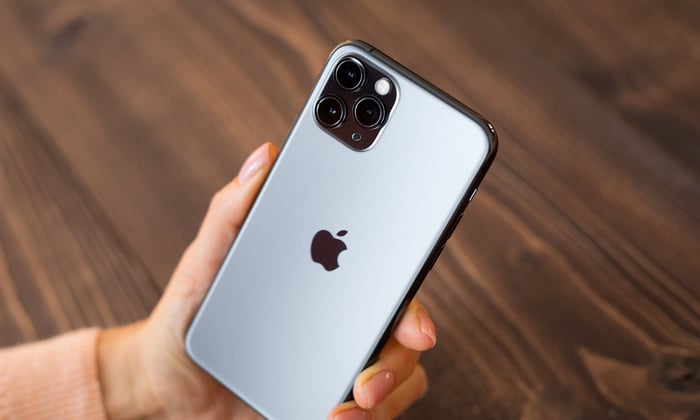
Image source: Getty Images.
SpaceX wants to disrupt the wireless industry
Most Americans buy cellular service through Verizon, AT&T, or T-Mobile. These companies operate networks that connect smartphones through ground-based cell towers. SpaceX wants to challenge that business model.
The company's Starlink Mobile initiative aims to combine satellite connectivity with traditional wireless infrastructure, allowing consumers to receive cellular service across a larger geographic area. To support this vision, SpaceX plans to acquire approximately $8 billion worth of low-frequency wireless spectrum.
Wireless companies need access to frequencies to transmit calls, messages, and internet data. The frequencies SpaceX is acquiring are attractive because they cover long distances and penetrate buildings more effectively than higher-frequency signals. When combined with Starlink's satellite network, they could help SpaceX develop an alternative to incumbent wireless carriers.
This is a big deal because SpaceX won't necessarily need to replicate every aspect of traditional cellular infrastructure. But building a reliable nationwide network requires substantial capital expenditures, regulatory approvals, technical execution, and customer adoption.
How does Starlink threaten Apple?
To understand the risk to Apple, investors need to consider how Americans buy smartphones. Rather than charging the full price for a new phone upfront, a wireless carrier usually offers a promotional credit if you trade in your existing device and agree to remain on its network. Essentially, you pay the difference for the new phone, and the promotional credit is typically distributed across your monthly bills. Interestingly, Apple still receives the phone's true selling price. Wireless providers absorb the promotional subsidy because retaining a paying subscriber can be financially worthwhile in the long run.
Bank of America estimates that 53 million iPhones are sold annually across America's three largest wireless carriers, with an average promotional credit of $800 per device. If SpaceX offers cheaper wireless plans without similar smartphone promotions, customers might become less eager to upgrade their iPhones. Mohan estimates that if Starlink captures 10% of the major carriers' postpaid subscriber base, Apple could lose 5 million iPhone sales per year, representing an estimated $6 billion in annual revenue.
In addition, SpaceX could eventually introduce its own lower-cost smartphone. By doing so, Musk would compete with the iPhone directly. These devices could integrate Starlink connectivity with Grok artificial intelligence (AI), creating an ecosystem that rivals Apple's hardware, software, and services businesses.
How Starlink might actually help Apple (for now)
It's important to understand that Starlink has not yet built enough commercial products to erode the dominance of America's largest wireless carriers. Building that business will take years, and increased competition might initially benefit Apple.
If Verizon, AT&T, and T-Mobile become concerned about losing subscribers to Starlink, they will likely respond by offering more aggressive iPhone promotions. That could encourage consumers to upgrade their devices, potentially supporting Apple's near-term sales.
Furthermore, Starlink's mobile service is designed to work with existing smartphones. This means consumers wouldn't necessarily need to abandon their iPhones to switch providers. Apple also has substantial competitive advantages, including its global installed device base, brand loyalty, and sticky services business.
Investors shouldn't equate Apple's revenue with its profitability. Even if the company eventually loses iPhone sales, that wouldn't automatically translate into an equivalent reduction in earnings. The bigger concern is whether reducing carrier subsidies weakens Apple's pricing power over time.
If investors begin questioning the durability of iPhone demand, they might become less willing to pay a premium multiple for Apple stock. Nevertheless, Mohan maintains a buy rating on Apple stock -- meaning he doesn't think these risks are a reason to abandon the company.
For now, SpaceX's disruption to Apple remains speculative and could take years to materialize, if it does. For existing Apple shareholders, I do not see a compelling reason to sell the stock solely because of Musk's ambitions to enter the communications industry. The more prudent approach is to hold and monitor whether Starlink begins to meaningfully disrupt the wireless sector.
We just issued 'double down' alerts on 3 stocks — find out if Apple made our list
Ever feel like you missed the boat in buying the most successful stocks? Then you’ll want to hear this.
On rare occasions, our expert team of analysts issues a “Double Down” stock recommendation for companies that they think are about to pop. If you’re worried you’ve already missed your chance to invest, now is the best time to buy before it’s too late. And the numbers speak for themselves:
- Nvidia: if you invested $1,000 when we doubled down in 2009, you’d have $594,105!*
- Apple: if you invested $1,000 when we doubled down in 2008, you’d have $65,100!*
- Netflix: if you invested $1,000 when we doubled down in 2004, you’d have $379,986!*
Right now, we’re issuing “Double Down” alerts for three incredible companies, available when you join Stock Advisor, and there may not be another chance like this anytime soon.
See the 3 stocks »
*Stock Advisor returns as of October 14, 2026.
Bank of America is an advertising partner of Motley Fool Money. Adam Spatacco has no position in any of the stocks mentioned. The Motley Fool has positions in and recommends Apple. The Motley Fool recommends T-Mobile US and Verizon Communications. The Motley Fool has a disclosure policy.
Recommended Articles


