


Starship, Starlink, or xAI: Which Part of SpaceX Could Move the Stock Most in 2027?
Key Points
Starlink generated 61% of SpaceX's revenue last quarter.
It's also SpaceX's only profitable business.
AI spending could overshadow Starlink growth if SpaceX doesn't rein in its data center costs.
- 10 stocks we like better than Space Exploration Technologies ›
Space Exploration Technologies (NASDAQ: SPCX) is moving quickly in so many directions that it can be hard to keep up.
Its artificial intelligence unit, xAI, is building data centers and has a top frontier model, Grok. And its rocket business recently launched its Starship rocket into orbit for the first time. Meanwhile, the company's Starlink satellite broadband business connects millions of customers worldwide to the internet and could become a leading provider in the coming years.
Missed Nvidia in 2009? This Rare Signal Is Flashing Again. In 2009, a "Double Down" signal flashed for a little-known chipmaker called Nvidia. For the first time in years, that same "Total Conviction" signal is flashing for a company 1/100th the size of Nvidia. Continue »
Investors wondering what part of SpaceX's business could most move its stock price next year should keep a close eye on Starlink. Here's why.
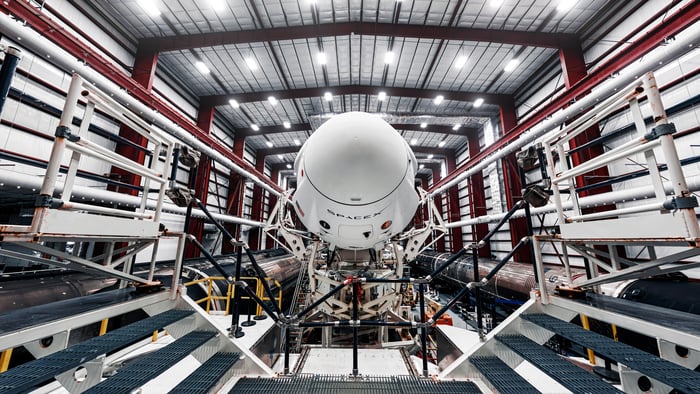
Image source: Getty Images.
Starlink is the main event, for now
Starlink is often overshadowed by SpaceX's other businesses because, well, it's hard to compete with the world's largest rocket blasting off into space or the latest news about the artificial intelligence race.
But Starlink is, for now, SpaceX's most important business because it generates the most revenue for the company -- more than 60% of total sales.
It's also SpaceX's only profitable business.
Starlink is a high-margin, recurring-cash-flow business, with earnings before interest, taxes, depreciation, and amortization (EBITDA) of $2.6 billion in the second quarter -- up 64% from the year-ago quarter.
Starlink reported a total of 12 million global customers as of the end of June, and about 3 million of those are in the U.S. Analysts believe there could be far more subscriber growth ahead, with the potential to reach 15 million U.S.-based customers by 2030.
The latest estimates put Starlink's satellite internet total addressable market at $129 billion just four years from now, providing SpaceX with plenty of opportunity to expand its sales in this business.
With Starlink being SpaceX's leading source of revenue and profit, and its potential to tap into a large global market, any indications that the business is continuing to expand at a healthy clip could send shares higher in 2027.
AI spending could have a major impact, too
The flip side of the positive impact Starlink could have on the stock is that SpaceX is spending a lot of money to expand its xAI business, including building expensive data centers.
SpaceX is spending far more on its artificial intelligence business than it is on anything else, including developing, building, and testing rocket ships. Capital expenditures more than tripled in the first half of 2026, with 83% of spending going to SpaceX's AI business.
Here's the breakdown:
| SpaceX Segment |
1H 2025 Capex |
1H 2026 Capex |
Change (YOY) |
|---|---|---|---|
|
Space |
$1.7 billion |
$2.2 billion |
30% |
|
Connectivity (Starlink) |
$1.9 billion |
$2.7 billion |
39% |
|
Artificial intelligence |
$3.3 billion |
$23.5 billion |
610% |
Data source: Starlink.
A 610% increase in AI capex is hard to overlook, and it's likely one of the reasons investors haven't been more eager to jump on board with SpaceX stock.
There are legitimate areas of growth for SpaceX's AI business, and Goldman Sachs underwriters said before SpaceX went public that the company's AI sales could reach $322 billion by 2030.
But its AI sales aren't anywhere close to that right now -- just $3.4 billion in the first half of 2026.
If SpaceX continues to increase AI spending at such a rapid pace, I don't know if any amount of Starlink growth will move the needle for the stock. This is why shareholders should pay close attention to both of these businesses next year and beyond.
Of course, if SpaceX can significantly ramp up its AI revenue and show that its spending is starting to pay off, that could be a catalyst for gains in its share price.
For now, though, investors should focus their attention on Starlink, while also keeping a close eye on AI spending.
Should you buy stock in Space Exploration Technologies right now?
Before you buy stock in Space Exploration Technologies, consider this:
The Motley Fool Stock Advisor analyst team just identified what they believe are the 10 best stocks for investors to buy now… and Space Exploration Technologies wasn’t one of them. The 10 stocks that made the cut could produce monster returns in the coming years.
Consider when Netflix made this list on December 17, 2004... if you invested $1,000 at the time of our recommendation, you’d have $373,352!* Or when Nvidia made this list on April 15, 2005... if you invested $1,000 at the time of our recommendation, you’d have $1,406,241!*
Now, it’s worth noting Stock Advisor’s total average return is 933% — a market-crushing outperformance compared to 212% for the S&P 500. Don't miss the latest top 10 list, available with Stock Advisor, and join an investing community built by individual investors for individual investors.
See the 10 stocks »
*Stock Advisor returns as of September 29, 2026.
Chris Neiger has no position in any of the stocks mentioned. The Motley Fool has positions in and recommends Goldman Sachs Group. The Motley Fool has a disclosure policy.
Recommended Articles


