


AMD Acquires World Labs in $8.2 Billion All-Stock Deal: Can It Catch Nvidia in Physical AI?
TradingKey - On September 28, Eastern Time, AMD (AMD) announced an all-stock transaction worth approximately $8.2 billion to acquire World Labs, expanding its presence in spatial intelligence and world models. The transaction is expected to close by the end of 2026, subject to regulatory approvals.
Upon completion of the transaction, World Labs co-founder Fei-Fei Li will serve as Executive Vice President and Chief Scientist at AMD, reporting directly to Chief Executive Officer Lisa Su. The World Labs team will continue to conduct AI model research, and AMD plans to leverage the relevant technology to improve hardware, software, and systems for new AI models.
What Kind of Company Is World Labs?
World Labs was founded in 2024, focusing on spatial intelligence and world models, with products including Atlas and Marble. Atlas can natively process text, images, video, and 3D data to understand and simulate spatial environments, while Marble can create and edit interactive 3D worlds based on various inputs.
These technologies can provide virtual training and testing scenarios for robots. Robots can first learn spatial recognition, object interaction, and task execution in simulated environments before applying the training results to physical devices.
AMD participated in World Labs' Series B funding round and joined its $1 billion funding round in February 2026. The two parties had previously collaborated to optimize model training and inference.
Why Is AMD Acquiring World Labs?
AMD's AI products cover EPYC server CPUs, Instinct accelerators, and the ROCm software platform, while acquiring World Labs will complement its R&D capabilities in spatial intelligence and world models.
World models need to process vast amounts of image, video, and 3D data, placing high demands on computing power, VRAM, data transmission, and inference efficiency. World Labs' research will help AMD understand the computational demands of new AI models and serve as a reference for future accelerator, software, and system designs.
The related technologies could also be used in robotics training, industrial simulation, and spatial computing, but AMD has not yet disclosed specific products, customers, or commercialization timelines.
World Labs has also not disclosed revenue, customer structure, or profitability data; Marble has already been launched, while Atlas remains in an early open access stage, making its short-term financial contribution difficult to assess.
Can AMD Catch Up With Nvidia in Physical AI After World Labs Acquisition?
Physical AI is primarily applied in robotics, autonomous driving, and industrial equipment. As AI moves into real-world scenarios, industry competition has expanded from chips to world models, simulation software, and development tools.
Nvidia (NVDA) has established a relatively comprehensive product ecosystem. Cosmos provides world models and synthetic data tools, Omniverse is used for digital twins and industrial simulation, Isaac Sim and Isaac Lab support robotics development, and platforms like Jetson Thor handle edge computing.
AMD possesses EPYC server CPUs, Instinct accelerators, and the ROCm software platform, but it still lags behind Nvidia in world models, robotics simulation tools, developer resources, and customer coverage.
Following the acquisition, the adaptation progress of World Labs technology with Instinct and ROCm, along with adoption by robotics and industrial customers, will reflect the true value of the transaction.
The $8.2 billion all-stock transaction will also introduce potential equity dilution, with the actual impact depending on the final number of shares issued and AMD's stock price prior to closing. Team integration, ongoing R&D, and product commercialization will also affect the return on the acquisition.
World Labs can enhance AMD's R&D capabilities in Physical AI, but it is unlikely to alter Nvidia's lead in the short term. Whether the gap between the two can narrow will depend on whether the relevant technologies can be translated into chip, software, and system revenue.
Can AMD Stock Keep Rising?
On September 28, AMD closed down 3.61% at $607.87; following the announcement of the acquisition, its stock price rose slightly by about 0.4% in after-hours trading. AMD's market cap surpassed $1 trillion for the first time in intraday trading on September 21, indicating that the market has priced in high expectations for the growth of its AI chip and data center businesses.
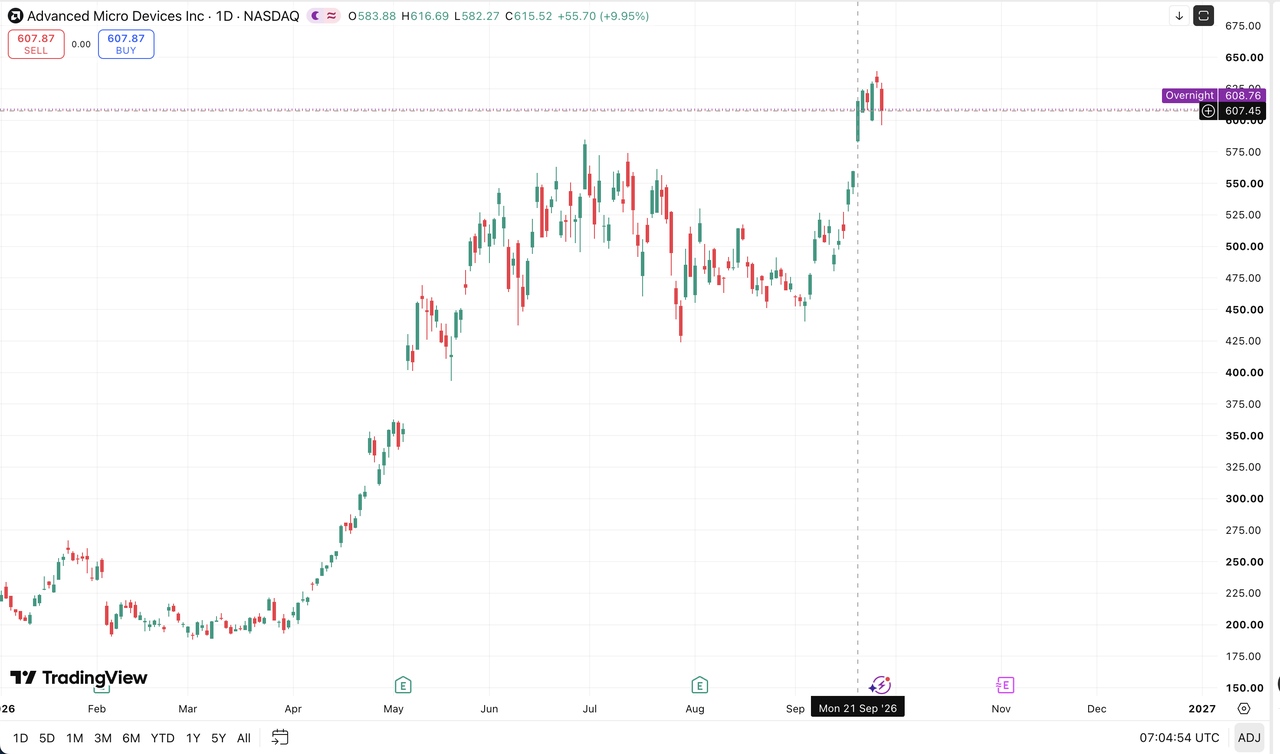
[Source: TradingView]
In the short term, the stock price will still be primarily affected by Instinct orders, data center revenue, and AI customer demand, while World Labs' contribution to the company's near-term performance remains difficult to assess.
If World Labs' technology is successfully adapted to the Instinct and ROCm platforms and adopted by robotics and industrial customers, the acquisition is expected to expand demand for AMD's chips, software, and systems. If commercialization progresses slowly, newly issued shares, R&D spending, and integration costs may limit profit and valuation growth.
Recommended Articles


