


The Fed Just Hiked Rates for the First Time Since 2023. 3 AI Stocks That Could Feel It Most
Key Points
The FOMC just voted 12-0 to increase the federal funds rate.
This is the first time the Fed has raised rates in over three years.
Several artificial intelligence (AI) hyperscalers have issued debt over the last year.
- 10 stocks we like better than Nvidia ›
The Federal Reserve just did something it hasn't done since July 2023. The Federal Open Market Committee (FOMC) voted 12-0 to raise the federal funds rate by a quarter point, to a range of 3.75% to 4%. New Chairman Kevin Warsh framed the move as overdue: Inflation remains too high, and the committee wants a faster path back to its long-term goal of 2%.
Rising interest rates matter for the artificial intelligence (AI) infrastructure boom because the build-out is no longer a cash-only story. The hyperscalers building data centers and buying chips have been flooding the bond market over the last year. A rate hike does not bankrupt big tech, but it does change the math on the next megawatt and the next graphics processing unit cluster.
Missed AI’s "Act 1"? Act 2 Could Be 15x Bigger. Most investors think they missed the AI boat because they didn't buy Nvidia in 2005. But according to our analysts, we’re only at the end of "Act 1"—the R&D phase. "Act 2" is the global rollout. Continue »
Three names capture the split. Nvidia (NASDAQ: NVDA) is printing cash, while Oracle (NYSE: ORCL) is burning it like there's no tomorrow. Meanwhile, Amazon (NASDAQ: AMZN) is writing an enormous check and will need to keep tapping the market to pay for its data centers.
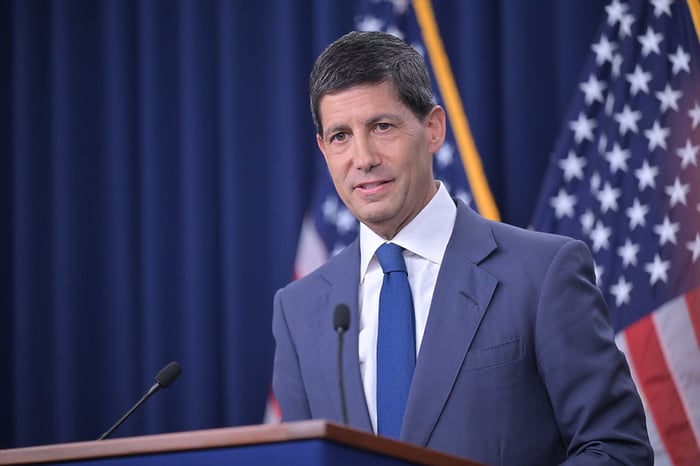
Fed Chairman Kevin Warsh. Image source: Official Federal Reserve Photo.
Nvidia has enough cash, but it may have a customer problem
Nvidia sells the chips everyone else is financing. The company's balance sheet is a fortress and clearly illustrates why the company can survive with higher interest rates better than AI builders can. During the first half of Nvidia's current fiscal year, it generated about $74 billion in operating cash flow and nearly $70 billion in free cash flow. Meanwhile, capital spending was only about $4.4 billion. This is the opposite of a hyperscaler problem: Nvidia is in a position where cash shows up before the cement trucks do.
This does not mean Nvidia is not vulnerable to the bond market. In June, the company issued $25 billion of unsecured senior notes to fund general corporate purposes. The company's long-term debt jumped to $32 billion by the end of the second quarter, up from about $7.5 billion at the start of the year. With nearly $100 billion in cash and marketable debt and equity securities, Nvidia can easily cover its debt load and continue buying back stock.
Where the new rate hike really hits Nvidia is through its customers. If hyperscalers like Oracle and Amazon have to pay more to borrow, they could delay purchasing additional racks. In turn, this quietly brings demand-side risk to Nvidia's data center empire, not a coupon it cannot service.
Oracle's balance sheet faces a stress test
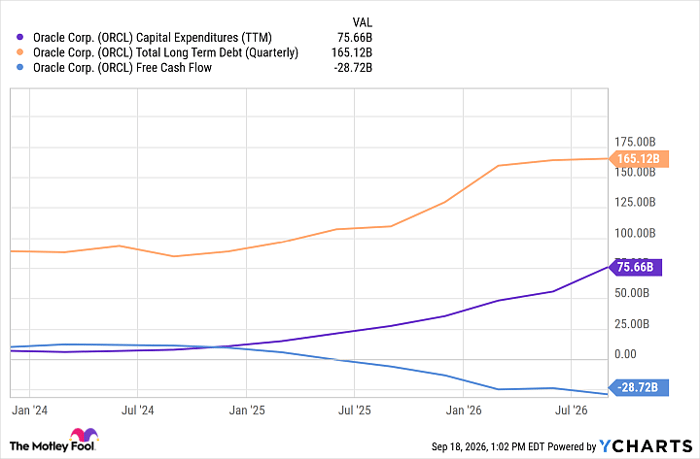
During its fiscal 2026, which ended May 31, Oracle's capital expenditures (capex) surged to about $55.7 billion. While operating cash flow came in at a record $32 billion, hefty infrastructure costs turned free cash flow to negative $24 billion.
To bridge its liquidity needs, Oracle raised $43 billion of debt and $5 billion of equity. On top of that, management guided for another $40 billion of debt and equity in fiscal 2027. S&P Global rates Oracle's credit at BBB-, one notch above junk bonds.
Data by YCharts.
Another subtle risk with Oracle is that a large portion of its backlog is tied to OpenAI. This makes the story even tighter because Oracle's infrastructure spending is front-loaded, while the payoff is concentrated and not guaranteed, given OpenAI's own cash burn. When you also consider that new money is more expensive, Oracle's financing activities begin to look disquieting.
Amazon is writing a huge check into a tighter market
Amazon is just a larger-scale version of Oracle's same problem. During Amazon's second-quarter earnings call, CEO Andy Jassy told investors the company is now guiding toward $220 billion of capex in 2026 -- up from a prior estimate of $200 billion and the highest among the hyperscalers.
In March, Amazon issued roughly $54 billion of bonds across U.S. and European markets. Similar to Oracle, Amazon is crossing the line where capex is eating into cash flow. For the trailing 12 months ended June 30, the company's free cash flow was negative $7.6 billion. Over the summer, Amazon raised an additional $25 billion in debt through an eight-part bond offering.
While the company still boasts a flagship e-commerce marketplace and can use Amazon Web Services cloud as a growth engine, there is vulnerability around the size and timing of Amazon's debt load.
Rate hikes will not end the AI build-out
According to research from Bank of America, the big five hyperscalers issued $121 billion in debt during 2025. This follows an average of $28 billion per year between 2020 and 2024. At their current pace, Bank of America now forecasts the hyperscalers to raise as much as $175 billion in debt this year.
Do not give in to any fearmongering around rate hikes ending the AI build-out. They won't. However, a more expensive cost of capital will put the builders in check for the time being. Nvidia can still fund the picks and shovels from its cash stockpile, while Amazon should be able to keep borrowing because its franchises are enormous and generally consistently profitable. Oracle is the one that most needs to prove that its contracts can cover the debt it raised.
Should you buy stock in Nvidia right now?
Before you buy stock in Nvidia, consider this:
The Motley Fool Stock Advisor analyst team just identified what they believe are the 10 best stocks for investors to buy now… and Nvidia wasn’t one of them. The 10 stocks that made the cut could produce monster returns in the coming years.
Consider when Netflix made this list on December 17, 2004... if you invested $1,000 at the time of our recommendation, you’d have $387,158!* Or when Nvidia made this list on April 15, 2005... if you invested $1,000 at the time of our recommendation, you’d have $1,365,749!*
Now, it’s worth noting Stock Advisor’s total average return is 932% — a market-crushing outperformance compared to 211% for the S&P 500. Don't miss the latest top 10 list, available with Stock Advisor, and join an investing community built by individual investors for individual investors.
See the 10 stocks »
*Stock Advisor returns as of September 21, 2026.
Bank of America is an advertising partner of Motley Fool Money. Adam Spatacco has positions in Amazon and Nvidia. The Motley Fool has positions in and recommends Amazon, Nvidia, Oracle, and S&P Global. The Motley Fool has a disclosure policy.
Recommended Articles


