


If You Invest $10,000 in This Bond ETF Today, Here's What History Says It Could Deliver in 20 Years
Key Points
The Vanguard Total Bond Market ETF has historically returned around 3% annually since its inception in 2007.
The past two decades have been a more challenging period for bonds.
Bonds play an important role in stabilizing a portfolio and providing income.
- 10 stocks we like better than Vanguard Total Bond Market ETF ›
The Vanguard Bond Market ETF (NASDAQ:BND) is the largest bond ETF with nearly $162.3 billion in assets. If you invested $10,000 into BND today, it could grow into over $18,000 in 20 years, given its historical 3% annualized return since inception (assuming you reinvest your interest payments). That's likely a lot less than you'd earn if you invested the same amount in an S&P 500 index fund. However, bonds are income generators and portfolio stabilizers, not wealth-building tools.
Here's a look at why you might still want to consider investing in this top bond ETF, despite its low historical returns.
Missed AI’s "Act 1"? Act 2 Could Be 15x Bigger. Most investors think they missed the AI boat because they didn't buy Nvidia in 2005. But according to our analysts, we’re only at the end of "Act 1"—the R&D phase. "Act 2" is the global rollout. Continue »

Image source: Getty Images.
A rough stretch for bonds
Vanguard launched BND in early 2007, right before the financial crisis, when interest rates were at their peak:
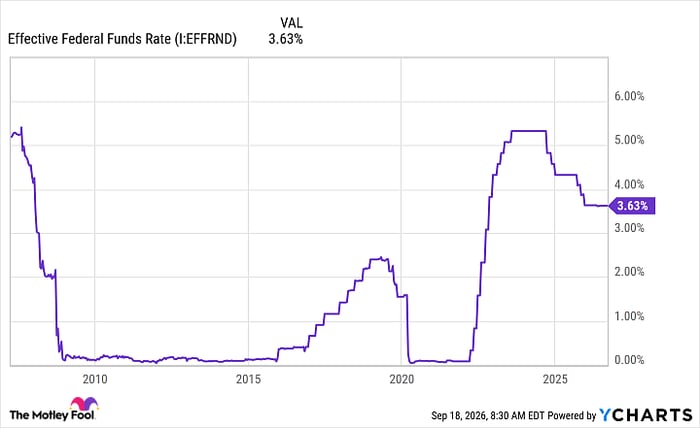
Effective Federal Funds Rate data by YCharts
Changes in rates have a significant impact on bond returns. BND's average annual return is a negative 0.31% over the past five years, which correlates with the post-pandemic plunge in interest rates. However, its returns have averaged 4.05% over the last three years, a period when rates were higher.
This year, rates have been rising due to elevated inflation, high deficit spending, and a surge in debt-funded AI-related capex. Rising rates have weighed on bond values, pushing up current yields.
Why you should still consider investing in BND
While bonds haven't been great investments since BND launched nearly two decades ago, they have still historically played a crucial role in strengthening an investment portfolio. They provide stability and income, help diversify your portfolio, and offer more secure inflation protection than cash. On that previous point, Vanguard has calculated that the average total return of bonds has beaten inflation 71% of the time over the last 50 years, yielding an average after-inflation return of over 3.1% compared to only 0.6% for cash. Meanwhile, bond returns over the last century have averaged 5.2%, according to Vanguard calculations based on Morningstar data. As a result, bonds have historically helped lower an investor's risk while providing a solid base return.
BND makes it easy to invest broadly in the bond market. The fund currently holds over 11,400 bonds from various issuers, led by the U.S. Government (68.9% of its holdings). The fund holds taxable investment-grade U.S. dollar-denominated bonds (it excludes inflation-protected and tax-exempt bonds). The ETF's current holdings have an average effective maturity of 8.2 years and an average yield to maturity of 5%. BND's current annualized yield based on its last monthly interest income payment is 4.85%, roughly aligning with the current yield of its portfolio.
With interest rates rising again, BND should be able to continue rolling lower-yielding bonds at maturity into new, higher-yielding bonds. That suggests it should be able to deliver a higher income yield in the current environment.
BND still deserves a place in a portfolio
Investing in bonds likely won't make you rich. However, they can still help preserve your wealth by serving as a portfolio stabilizer and providing inflation-protected income. That's why investors should consider building a position in a top bond ETF like BND over time. It might not produce the biggest return over the next two decades, but it should help you protect your growing wealth.
Should you buy stock in Vanguard Total Bond Market ETF right now?
Before you buy stock in Vanguard Total Bond Market ETF, consider this:
The Motley Fool Stock Advisor analyst team just identified what they believe are the 10 best stocks for investors to buy now… and Vanguard Total Bond Market ETF wasn’t one of them. The 10 stocks that made the cut could produce monster returns in the coming years.
Consider when Netflix made this list on December 17, 2004... if you invested $1,000 at the time of our recommendation, you’d have $387,158!* Or when Nvidia made this list on April 15, 2005... if you invested $1,000 at the time of our recommendation, you’d have $1,365,749!*
Now, it’s worth noting Stock Advisor’s total average return is 932% — a market-crushing outperformance compared to 211% for the S&P 500. Don't miss the latest top 10 list, available with Stock Advisor, and join an investing community built by individual investors for individual investors.
See the 10 stocks »
*Stock Advisor returns as of September 20, 2026.
Matt DiLallo has positions in Vanguard Total Bond Market ETF. The Motley Fool has positions in and recommends Vanguard Total Bond Market ETF. The Motley Fool has a disclosure policy.
Recommended Articles


