


Social Security's Trump Bump-Led 2027 COLA Would Be the 6th-Largest Raise in 35 Years -- but This Isn't the Full Story
Key Points
Social Security’s highly anticipated 2027 cost-of-living adjustment (COLA) will be revealed on Oct. 14.
Thanks to a pair of President Donald Trump’s policies, Social Security’s 2027 raise should be among the largest since 1993.
Though an outsize Social Security COLA can benefit tens of millions of seniors next year, it can further weaken an already financially compromised retirement program.
- The $23,760 Social Security bonus most retirees completely overlook ›
For a majority of the nearly 55 million retired workers bringing home a monthly Social Security benefit, this income isn't a luxury -- it's a necessity. A quarter-century of annual Gallup surveys shows that 80% to 90% of retirees consistently rely on their Social Security income, in some capacity, to make ends meet.
For retirees, few, if any, announcements are of greater importance than the cost-of-living adjustment (COLA) reveal. Social Security's COLA is the near-annual "raise" given to beneficiaries that's designed to offset the inflation they've faced. When the U.S. Bureau of Labor Statistics publishes the September inflation report on Oct. 14, the Social Security Administration will have the final puzzle needed to calculate and announce the 2027 COLA.
Missed AI’s "Act 1"? Act 2 Could Be 15x Bigger. Most investors think they missed the AI boat because they didn't buy Nvidia in 2005. But according to our analysts, we’re only at the end of "Act 1"—the R&D phase. "Act 2" is the global rollout. Continue »
But make no mistake: This won't be an ordinary raise.

President Trump's policies are directly influencing Social Security's projected 2027 raise. Image source: Official White House Photo by Daniel Torok.
For a second consecutive year, Social Security's cost-of-living adjustment will be privy to a "Trump bump" -- i.e., a boost directly tied to President Donald Trump's policies. While this should result in an outsize benefit increase in 2027, it doesn't tell the full story.
Next year's Social Security raise will be among the largest since 1993
Inflation (rising prices) is normal in an expanding economy. Since America's leading retirement program began using the Consumer Price Index for Urban Wage Earners and Clerical Workers as its inflation-measuring yardstick in 1975, beneficiaries have received a COLA all but three years (2010, 2011, and 2016).
However, inflation has been persistently elevated for years. In May 2026, trailing 12-month inflation reached a three-year high of 4.2%, thanks in large part to two of President Trump's policies.
Firstly, there's the president's tariff and trade policy. In July, the Trump administration reimposed sweeping global tariffs, ranging from 10% to 12.5%, on more than 80 countries. Applying duties to imported, unfinished goods can increase domestic production costs, which are then passed on to consumers.
Secondly, the Trump-led Iran war is fueling higher prices. Shortly after military operations began against Iran on Feb. 28, the latter closed the Strait of Hormuz to virtually all maritime traffic. The largest energy supply disruption in modern history sent fuel prices soaring.
BREAKING: August CPI inflation comes in at 3.4%, in-line with expectations of 3.4%
— The Kobeissi Letter (@KobeissiLetter) September 11, 2026
Core CPI inflation falls to 2.4%, also in-line with expectations of 2.4%.
Month-over-month CPI inflation rose +0.4%, the biggest increase since May 2026.
Treasury yields are rising on the news.
Additionally, we're starting to see evidence, in the form of sticky Core Personal Consumption Expenditures, of Iran-war-driven inflation spilling over into the broader economy. Businesses paying more for petroleum-based goods (e.g., plastics), altering shipping routes, and changing suppliers are resulting in higher consumer prices.
According to independent estimates from The Senior Citizens League (TSCL), a nonpartisan senior advocacy group, and Mary Johnson, a Medicare and Social Security policy analyst, the program's 2027 COLA is projected to be 3.5%.
If TSCL's and Johnson's estimates prove accurate, this would mark a tie for the sixth-largest Social Security raise over the last 35 years, outdone only by COLAs of 4.1% (2006), 5.8% (2009), 3.6% (2012), 5.9% (2022), and 8.7% (2023).
However, a tie for the sixth-largest percentage increase in benefits since 1993 is just part of the story.

Image source: Getty Images.
A temporary silver lining for retirees will be offset by a potential disaster
For tens of millions of retirees, Social Security's Trump bump-led 2027 COLA should provide them with a silver lining that's been missing since 2023.
Close to half of all retirees aged 65 and older are enrolled in traditional Medicare, which consists of Parts A (in-hospital stays), B (outpatient services), and D (prescription drugs). Part B has a standard monthly premium that's usually deducted from a retired worker's monthly Social Security check.
Typically, the year-over-year percentage increase in Medicare's Part B premium is significantly higher than Social Security's COLA. For instance, Social Security raises of 3.2% (2024), 2.5% (2025), and 2.8% (2026) were met by Medicare Part B premium increases of 5.9% (2024), 5.9% (2025), and 9.7% (2026). This rapid rise in Part B's standard premium is offsetting some, or potentially all, of the annual raise retirees have been receiving.
According to the 2026 Medicare Trustees Report, Part B's standard monthly premium is expected to climb by 3.25% to $209.50 in 2027.
If this estimate and independent Social Security COLA projections prove accurate, it would mark the first time since 2023 that Social Security payouts would be climbing by a larger percentage than the Part B premium. For the tens of millions of traditional Medicare enrollees, this silver lining would mean they get to keep more of next year's Social Security COLA.
But there's a downside to this silver lining as well, which potentially affects all current and future beneficiaries.
While beneficiaries certainly enjoy a beefier monthly payout, outsize cost-of-living adjustments threaten to weaken an already financially compromised retirement program.
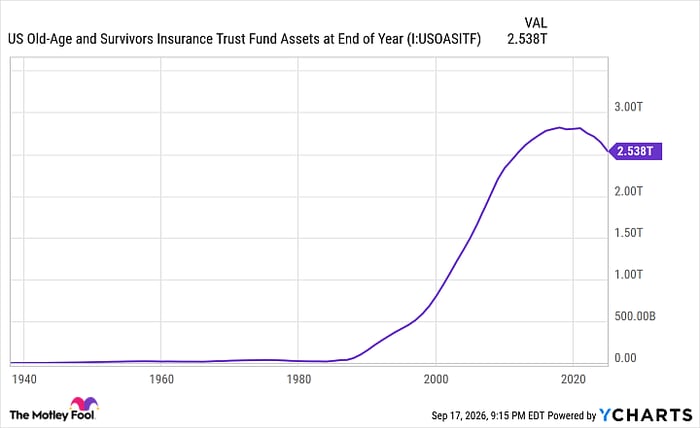
US Old-Age and Survivors Insurance Trust Fund Assets at End of Year data by YCharts
The latest Social Security Board of Trustees Report estimates that the Old-Age and Survivors Insurance trust fund (OASI) will exhaust its asset reserves by the fourth quarter of 2032. The OASI's asset reserves represent the excess income collected since inception that has been invested in special-issue, interest-bearing government bonds, as required by law.
The Trustees' asset reserve depletion projections are modeled using modest annual COLAs. If TSCL's and Johnson's estimates are correct and beneficiaries receive the sixth-largest COLA since 1993, it could drain the OASI's asset reserves even faster than forecast.
The good news is that the OASI doesn't need a penny in its asset reserves to continue doling out monthly payments to retired workers and survivors of deceased workers. However, if this excess income is fully depleted, it could lead to sweeping benefit cuts of up to 22%. Social Security's Trump bumps threaten to accelerate the timeline to this projected exhaustion.
The $23,760 Social Security bonus most retirees completely overlook
If you're like most Americans, you're a few years (or more) behind on your retirement savings. But a handful of little-known "Social Security secrets" could help ensure a boost in your retirement income.
One easy trick could pay you as much as $23,760 more... each year! Once you learn how to maximize your Social Security benefits, we think you could retire confidently with the peace of mind we're all after. Join Stock Advisor to learn more about these strategies.
View the "Social Security secrets" »
The Motley Fool has a disclosure policy.
Recommended Articles


