


The S&P 500 Yields Just 1.1% While 10-Year Treasury Yields Have Surged to 5%. This Dividend Stock Provides a Middle Ground for Long-Term Investors.
Key Points
Coca-Cola's yield is almost halfway between that of the 10-year U.S. Treasury and the S&P 500.
The stock is a Dividend King.
It may also provide investors with protection against rising interest rates.
- 10 stocks we like better than Coca-Cola ›
Investors today could be forgiven for feeling as though they're back in driver's education class, because they're sure hearing a lot about yield these days.
While the average dividend yield on the S&P 500 is hovering around 1.1%, it hit an all-time low of 1.04% last month. Conversely, yields on 10-year Treasuries briefly nudged above 5% this month before retreating modestly. As of Friday midday, they were at almost precisely 5%. The point is that stock prices are rising, forcing their dividend yields down, while bond prices are faltering, boosting those securities' yields in the process.
Missed AI’s "Act 1"? Act 2 Could Be 15x Bigger. Most investors think they missed the AI boat because they didn't buy Nvidia in 2005. But according to our analysts, we’re only at the end of "Act 1"—the R&D phase. "Act 2" is the global rollout. Continue »
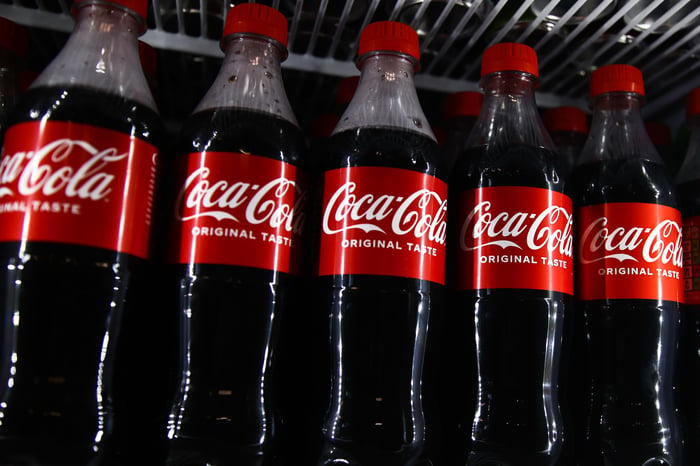
Image source: Getty Images
Market participants looking for a middle ground between high Treasury yields and the barely visible yield on the S&P 500 have a few options to consider, including such familiar fare as Coca-Cola (NYSE: KO).
Not too hot, not too cold
Coca-Cola has maintained a 65-year streak of annual payout hikes, making it a Dividend King -- one of just a few dozen companies that have raised dividends for 50 consecutive years or more. That's an interesting historical footnote, and one that's not lost on the company, which takes yearly payout increases quite seriously.
But in yield terms, Coca-Cola is in fact "Goldilocks," and that's a good thing. Obviously, Coke's 2.5% dividend yield puts the S&P 500 to shame, but in context, it's also attractive compared to nearly 5% yields on 10-year Treasuries.
First, although it's one of the largest consumer staples companies by market cap, implying it's a defensive stock (it is), Coke offers more long-term appreciation potential than U.S. government bonds.
Second, the Federal Reserve may have one more federal funds rate hike left in its pocket this year. Expectations of further tightening could weigh on Treasury prices, sending yields higher. If that happens, investors who like 10-year Treasuries at nearly 5% may be forced to fall in love at north of that percentage.
That scenario is less of a concern when owning Coca-Cola. In fact, history confirms that defensive sectors, namely consumer staples and healthcare, often perform well during periods of rising interest rates.
Coca-Cola showing confidence
If Coca-Cola were a peacock, it'd have every right to flash its feathers, because the stock is up 26% year to date, confirming that it's delivering in the current economic environment. Alone, that should be important to investors, but the company is displaying confidence in other ways.
On Wednesday, Sept. 15, Coca-Cola announced that its bottlers and other members of the broader Coke U.S. ecosystem are planning $10 billion in domestic spending starting this year through 2030. Often, companies rein in spending when interest rates climb because it moves their cost of capital higher.
Yet Coca-Cola stock barely moved on the news, suggesting the market didn't think much of it, but that confidence shouldn't be ignored; it may be a sign that, with a 2.5% dividend yield, Coca-Cola is a better long-term bet than 10-year Treasuries, even at 5%.
Should you buy stock in Coca-Cola right now?
Before you buy stock in Coca-Cola, consider this:
The Motley Fool Stock Advisor analyst team just identified what they believe are the 10 best stocks for investors to buy now… and Coca-Cola wasn’t one of them. The 10 stocks that made the cut could produce monster returns in the coming years.
Consider when Netflix made this list on December 17, 2004... if you invested $1,000 at the time of our recommendation, you’d have $387,158!* Or when Nvidia made this list on April 15, 2005... if you invested $1,000 at the time of our recommendation, you’d have $1,365,749!*
Now, it’s worth noting Stock Advisor’s total average return is 932% — a market-crushing outperformance compared to 211% for the S&P 500. Don't miss the latest top 10 list, available with Stock Advisor, and join an investing community built by individual investors for individual investors.
See the 10 stocks »
*Stock Advisor returns as of September 19, 2026.
Todd Shriber has no position in any of the stocks mentioned. The Motley Fool has no position in any of the stocks mentioned. The Motley Fool has a disclosure policy.
Recommended Articles


