


Boeing Isn't Perfect -- but It's Still a Compelling Value Buy Right Now
Key Points
Boeing trades at a valuation discount versus peers, especially after 2028.
Recent management actions are addressing operational and supply chain issues.
Execution on Boeing’s backlog is not a given, but it is a major opportunity to generate value for investors.
- 10 stocks we like better than Boeing ›
Boeing (NYSE: BA) stock presents a rare value in the aerospace sector right now. Commercial aerospace-focused stocks tend to command premium valuations because the market prices in a long-term stream of income coming from a combination of lucrative aftermarket services and the surety of massive commercial aircraft backlogs at Boeing and Airbus.
However, the valuation discount makes it appear attractive to value-oriented investors. Here's why.
Missed AI’s "Act 1"? Act 2 Could Be 15x Bigger. Most investors think they missed the AI boat because they didn't buy Nvidia in 2005. But according to our analysts, we’re only at the end of "Act 1"—the R&D phase. "Act 2" is the global rollout. Continue »
Boeing's valuation discount
The table shows price-to-free cash flow (FCF) valuations based on the Wall Street consensus from Visible Alpha.
|
Price to Free Cash Flow |
2025 |
2026 |
2027 |
2028 |
2029 |
2030 |
|---|---|---|---|---|---|---|
|
The Boeing Company |
NM |
66.6x |
27.3x |
17.1x |
13.8x |
11.6x |
|
GE Aerospace |
42.8x |
35.3x |
31.3x |
28.3x |
25.9x |
23.1x |
|
Howmet Aerospace |
58.2x |
46.6x |
38.6x |
32.5x |
28.6x |
26.5x |
|
Hexcel |
37.6x |
33.4x |
25.7x |
21.6x |
18.2x |
16.8x |
|
RTX |
31.3x |
30.6x |
26.1x |
23.0x |
20.5x |
18.7x |
Data source: Visible Alpha. Chart by author.
The clear discount beyond 2028 then leads to an almost philosophical question: If Boeing and Airbus aircraft are the starting point of the commercial aerospace industry and Boeing's current backlog of more than 6,200 airplanes (worth $597 billion) is a large part of the rationale for buying aerospace stocks, why does Boeing deserve such a valuation discount?
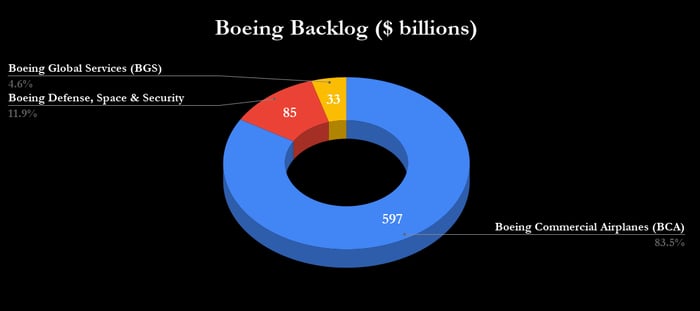
Data source: Boeing presentations. Chart by author.
The answer lies in the much-maligned, high-profile 737 MAX quality issues and groundings, as well as delays in commercial aircraft certifications and massive losses on fixed-price development programs in its defense arm, Boeing Defense, Space & Security (BDS). Simply put, Boeing needs to convince investors that its worst days are behind it and that it can execute to meet the numbers implied by the valuations above for 2028 and beyond.
CEO Kelly Ortberg is turning the company around
The good news is there are signs of progress.
First, having started 2025 with 737 MAX production in the low 30s per month, CEO Kelly Ortberg said in July that Boeing is "now ramping to 47 airplanes per month" and that a production line in Everett, Washington, will be opened to reach 52 per month in the future.
Ortberg recently spoke at a Morgan Stanley conference, saying, "We are not stable yet at 47 a month," which is a little disappointing. On a more positive note, he confirmed that the new production line in Everett is now open. Moreover, Ortberg believes certification on the 737 MAX 10 (an aircraft likely to compete with the hugely successful Airbus A321) is coming very soon.

Image source: Getty Images.
Second, the acquisition of Spirit AeroSystems in December 2025 has derisked its supply chain for fuselages and other components for the 737 MAX, 777, and 787 Dreamliner.
Third, the issues at BDS primarily relate to a few problematic fixed-price development programs (KC-46 Tanker and Air Force One among them), which the company is working through (the rest of the business is profitable). The company is on track to return to profitability at BDS in 2026.
Finally, Boeing's sale of its electric vertical takeoff and landing (eVTOL) business, Wisk, to Archer Aviation helps to focus Boeing on its core business.
A stock to buy?
When you put these things together, it's clear that Ortberg is making progress at Boeing, and the enduring opportunity to execute on its massive backlog underpins the stock's valuation case.
Should you buy stock in Boeing right now?
Before you buy stock in Boeing, consider this:
The Motley Fool Stock Advisor analyst team just identified what they believe are the 10 best stocks for investors to buy now… and Boeing wasn’t one of them. The 10 stocks that made the cut could produce monster returns in the coming years.
Consider when Netflix made this list on December 17, 2004... if you invested $1,000 at the time of our recommendation, you’d have $387,158!* Or when Nvidia made this list on April 15, 2005... if you invested $1,000 at the time of our recommendation, you’d have $1,365,749!*
Now, it’s worth noting Stock Advisor’s total average return is 932% — a market-crushing outperformance compared to 211% for the S&P 500. Don't miss the latest top 10 list, available with Stock Advisor, and join an investing community built by individual investors for individual investors.
See the 10 stocks »
*Stock Advisor returns as of September 19, 2026.
Lee Samaha has no position in any of the stocks mentioned. The Motley Fool has positions in and recommends Boeing, GE Aerospace, Howmet Aerospace, and RTX. The Motley Fool recommends Hexcel. The Motley Fool has a disclosure policy.
Recommended Articles


