


What History Reveals About Investing Through a Stock Market Crash
Key Points
The S&P 500 lost over 40% of its value during the dot-com crash.
The S&P 500 lost over 50% of its value during the Great Recession.
Those massive declines are barely noticeable today.
- 10 stocks we like better than Vanguard S&P 500 ETF ›
Wall Street pays a huge amount of attention to the price movements of the S&P 500 index (SNPINDEX: ^GSPC). If stocks are in a bull market, everyone wants to know when the next bear market will arrive. If there's a bear market, everyone keeps an eye out for the sign that the next bull market has come along. History shows you should ignore Wall Street and focus on a long-term plan of saving and investing, no matter what the market is doing.
Just buy the S&P 500 and keep buying it
World-famous investor and Wall Street icon Warren Buffett has often said that most investors would be better off buying an S&P 500 index fund, such as SPDR S&P 500 Trust (NYSEMKT: SPY) or Vanguard S&P 500 ETF (NYSEMKT: VOO), than trying to buy individual stocks. The real purpose of this is to create a simple, diversified portfolio that allows the investor to focus their attention on saving money and, frankly, living a happy life.
Missed AI’s "Act 1"? Act 2 Could Be 15x Bigger. Most investors think they missed the AI boat because they didn't buy Nvidia in 2005. But according to our analysts, we’re only at the end of "Act 1"—the R&D phase. "Act 2" is the global rollout. Continue »

Image source: Getty Images.
That said, a key part of Buffett's investment advice is that you should keep buying the S&P 500 no matter what is happening with the market. That's called dollar-cost averaging. You should also reinvest your dividends, which allows the dividends to compound over time. Both are simple, but powerful wealth-building tools.
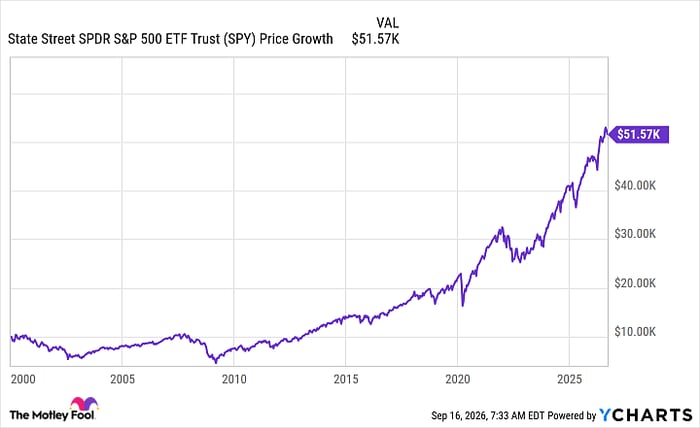
SPY data by YCharts
The proof of this approach is shown in the graph above. A $10,000 investment in SPDR S&P 500 ETF right before the dot-com bubble burst, leading to an over 40% market drawdown, would be worth over $50,000 as of this writing. That bear market is just a blip today.
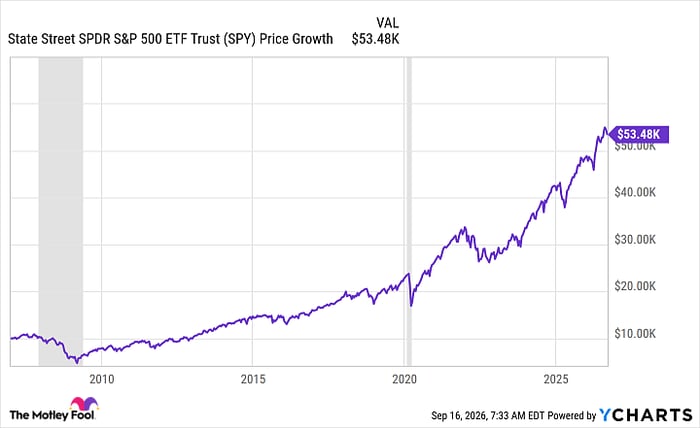
SPY data by YCharts
The same story holds true if you had bought just before the Great Recession, when the market fell by over 50%. A $10k investment just before that painful drop would also be worth more than $50,000. That drop is barely a blip today, as well.
The one caveat here is that the market basically went sideways between the dot-com crash and the Great Recession. Falling into a bear market again soon after recovering from the previous bear market. But stocks do that sometimes. Over very long periods, the S&P 500 index has tended to trend higher in a jagged pattern, building wealth for investors who keep saving and investing through both bear markets and bull markets.
You don't have to buy the S&P 500 to benefit
Buying the S&P 500 index is a simple and powerful long-term investment plan. However, some people prefer to follow different approaches. But the S&P 500's history is still informative. The real takeaway is to create an investment approach you can stick to through thick and thin, and then keep following it regardless of whether or not there's a bull or bear market. Or, to simplify that a bit, the S&P 500's history reveals that most investors should buy and hold for the long term.
Should you buy stock in Vanguard S&P 500 ETF right now?
Before you buy stock in Vanguard S&P 500 ETF, consider this:
The Motley Fool Stock Advisor analyst team just identified what they believe are the 10 best stocks for investors to buy now… and Vanguard S&P 500 ETF wasn’t one of them. The 10 stocks that made the cut could produce monster returns in the coming years.
Consider when Netflix made this list on December 17, 2004... if you invested $1,000 at the time of our recommendation, you’d have $406,141!* Or when Nvidia made this list on April 15, 2005... if you invested $1,000 at the time of our recommendation, you’d have $1,347,745!*
Now, it’s worth noting Stock Advisor’s total average return is 940% — a market-crushing outperformance compared to 211% for the S&P 500. Don't miss the latest top 10 list, available with Stock Advisor, and join an investing community built by individual investors for individual investors.
See the 10 stocks »
*Stock Advisor returns as of September 19, 2026.
Reuben Gregg Brewer has no position in any of the stocks mentioned. The Motley Fool has positions in and recommends Vanguard S&P 500 ETF. The Motley Fool has a disclosure policy.
Recommended Articles


