


2 Growth Stocks I Plan to Buy if the Stock Market Crashes
Key Points
The S&P 500 index is approaching its highest-ever valuation, which could make it vulnerable to a correction.
A number of headwinds could derail the bull market, including soaring oil prices and elevated inflation.
But the S&P 500 has always trended higher over the long term, so I'll be buying stocks if the index plummets.
- 10 stocks we like better than DigitalOcean ›
At the close of trading on Tuesday, Sept. 15, the benchmark S&P 500 stock market index had a Shiller Cyclically Adjusted Price-to-Earnings (CAPE) ratio of 40.3, its second-highest valuation since the peak of the dot-com internet bubble in 2000. Meanwhile, risks are quickly mounting.
Oil prices are currently soaring due to the ongoing geopolitical tensions in the Middle East, placing upward pressure on inflation and global interest rates. Moreover, start-ups like Anthropic, OpenAI, and xAI are calling for a slowdown in the pace of artificial intelligence (AI) development, which could derail high-growth sectors like semiconductors. To top things off, the midterm congressional elections are coming up in November, which could be another source of market volatility.
Missed Nvidia in 2009? This Rare Signal Is Flashing Again. In 2009, a "Double Down" signal flashed for a little-known chipmaker called Nvidia. For the first time in years, that same "Total Conviction" signal is flashing for a company 1/100th the size of Nvidia. Continue »
With all that said, the S&P 500 has trended higher over the long term, so I'll be looking for buying opportunities if the aforementioned headwinds cause a crash. Here are two stocks I'd like to scoop up at a discount.

Image source: Getty Images.
The first stock I plan to buy: DigitalOcean
DigitalOcean (NYSE: DOCN) provides cloud services, but unlike its much larger competitors, such as Amazon Web Services and Microsoft Azure, it primarily targets small and mid-sized (SMB) enterprise customers. It offers them clear, transparent pricing, highly personalized support, and a simple platform that makes deployment easy, even for enterprises without in-house technical teams.
The company is now applying that blueprint to its growing portfolio of AI products and services. It offers these through a new platform called AI-Native Cloud, which features five distinct layers to help enterprises deploy AI software. The infrastructure layer sits at the foundation: DigitalOcean now operates 20 data centers equipped with specialized chips from suppliers like Nvidia and Advanced Micro Devices, and it leases the computing capacity to its customers.
Another key layer is the inference engine, where customers can tap into foundation models from developers, such as OpenAI and Anthropic, in addition to over 70 open-source models. Using these models and the computing capacity from the infrastructure layer, enterprises can rapidly build and deploy AI agents, chatbots, and other applications.
DigitalOcean had $1.1 billion in annual recurring revenue (ARR) as of June 30. AI customers accounted for $234 million of that total, a staggering 212% increase from the same time last year. The company's order backlog from customers who are waiting for more data centers to come online was also $894 million as of June 30, a 12-fold increase from the year-ago period. That suggests even faster AI revenue growth might be on the horizon.
Its stock looks like a great investment based on those numbers alone, but valuation matters. Its shares currently sport a price-to-sales (P/S) ratio of 13.2, which far exceeds its long-term average of 8.6 since going public in 2021. I would be a buyer near the average because of the AI growth this company has in the pipeline, so I will wait and see if a broad market correction presents me with an opportunity.
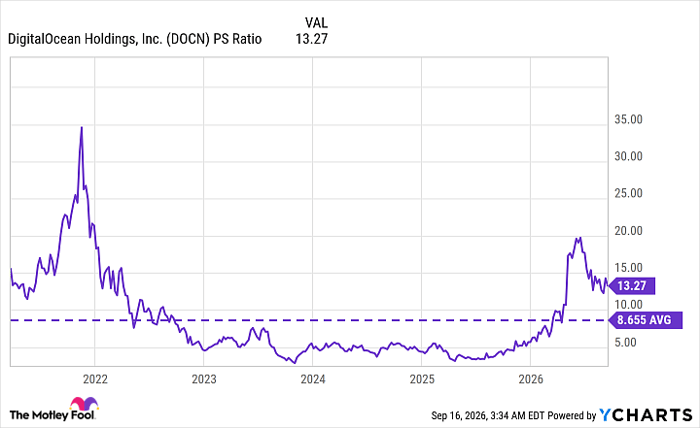
DOCN PS Ratio data by YCharts
The second stock I plan to buy: Lemonade
Lemonade (NYSE: LMND) offers homeowners, renters, life, pet, and car insurance to over 3.3 million customers across the U.S. and Europe. But it separates itself from traditional insurers by placing AI at the center of its business. For example, a prospective customer can get a quote from Lemonade in under 90 seconds via the Maya chatbot on its website, and a separate AI assistant, Jim, can process claims in just a few seconds without human intervention.
The insurer also uses AI to calculate premiums and manage its operations, resulting in a high degree of efficiency. During the second quarter of 2026, the company's loss adjustment expense (LAE) ratio fell to a record low of 5%, nearly half the industry average of 9%. The LAE ratio measures the percentage of premiums an insurer spends on handling claims (the lower the better), so 5% is very efficient.
Lemonade had over $1.4 billion of in-force premiums (IFP) at the end of the second quarter of 2026, representing the value of the premiums from all active policies. That figure grew by 32% year over year. And thanks to the company's low gross loss ratio of 60% (the percentage of premiums paid out as claims), its revenue soared by 79% year over year to $294.4 million.
But Lemonade's growth story is still in the early stages, because management believes the company's IFP could grow by 600% to $10 billion by 2034. Its stock is already relatively inexpensive because its P/S ratio of 4.3 is actually lower than its three-year average of 5.3, so a broad market correction could present investors with a golden long-term buying opportunity.
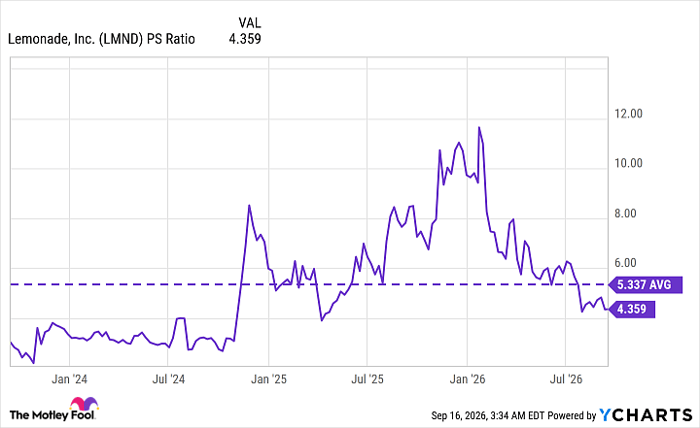
LMND PS Ratio data by YCharts
As a result, Lemonade stock is very high on my watch list right now.
Should you buy stock in DigitalOcean right now?
Before you buy stock in DigitalOcean, consider this:
The Motley Fool Stock Advisor analyst team just identified what they believe are the 10 best stocks for investors to buy now… and DigitalOcean wasn’t one of them. The 10 stocks that made the cut could produce monster returns in the coming years.
Consider when Netflix made this list on December 17, 2004... if you invested $1,000 at the time of our recommendation, you’d have $406,141!* Or when Nvidia made this list on April 15, 2005... if you invested $1,000 at the time of our recommendation, you’d have $1,347,745!*
Now, it’s worth noting Stock Advisor’s total average return is 940% — a market-crushing outperformance compared to 211% for the S&P 500. Don't miss the latest top 10 list, available with Stock Advisor, and join an investing community built by individual investors for individual investors.
See the 10 stocks »
*Stock Advisor returns as of September 18, 2026.
Anthony Di Pizio has no position in any of the stocks mentioned. The Motley Fool has positions in and recommends Advanced Micro Devices, Amazon, DigitalOcean, Lemonade, Microsoft, and Nvidia. The Motley Fool has a disclosure policy.
Recommended Articles


