


South Korean Deputy Prime Minister Bae Kyung-hoon Opposes Slowing AI Development, Says Nation Has No Room to Slow Down
TradingKey - During the Asian trading session on September 16, South Korea's Deputy Prime Minister and Minister of Science and ICT, Bae Kyung-hoon, stated that South Korea will not slow its pace of AI research and development. He advocated replacing mere speed control with 'responsible speed,' strengthening safety management while advancing R&D and industrial applications.
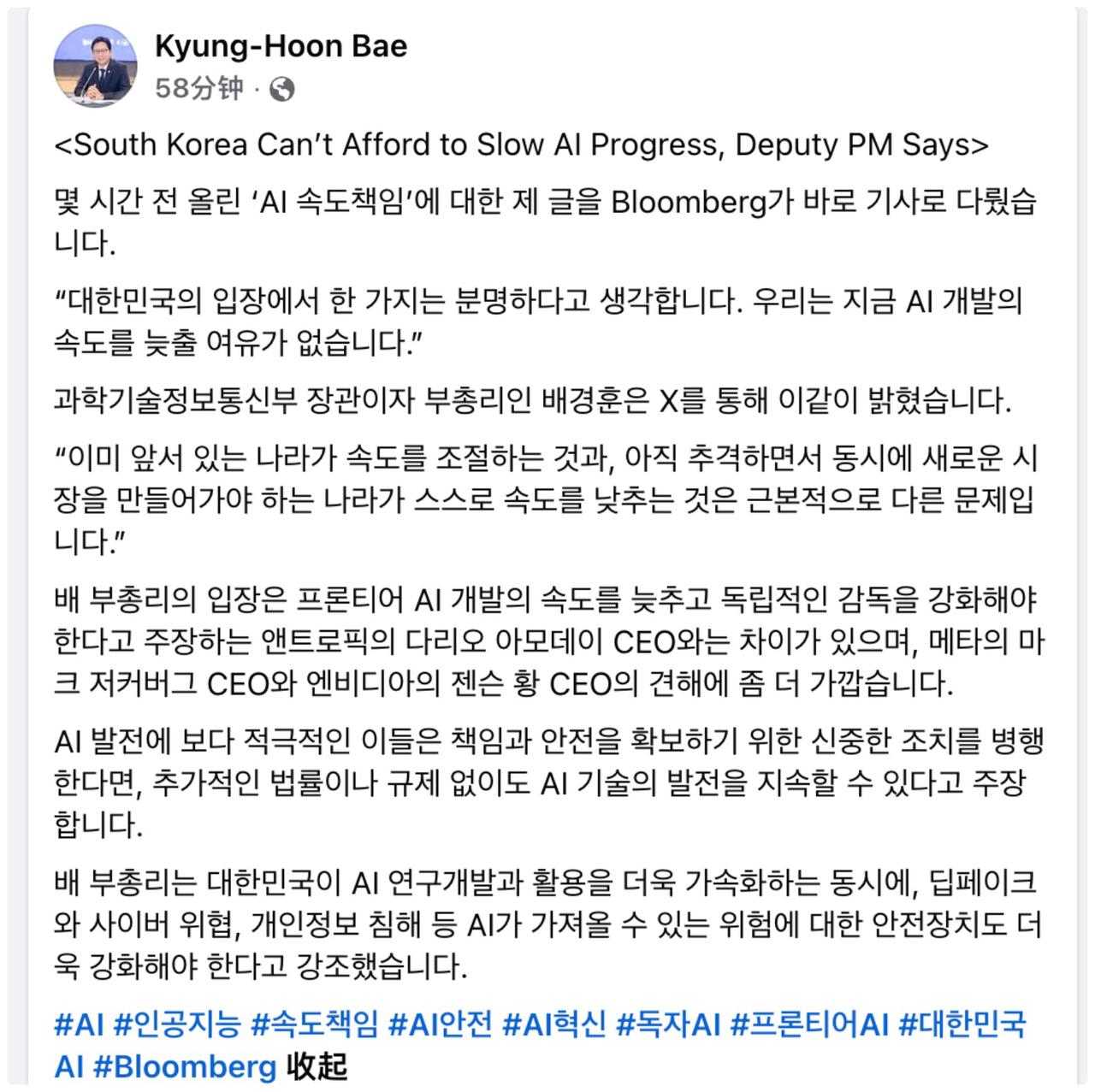
[Source: Facebook]
Bae Kyung-hoon believes that leading technology nations proactively adjusting their R&D pace has a different impact than South Korea voluntarily slowing down during its catch-up phase. He added that beyond sovereign AI foundation models, South Korea also needs to develop vision-language models and vision-language-action models capable of observing, understanding, and executing tasks.
The South Korean government will continue to advance sovereign AI foundation models and prepare frontier AI model projects, with specific development directions to be announced in the near future.
Maintaining R&D momentum is also reflected in computing power investments. As Upstage, SK Telecom, and LG AI Research advance to the next round of the sovereign AI foundation model project, the government plans to increase the supply of Nvidia B200 GPUs from approximately 768 units in the first half of 2026 to around 1,000 units in the second half.
Meanwhile, South Korea continues to press ahead with AI safety regulation. The Basic Act on Artificial Intelligence, taking effect on January 22, 2026, specifies transparency requirements for generative AI, obligations for high-impact AI operators, and safety duties for AI systems meeting statutory standards.
The law provides a grace period of at least one year, during which fact-finding investigations and penalties will in principle be suspended, except for incidents resulting in deaths, human rights violations, or other severe social harms.
Bae's remarks respond to recent debates surrounding the pace of frontier AI development. Anthropic CEO Dario Amodei advocates controlling the speed at which frontier model capabilities advance; OpenAI CEO Sam Altman supports introducing independent evaluation mechanisms, and Musk has also expressed support for Amodei's call.
Nvidia (NVDA) CEO Jensen Huang opposes a uniform slowdown in AI development. Speaking at the Dreamforce conference on September 15, he stated that development speed does not conflict with product safety; companies should accelerate technical R&D, but should not release products when functionality and safety cannot be verified. Huang views AI safety as an engineering problem and opposes introducing new laws or regulatory measures for it.
Based on the policies announced by the South Korean government so far, its stance is closer to continuing to accelerate R&D while simultaneously enhancing safety safeguards: the government will make sustained investments in models and computing infrastructure, while managing related risks through the Basic Act on Artificial Intelligence.
Recommended Articles


