


Investors Just Got a Reality Check From Fed Chair Kevin Warsh. History Says This 1 Move Is Crucial Right Now.
Key Points
Fed Chair Kevin Warsh has repeatedly signaled that more action to control inflation is likely.
Rate hikes will have the effect of making money market funds yield slightly more.
But, they still won't be a good place to store your capital to protect it from inflation.
- 10 stocks we like better than S&P 500 Index ›
The new Federal Reserve Chair Kevin Warsh gave investors a stern warning on Aug. 28 at a symposium in Jackson Hole, stating that "price stability is not self-executing, nor is inflation necessarily mean-reverting." In doing so, he dumped a bucket of cold water onto the market, dispelling some illusions about the Fed's commitment to controlling inflation by increasing the federal funds rate. Since then, the S&P 500 (SNPINDEX: ^GSPC) has been flat, awaiting the central bank's next decision on whether or not to hike rates, which we'll know on Sept. 16; right now a hike looks like the most likely outcome.
Rate hikes could pose a bit of a problem for the nearly $8 trillion that's parked in U.S. money market funds as of Sept. 10. Nearly all investors use such funds, and history says that there's one move in particular that's crucial to do if you're one of them.
Missed Nvidia in 2009? This Rare Signal Is Flashing Again. In 2009, a "Double Down" signal flashed for a little-known chipmaker called Nvidia. For the first time in years, that same "Total Conviction" signal is flashing for a company 1/100th the size of Nvidia. Continue »
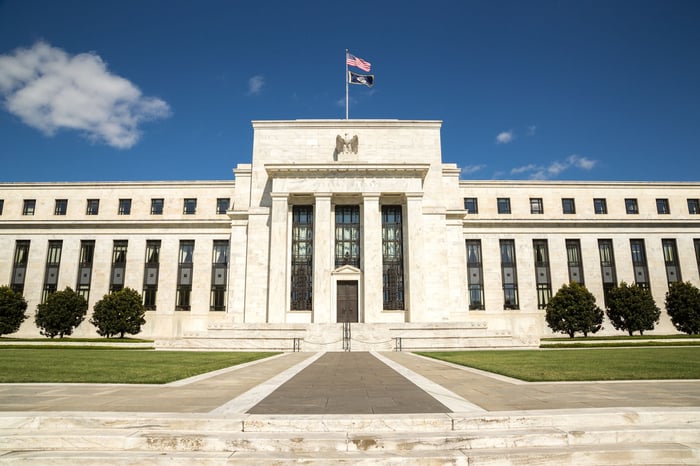
Image source: Getty Images.
Cash equivalents aren't yielding as much as inflation
All of the biggest money market funds have an average annualized yield of nearly 3.5% as of mid-August.
But, against inflation that's running at 3.7% annually per the Fed's own data, the yield generated by money market funds is losing ground to inflation before even opening the discussion about the taxes on their interest.
Interest from the money market funds is taxed as ordinary income. So, anyone screening for investments that outrun rising prices can remove money funds from the list even if the Fed hiking rates by 0.25% is very probable in the near term.
The synthesis of this information is that the crucial move for your portfolio to have a shot at beating inflation is to allocate your capital into assets which grow substantially faster than the yield on money market funds.
The stock market is the most obvious place to find those assets.
Did stocks actually beat inflation historically?
It's necessary to transition away from holding a lot of cash given the elevated inflation and the Fed's stated commitment to fighting it, but it might not be sufficient.
The selection of stocks matters quite a bit; riskier stocks, especially in tech, tend to be more sensitive to rising interest rates because it means they'll need to pay more to borrow the money they need to grow. Investing in index funds is, based on the historical data, a mediocre solution. It still beats staying in cash.
Per data compiled by the illustrious NYU Stern professor Aswath Damodaran, the S&P 500 returned about 5.9% a year from 1970 through 1979, the last major inflationary epoch before the current one, while three-month Treasury bills returned 6.3% on an annualized basis in the same period. Consumer prices increased by 7.1% annually during that time, so owning the index wouldn't have helped much, and money market funds would have lost ground too.
But don't take the outperformance of cash equivalents in that stretch as being evidence that cash is worth holding in large sums on the off chance that it could hold up against inflation under the right circumstances.
In the following period, from 1980 to 1989, the S&P 500 returned 17.3% a year while three-month Treasury bills returned 9%, with inflation at 5.5%.
Whoever got tired of seeing their stocks underperform and rotated into cash in 1974 collected the damage and skipped the recovery.
The lesson is to avoid sitting in cash while you wait for the Fed to win its fight with inflation. As long as inflation is elevated, cash feels safer, but it may just denominate your losses in lost purchasing power rather than in underwater asset prices.
Should you buy stock in S&P 500 Index right now?
Before you buy stock in S&P 500 Index, consider this:
The Motley Fool Stock Advisor analyst team just identified what they believe are the 10 best stocks for investors to buy now… and S&P 500 Index wasn’t one of them. The 10 stocks that made the cut could produce monster returns in the coming years.
Consider when Netflix made this list on December 17, 2004... if you invested $1,000 at the time of our recommendation, you’d have $417,413!* Or when Nvidia made this list on April 15, 2005... if you invested $1,000 at the time of our recommendation, you’d have $1,341,294!*
Now, it’s worth noting Stock Advisor’s total average return is 950% — a market-crushing outperformance compared to 210% for the S&P 500. Don't miss the latest top 10 list, available with Stock Advisor, and join an investing community built by individual investors for individual investors.
See the 10 stocks »
*Stock Advisor returns as of September 13, 2026.
Alex Carchidi has no position in any of the stocks mentioned. The Motley Fool has no position in any of the stocks mentioned. The Motley Fool has a disclosure policy.
Recommended Articles


