


Prediction: Marvell Technology Stock Will Jump 150% in 5 Years. Here’s the Math.
Key Points
Investors pressed the panic button after Marvell Technology's latest quarterly report.
The semiconductor specialist, however, anticipates stronger growth due to its expanding influence in AI chips.
Marvell can sustain healthy earnings growth for the next five years, paving the way for a big jump in its stock price.
- 10 stocks we like better than Marvell Technology ›
Marvell Technology (NASDAQ:MRVL) is emerging as a key player in the artificial intelligence (AI) semiconductor ecosystem. The company designs application-specific integrated circuits (ASICs) and networking components, and that explains why it has been clocking impressive growth in recent quarters.
Marvell Technology released its fiscal 2027 second-quarter results (for the three months ended Aug. 1) on Aug. 27. The stock fell as Wall Street wasn't pleased with the company's outlook for next year. It is worth noting that Marvell stock has pulled back 26% from the 52-week high it reached in mid-June.
Missed Nvidia in 2009? This Rare Signal Is Flashing Again. In 2009, a "Double Down" signal flashed for a little-known chipmaker called Nvidia. For the first time in years, that same "Total Conviction" signal is flashing for a company 1/100th the size of Nvidia. Continue »
I think that the recent slide in this semiconductor stock is a buying opportunity for savvy investors. After all, Marvell's growth rate is poised to accelerate over the long run, potentially paving the way for a big rally. Let's take a closer look at the company's catalysts and check why it could skyrocket over the next five years.

Image source: The Motley Fool.
Marvell Technology's growth trajectory is getting better
Marvell's fiscal Q2 revenue increased by 37% year over year to $2.74 billion, while non-GAAP earnings per share jumped 40% to $0.94. Wall Street, however, was more concerned with Marvell's fiscal 2028 guidance. Though Marvell raised its revenue growth forecast for fiscal 2028, investors were probably expecting more.
However, it would make sense to take a closer look at the bigger picture. Marvell has increased its fiscal 2028 revenue guidance by $1.5 billion to $18 billion. That would be a 50% improvement over fiscal 2027's projected revenue of $12 billion. Additionally, Marvell has raised its fiscal 2027 revenue guidance and expects to post a 45% revenue increase this year.
Importantly, Marvell has consistently raised its guidance through the course of the year. It originally expected a 30% increase in fiscal 2027 revenue to $11 billion, followed by $15 billion in fiscal 2028. The company has been encouraged to raise its guidance owing to the stronger demand for its custom AI processors and networking chips from Google and others.
I won't be surprised to see Marvell raising its guidance further. That's because Marvell sees its custom AI processor business jumping by more than 2x in fiscal 2028, followed by a significant acceleration in fiscal 2029. Also, the company's networking business could continue to expand thanks to new contracts it may land.
Marvell management pointed out on the latest earnings call that it is "engaged in multiple deep discussions with Tier 1 customers across our scale-up switch portfolio, with each engagement representing a multibillion-dollar lifetime revenue opportunity given the expected size of the scale-up TAM."
It is easy to see why Marvell management remains confident of winning more business in the networking space. The optical networking market's total addressable opportunity is poised to jump from $15 billion in 2026 to $154 billion in 2028, according to Goldman Sachs. This explains why Marvell is experiencing healthy growth in demand for its optical digital signal processors (DSPs) and expects the business to improve further, driven by the potential addition of Tier 1 customers.
So, investors may have made a mistake by selling this AI stock following its latest quarterly report. Marvell management seems to be treading a cautious path and isn't promising eye-popping growth to investors. While that may cause disappointment in the near-term, the long-term growth story remains intact.
This AI stock can regain its mojo
Marvell's earnings per share could jump by 48% in fiscal 2027 to $4.20, according to consensus estimates. The forecast for the next year points to a bigger jump in its bottom line, followed by another robust jump in fiscal 2029.
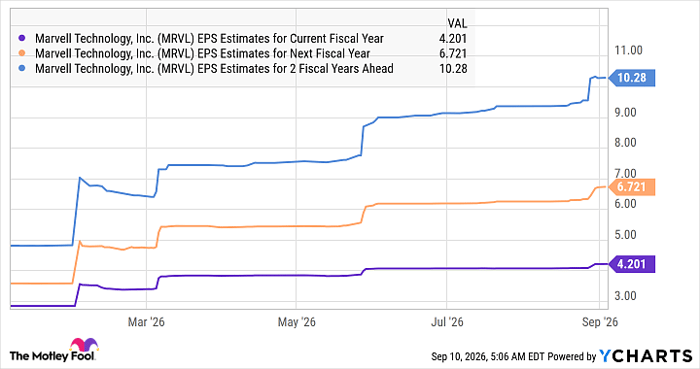
MRVL EPS Estimates for Current Fiscal Year data by YCharts
What's more, Marvell's long-term earnings-per-share growth estimates have jumped significantly following its latest report.
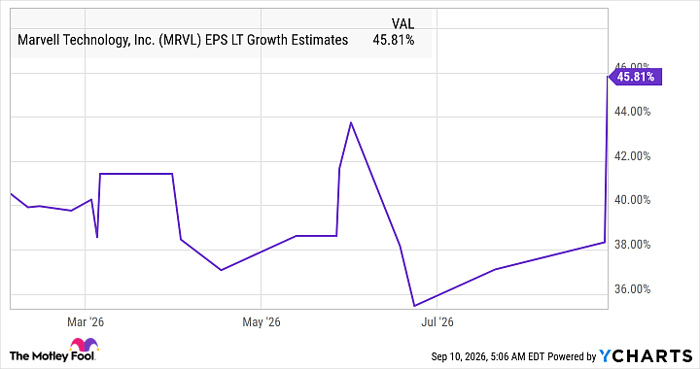
MRVL EPS LT Growth Estimates data by YCharts
Assuming it can maintain a 40% earnings growth rate in fiscal 2030 and 2031 (which will end in January 2031), Marvell's earnings per share could increase to $20.15 in five years (using fiscal 2029's projected earnings per share of $10.28 as the base). If Marvell trades at 30 times earnings after five years (a significant discount to its forward earnings multiple of 54), its stock price will jump to $604.
That's 157% above where this tech stock is right now, which is why buying Marvell after its recent slide could be a smart long-term move.
Should you buy stock in Marvell Technology right now?
Before you buy stock in Marvell Technology, consider this:
The Motley Fool Stock Advisor analyst team just identified what they believe are the 10 best stocks for investors to buy now… and Marvell Technology wasn’t one of them. The 10 stocks that made the cut could produce monster returns in the coming years.
Consider when Netflix made this list on December 17, 2004... if you invested $1,000 at the time of our recommendation, you’d have $410,024!* Or when Nvidia made this list on April 15, 2005... if you invested $1,000 at the time of our recommendation, you’d have $1,372,815!*
Now, it’s worth noting Stock Advisor’s total average return is 950% — a market-crushing outperformance compared to 211% for the S&P 500. Don't miss the latest top 10 list, available with Stock Advisor, and join an investing community built by individual investors for individual investors.
See the 10 stocks »
*Stock Advisor returns as of September 10, 2026.
Harsh Chauhan has no position in any of the stocks mentioned. The Motley Fool has positions in and recommends Goldman Sachs Group and Marvell Technology. The Motley Fool has a disclosure policy.
Recommended Articles


