


The Nasdaq, S&P 500, and Dow All Fell Slightly Friday. The Jobs Report Wasn't Really Why.
Key Points
The Nasdaq Composite fell 0.3%, the S&P 500 0.4%, and the Dow 0.5% by early Friday afternoon.
August payrolls rose 162,000 against a consensus of 53,000, the strongest month since March.
Not one of the 30 Dow stocks moved more than 2% in either direction.
- 10 stocks we like better than Dow Jones Industrial Average ›
Stocks edged lower Friday after the August jobs report came in roughly three times as strong as economists expected. Hot jobs reports are usually bad news for Wall Street, as investors ponder rising risks of inflation-fighting Fed rate increases. The major indexes are indeed down today, but the drops are fairly small.
The Nasdaq Composite (NASDAQINDEX: ^IXIC) was down 0.3% as of 1:20 p.m. ET, the S&P 500 (SNPINDEX: ^GSPC) down 0.4%, and the Dow Jones Industrial Average (DJINDICES: ^DJI) down 0.5%. The Dow fell as much as 0.7% around 11 a.m. ET before clawing most of it back.
Missed Nvidia in 2009? This Rare Signal Is Flashing Again. In 2009, a "Double Down" signal flashed for a little-known chipmaker called Nvidia. For the first time in years, that same "Total Conviction" signal is flashing for a company 1/100th the size of Nvidia. Continue »
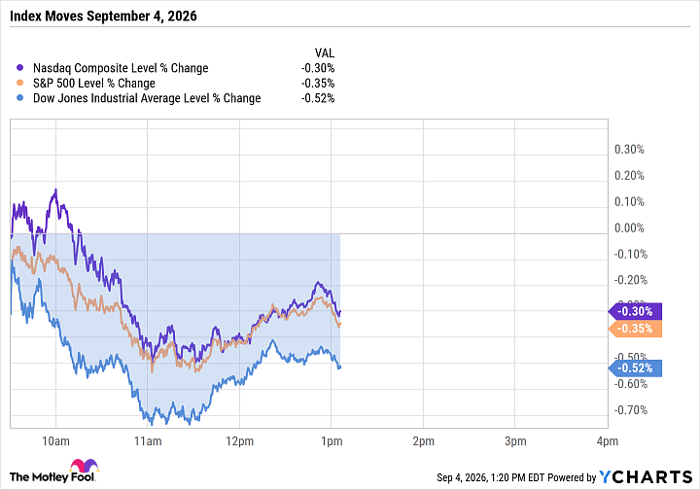
^IXIC data by https://ycharts.com">YCharts
162,000 new jobs made investors nervous
Economists were looking for 53,000 payroll additions in August. They got 162,000, the best month since March. Unemployment held steady at 4.1% and prior months revised upward. That's good news for people who want jobs, but a complicated report for people who want cheaper access to borrowed funds.
It wasn't a clear win, though. Average hourly earnings rose 3.1% from a year earlier, slightly above expectations but below July's inflation reading at 3.4%. People are finding jobs, but wages are rising slower than prices.
Traders responded by pricing in roughly 60% odds of a quarter-point increase at the Federal Reserve's Sept. 15-16 meeting. Short-term Treasury yields, the maturities most sensitive to Fed policy, rose sharply on the news. Attention now shifts to next week's consumer and producer price reports, which will appear just before the rate decision.
Oil prices are slightly down today amid quieter tension in the Strait of Hormuz. The Trump administration says that oil traffic is back to pre-war levels, though independent tracking services disagree. Either way, average gas prices have been fairly stable over the last week. A gallon of regular unleaded costs roughly $4.14 today, up 1.2% from $4.09 a week ago.
None of the 30 Dow stocks moved more than 2% in either direction. The bearish trend remained clear, as 21 of them printed small moves in red ink.
Image source: Getty Images.
Apple (NASDAQ: AAPL) weighed on the S&P 500 and Nasdaq Composite indexes as the upcoming range of iPhone and MacBook devices seems to have issues. The foldable iPhone is reportedly being produced at low volumes, and Apple has canceled a tablet-like foldable MacBook. Memory chips are expensive and hard to find, even in Apple's mighty production pipeline.
On that note, Micron Technology (NASDAQ: MU) plans to double the production of its AI-friendly High Bandwidth Memory (HBM) in 2027, and memory stocks responded with significant price jumps.
Another Magnificent 7 stock followed Apple sharply lower, but for different reasons. Tesla (NASDAQ: TSLA) shares fell 6.4% after its Cybercab service went live in Austin. Early reviews ranged from polite to disappointed, and Federal safety regulators are closely watching the driverless service. Friday's drop erased Thursday's optimistic 7% price jump.
Next week's inflation data gets the last word
The Apple and Micron stories are worth reading together, because they're the same story. Memory chips are scarce and pricey, which is a headache if you build phones and a gift if you build memory.
Next week brings consumer and producer price data, the last major inputs before the Sept. 15-16 decision. A payroll number three times consensus barely moved hike odds. Many traders are bracing for the inflation report, largely brushing off the job-market data in the interim.
Should you buy stock in Dow Jones Industrial Average right now?
Before you buy stock in Dow Jones Industrial Average, consider this:
The Motley Fool Stock Advisor analyst team just identified what they believe are the 10 best stocks for investors to buy now… and Dow Jones Industrial Average wasn’t one of them. The 10 stocks that made the cut could produce monster returns in the coming years.
Consider when Netflix made this list on December 17, 2004... if you invested $1,000 at the time of our recommendation, you’d have $445,833!* Or when Nvidia made this list on April 15, 2005... if you invested $1,000 at the time of our recommendation, you’d have $1,402,153!*
Now, it’s worth noting Stock Advisor’s total average return is 993% — a market-crushing outperformance compared to 214% for the S&P 500. Don't miss the latest top 10 list, available with Stock Advisor, and join an investing community built by individual investors for individual investors.
See the 10 stocks »
*Stock Advisor returns as of September 4, 2026.
Anders Bylund has positions in Micron Technology. The Motley Fool has positions in and recommends Apple, Micron Technology, and Tesla. The Motley Fool has a disclosure policy.
Recommended Articles


