


FinCEN ties $12.7 billion in crypto scam flows to overseas fraud rings
The Financial Crimes Enforcement Network (FinCEN), division of the U.S. Treasury, has identified about $12.7 billion in financial activity reported by U.S. institutions linked to suspected investment scams involving digital assets. FinCEN says that these scams are typically operated by transnational organized crime groups based in Southeast Asia.
As released on FinCEN’s Financial Trend Analysis and an accompanying alert to financial institutions on September 3, 2026, this discovery increases the burden on exchanges, stablecoin issuers, and regulators as perpetrated fraudulent funds are still transferred through the same channels as the funds of legal customers.
FinCEN has advised banks and cryptocurrency companies to be vigilant about the signs of scam operations and to provide information on scams on a voluntary basis according to Section 314(b) of the USA PATRIOT Act. However, it is quite difficult to tighten cross-border controls without hindering legitimate cryptocurrency activity.
Two years of filings, $12.7 billion flagged
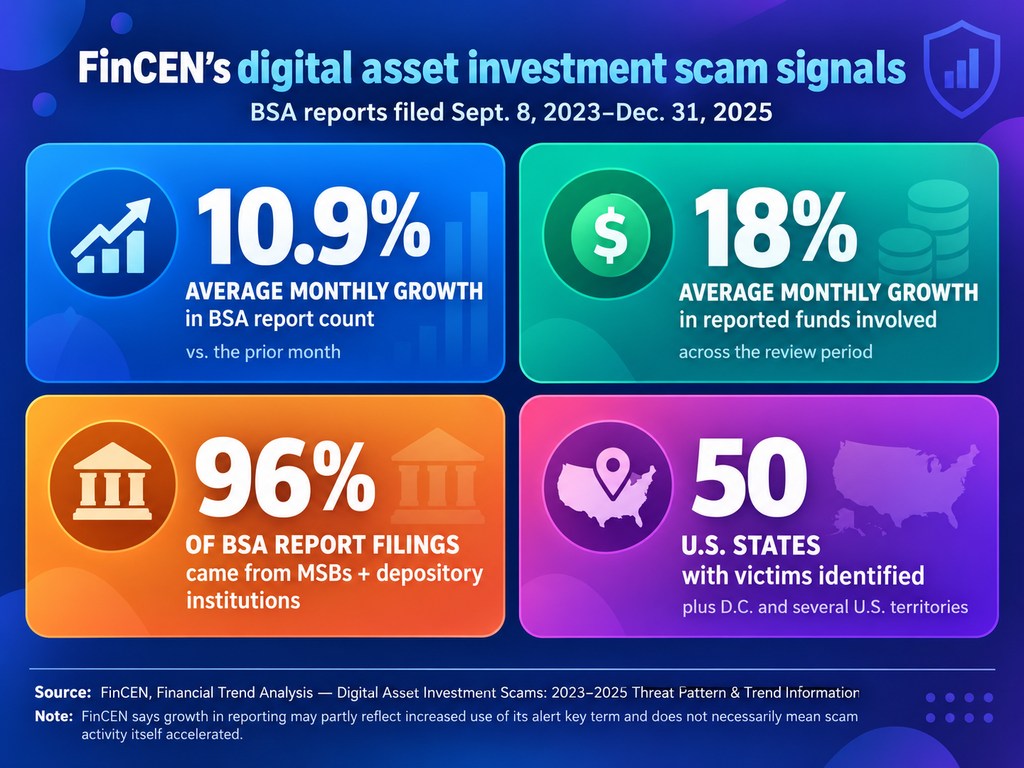
The figure of $12.7 billion relates to 33,904 reports submitted under the Bank Secrecy Act in the period between September 8, 2023 and December 31, 2025. The majority of these reports were made by money services businesses that were largely dependent on the digital assets industry and depository institutions accounted for as much as 96% of all reports.
FinCEN has pointed out that the total doesn’t represent confirmed losses by victims. The overall data may consist of cases involving attempts to conduct these transactions, multiple reporting, transfers in both directions, as well as amendments made to some reports submitted earlier.
The volume of reports filed increased by an average of 10.9% compared to the previous month while amount of money reported grew by approximately 18%. The number of victims is known across all 50 states plus some of the US territories. FinCEN has made it clear that the rise in reporting can be attributed to the expansion of the vocabulary that is used to announce the alerts, which should not be taken as an indication of the growth in scam activities.
“Digital asset investment scams pose one of the most significant fraud threats facing Americans today.” The organizations behind them “exploit both emerging technologies and human vulnerabilities.” — Gene Lange, performing the duties of Under Secretary for Terrorism and Financial Intelligence
Where the money goes: guarantee marketplaces and stablecoin off-ramps
The alert of FinCEN provides an insight into a completely outsourced criminal system. The criminals operate through “guarantee marketplaces” to avail services ranging from account creation and phishing to money laundering. Professional laundering service providers set up shell companies and mule accounts that allow for funds to be moved illegally through the financial system, including using stablecoins for transfers to exchanges outside the United States.
This trend can also be supported through the reports from other regulatory organizations. For instance, the FATF report released in March regarding the usage of stablecoins and unhosted wallets mentioned that stablecoins accounted for the overwhelming 84% of illegal transactions related to virtual assets in 2025, citing Chainalysis. FATF also elaborated on the usage of unhosted wallets and sophisticated methods of laundering that are used to cover up origin of funds.
The September 3 FATF report on underground banking and the hawala system also recorded the emergence of “digital hawala” where the operators communicate through encrypted messaging applications such as WhatsApp, Telegram, and Signal and settle accounts by means of virtual assets including stablecoins.
A single Southeast Asian crime economy
According to an assessment from UNODC in July, crime syndicates in Southeast Asia are part of a growing service-based economy in which fraud, trafficking, and money laundering share the same infrastructure.
UNODC estimated scam losses across East Asia, Southeast Asia, Australia and New Zealand at between $88.3 billion and $114.1 billion in 2025. It also said people from at least 80 countries and territories had been identified in scam compounds across the region.
Cryptopolitan has previously reported on how those networks reach individual courtrooms. In August, the Court of Appeal in Hong Kong confirmed the sentence of 56 months to a recruiter who attracted five people to Southeast Asia. Some of those victims were confined to KK Park in Myanmar. The court treated human trafficking and forced labor as aggravating circumstances for the fraud case.
The compliance squeeze
The FinCEN alert increases pressure on cryptocurrency companies to invest more in transaction surveillance, mule account monitoring, and prompt international information sharing.
However, as shown by the FATF report from March that looks into offshore virtual assets service providers, the more pressing issue is that jurisdictions have unequal oversight, which criminals can exploit.
According to FinCEN, its Rapid Response Program allows FinCEN to work with foreign financial intelligence units to identify and recover fraudulent transactions, but people are still advised to report their cases to the FBI’s Internet Crime Complaint Center (IC3) quickly. The main question here is how effective and fast is such cooperation while criminals use money laundering services more frequently.
Don’t just read crypto news. Understand it. Subscribe to our newsletter. It's free.
Recommended Articles


