


NVIDIA Crushed Data Center at +92% — So Why Is the Stock Still Climbing Toward $229?
TradingKey - NVIDIA (NVDA) continues to break out, trading at $225.34. The stock is currently focused on the $229.51 resistance (161.8% Fibonacci extension) and $226 earnings before August 26. The stock has already reclaimed the important $221.01 breakout level (in light of $226 earnings). It is trading well above both the major moving averages. Fundamentally, Q1 FY2027 closed at $81.6 billion revenues (85% YoY growth) and Data Center revenue at $75.2 billion (92% YoY). Close to 75% GAAP gross margins were recorded for the same period. For Q2, $91 billion is anticipated (near the $100B run rate). From a demand perspective, SpaceX has announced the use of NVIDIA's Vera Rubin for its first AI projects.
SpaceX is expected to build its infrastructure on Rubin. China has also reopened and placed limited orders on NVIDIA's H200. Traders are looking at the $229.51 breakout level as the next target. Possible targets for a breakout above this level are $234.51 and $238.89. For August earnings, investors will determine whether the SpaceX and hyperscaler demand will continue to support the current growth rates, or if we should expect a pullback after a positive run for the stock.
Q1 Results Were Record, Q2 Guidance Implies Near-Doubling of Quarterly Revenue in One Year
NVIDIA posted record fiscal Q1 FY2027 results of USD $81.6 billion, or 85% increasing YoY, surpassing the mark guided. Data Center revenue ended up at $75.2 billion, a 92% increase, with Data Center compute hitting $60.4 billion or a 77% YoY increase. Networking ended up at $14.8 billion, a 199% increase. Gross margin arose to 74.9% on a GAAP basis. Non-GAAP EPS landed at $1.87 astonishingly, surpassed expectations. NVIDIA established a Q2 revenue target of $91 billion, plus or minus 2% of the original figure. This establishes a sequential marked increase toward the goal of achieving $100 billion per quarter.
Vera Rubin Is Already in Full Production — Not a Roadmap Anymore
With the switching of focus from Blackwell to Vera Rubin, we now see production and not just roadmap. According to NVIDIA, Rubin is currently in full production and partner systems will ship in the second half of 2026. The structure combines Vera CPUs, Rubin GPUs, BlueField-4 storage, Spectrum-6 Ethernet, and ancillary components. Cloud providers like Microsoft Azure, CoreWeave, IBM Cloud, Lambda, and Nebius are among the first adopters of these Rubin based systems. One of the strategically important things is demand for the Rubin systems does not appear to be focused around a single customer class, with the growing number of system vendors.
SpaceX Endorsement Is One of the Freshest Major Demand Signals
In the August 13 earnings call, SpaceX stated they will be building exclusively on NVIDIA for their AI infrastructure. This is very important, as SpaceX is one of the largest spenders in the market for AI infrastructure. Their AI business reported $2.6B in revenue for the second quarter. They also stated they wanted to increase compute capacity up to 10 gigawatts by the end of 2027. NVIDIA stated each gigawatt of capacity could equate to $40-$50 billion of revenue, depending on how the capacity is utilized. Even a small fraction of SpaceX's demand could be significant. This announcement is also very timely. as the major hyperscalers are continuously increasing, not decreasing, their AI expenditures.
Hyperscaler Purchase Commitments Are Still Climbing, Not Declining
According to Financial Times, large hyperscalers and AI infrastructure companies have purchase commitments of roughly $1.5 trillion and lease commitments of roughly $1.5 trillion. Alphabet reported purchase commitments of approximately $811 billion for this quarter. For Meta, purchase commitments were around $349 billion. Just because hyperscalers are making a lot of purchase commitments doesn't mean all of that money will go to NVIDIA, but it shows that their physical construction to support their growth is not being canceled. Rather, concerns have shifted from potential demand to supply of power, networking, memory, and data-center capacity.
NVIDIA's Own Supply Commitments Show Confidence but Increase Execution Risk
NVIDIA disclosed about $119 billion of committed supply and capacity. Approximately $95 billion is scheduled to be spent over the next fiscal year, FY2027. In addition, they disclosed $30 billion of multi-year cloud service (predominantly R&D) commitments and another $6 billion of supplier commitments. The confidence these figures represent comes at the cost of increased risk of execution. It is prudent that AI demand does not decrease in the near future as the company has locked in long-term capacity. Should demand head in the opposite direction and cash commitments remain, the company will be executing contracts in a more bearish economic climate. At this time, the demand signals are looking positive.
Margins Remain One of NVIDIA's Biggest Competitive Advantages
It is safe to say that NVIDIA achieving a GAAP gross margin of 74.9 percent, amidst selling physical infrastructure at scale, is remarkable. As a target, management set the goal of maintaining margin at about 74.9 percent for next fiscal year Q2, which in turn continues the positive trend of Q1. NVIDIA is clearing margins closer to 75 percent, and quarterly sales trek towards the $91 billion target. Should the Rubin transition remain the most significant expense, margin sustainability and highly competitive pricing will drive focus during the August 26 Earnings call.
China Reopening Represents Upside Optionality, Not Base Case
NVDlA has been permitted by the U.S government to export to a select number of Chinese customers H200 chips.Shipments are beginning, says a Commerce Department spokesperson. The aforementioned companies, ZTE, Alibaba, Tencent and ByteDance among others, are said to have received or requested government approvals. Nvdia in its Q2 guidance, has built an assumption of zero Data Center compute revenue, hence there is possible upside optionality given that any possible revenue from H200 sales could be construed as a positive earnings surprise.
The China policy uncertain environment only continues to grow with an anticipated AI chip regulation overlay along with legislative scrutiny of U.S exports to China. A best case scenario when considering the potential for Nvidia within China is that it is treated as optionality and not as a stable growth expectation.
Technical Setup: Breaking Above $221, Targeting $229.51, Then $234-239
Recent improvements to NVDA's structure has allowed the stock to break above the long-standing downtrend with the fundamentals now well above both the 50-period EMA at $211.20 and the 100-period EMA at $208.14. Recovery from the lows of $189.93 in July has been strong. NVDA trades at $225.34 with RSI at 67 just above the signal line at 65 and approaching overbought territory.
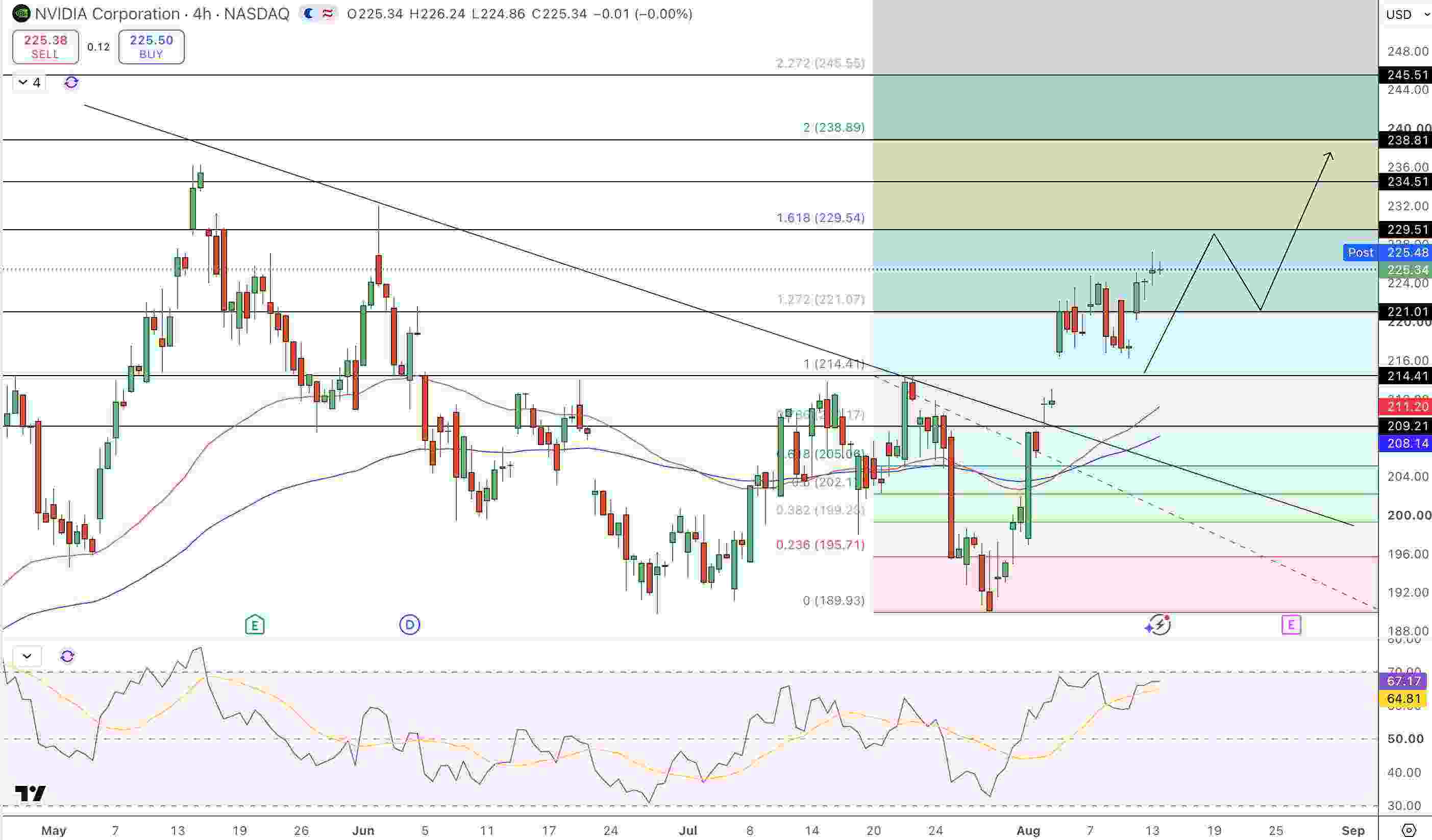
NVIDIA Price Chart - Source: Tradingview
The immediate upside target is $229.54 (161.8% Fibonacci extension), closely aligned with horizontal resistance at $229.51. A break above that area exposes $234.51 with the 200% Fibonacci extension at $238.89 above that. Defensive levels for buyers are $221.01, $214.41 below that, along with the moving average cluster at $208-211.
Key Levels (Aug 14)
- Immediate resistance: $229.51 (161.8% Fib, critical breakout)
- Extended targets: $234.51, $238.89, $245.51 (200% Fib+)
- Critical support: $221.01 (must hold)
- Secondary support: $214.41
- EMA support cluster: $211.20 (50-EMA), $208.14 (100-EMA)
- Current price: $225.34 (approaching $229 resistance)
- RSI: 67 (strong, approaching overbought)
What to Watch at August 26 Earnings
There are four chief concerns for Q2 earnings: Did revenue surpass $91B? Was gross margin close to 75%? What was the expects guidance for Q3, and has demand for Blackwell holdings continued to rise while demand for Rubin is growing? Any notable information regarding China or H200 revenue? Earnings calls focus on the Rubin supply, the influence of new customers (Safe Superintelligence and SpaceX), the influence of new sovereign operators, and the Rubin backlog. Comments pertaining to the sustainable size of hyperscaler capex will also be analyzed.
Bottom Line
Going into August 26 earnings, NVIDIA still has very strong fundamentals. Q1 brought $81.6B revenue (85%), $75.2B (92%) of which came from the data center. With anticipated revenue of close to $91B for Q2, we should expect $100B+ as the new lower threshold for revenue. New demand signals are favorable: increasing commitments from the hyperscalers (valued at over $1.5T), the re-opening of China, and limited shipments of H200. Rubin has begun full production.
NVDA is breaking above its descending trendline now at $225.34, with $229.51 the next resistance (161.8% Fibonacci extension). With the RSI at 67, it has some strength, though it is approaching overbought. A break of $229.51 would target $234.51 and $238.89. Support at $221.01 must hold; if it breaks, it would compromise structure and lead to a drop to $214.41.
This is important for tactical traders: $229.51 is the level to watch for a breakout. A close above that level suggests a range of $234 to $239. For investors: We will find out after the August 26 earnings release whether this move is real and shows the market is beginning to get nervous and take profits before the forecast does ease and whether the market has concerns about the artificial intelligence growth. As long as Hyperscaler capital expenditures and Rubin adoption continue to increase, there should be a fundamental case for sustained AI-driven growth.
Recommended Articles


