


Not Micron, Not Sandisk. This Artificial Intelligence (AI) Memory Stock Could Be the Next Nvidia.
Key Points
Demand for high bandwidth memory, DRAM, and NAND flash storage is on the rise.
Micron and Sandisk are two of the best-known players in the AI memory segment.
A rival from Korea may offer more compelling upside in the long run as AI infrastructure spend accelerates.
- 10 stocks we like better than SK Hynix ›
The artificial intelligence (AI) revolution started with a scramble for processing power, as graphics processing units (GPUs) from Nvidia (NASDAQ: NVDA) powered large language model training. Although GPUs remain top of mind for hyperscalers, demand has also begun to shift toward custom application-specific integrated circuits (ASICs) designed by Broadcom.
Now, the bottleneck has moved downstream to memory chips. Micron Technology (NASDAQ: MU) stands at the center of this market. The company designs and manufactures DRAM and high bandwidth memory (HBM) stacks that sit on top of GPUs. Equally important is Sandisk (NASDAQ: SNDK), which focuses on NAND flash storage and enterprise solid-state drives (SSDs).
Missed Nvidia in 2009? This Rare Signal Is Flashing Again. In 2009, a "Double Down" signal flashed for a little-known chipmaker called Nvidia. For the first time in years, that same "Total Conviction" signal is flashing for a company 1/100th the size of Nvidia. Continue »
Both companies have delivered extraordinary returns during the past year: Micron shares have surged more than 600%, while Sandisk's have multiplied by nearly 2,800%. But what if I told you there is another memory pure play that may offer even more compelling upside and the potential to mirror Nvidia's transformative run?
Let's dig into another AI memory stock hiding in plain sight.
This Korean semiconductor giant is flying under the radar
Many investors outside Asia have limited familiarity with SK Hynix (NASDAQ: SKHY) because the company historically traded primarily on South Korean exchanges and only recently listed American depositary receipts. That distance inherently kept SK Hynix out of the spotlight.
SK Hynix holds a dominant position in critical segments of AI memory. According to Counterpoint Research, SK Hynix holds a clear majority share in HBM, near 58%. This is more than double that of Micron and Samsung, each of which hovers at about a fifth of the market.
In the broader DRAM category, the company ranks second with roughly 29% share -- trailing only Samsung while comfortably ahead of Micron. In NAND flash, SK Hynix maintains 18% market share, again behind Samsung but competitively ahead of both Micron and Sandisk. Across the entire memory landscape, SK Hynix trails only Samsung overall and leads decisively over its Western rivals.
Image source: The Motley Fool.
Analyzing SK Hynix's business momentum
SK Hynix's financial results throughout 2026 illustrate how its dominant market share is translating into operational strength. During the first quarter, the company's revenue reached 52.6 trillion Korean won (roughly $34.5 billion), while operating margin stood at 72%.
The company's momentum accelerated even faster during the second quarter. Revenue climbed to 79.3 trillion won (roughly $55 billion USD), a sequential increase of 51% and a surge of 257% year over year. Operating profit jumped 61% from the prior quarter and 557% from the prior-year period.
Overall, cumulative revenue in the first half of the year surpassed 100 trillion won for the first time in the company's history. These results reflect not only unprecedented volume growth but also the pricing power SK Hynix commands.
Could SK Hynix become the next Nvidia?
SK Hynix's growth trajectory overlaps with Nvidia's ascent in the early phases of the AI revolution. Both companies supply a critical input to the AI chip stack -- Nvidia with the underlying accelerators and SK Hynix with the HBM that facilitates data flows.
Both companies enjoy elevated and widening profit margins as hyperscalers prioritize capacity over raw compute costs. Moreover, each company also benefits from multiyear growth thanks to long-term supply agreements and sold-out inventory.
The sustainability of this growth appears robust. Memory shortages are projected to persist well into the latter half of the decade as AI capital expenditures accelerate and new generations of high-bandwidth chips scale.
Despite the strong fundamental performance during the past year, SK Hynix's valuation still looks reasonable. The company's forward price-to-earnings (P/E) ratio sits at just 5.3 -- a level far below what Nvidia commanded during its most explosive phase.
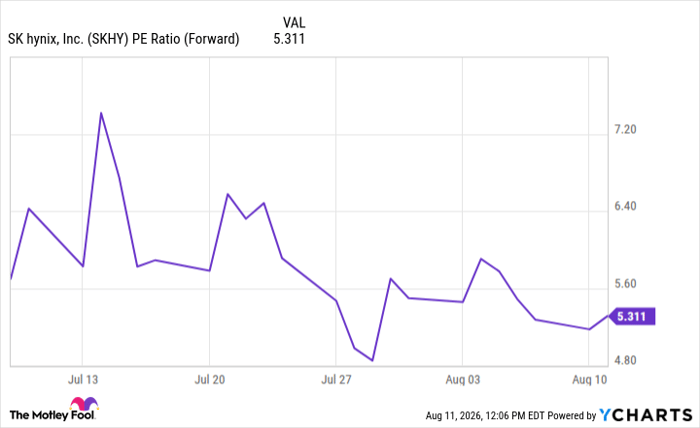
SKHY PE Ratio (Forward) data by YCharts
Although cyclical risks inherent in the memory industry remain, the secular demand shift supporting AI workloads has raised the floor relative to prior cycles. Against this backdrop, I think SK Hynix has yet to experience multiple expansion alongside compounding earnings.
Continued execution on capacity, sustained technology leadership, and deep customer lock-in should drive both higher earnings and a valuation gains, making SK Hynix stock a compelling long-term buy for investors seeking exposure to the memory piece of the AI boom.
Should you buy stock in SK Hynix right now?
Before you buy stock in SK Hynix, consider this:
The Motley Fool Stock Advisor analyst team just identified what they believe are the 10 best stocks for investors to buy now… and SK Hynix wasn’t one of them. The 10 stocks that made the cut could produce monster returns in the coming years.
Consider when Netflix made this list on December 17, 2004... if you invested $1,000 at the time of our recommendation, you’d have $400,209!* Or when Nvidia made this list on April 15, 2005... if you invested $1,000 at the time of our recommendation, you’d have $1,375,393!*
Now, it’s worth noting Stock Advisor’s total average return is 964% — a market-crushing outperformance compared to 215% for the S&P 500. Don't miss the latest top 10 list, available with Stock Advisor, and join an investing community built by individual investors for individual investors.
See the 10 stocks »
*Stock Advisor returns as of August 14, 2026.
Adam Spatacco has positions in Nvidia. The Motley Fool has positions in and recommends Broadcom, Micron Technology, and Nvidia. The Motley Fool has a disclosure policy.
Recommended Articles


