


The Puzzle Pieces for Stagflation Are Beginning to Take Shape, and That's Terrible News for Fed Chair Kevin Warsh and Wall Street
Key Points
Despite the Dow Jones Industrial Average, S&P 500, and Nasdaq Composite vaulting to new highs in 2026, a nightmare scenario may be brewing on Wall Street.
Several traits associated with stagflation are beginning to come together.
If the job market or wage growth materially worsens, Fed Chair Warsh and his FOMC colleagues may be forced to act.
- 10 stocks we like better than S&P 500 Index ›
Despite short-lived periods of outsize volatility, it's shaping up as another stellar year for the stock market. Since early June, the Dow Jones Industrial Average (DJINDICES: ^DJI), S&P 500 (SNPINDEX: ^GSPC), and Nasdaq Composite (NASDAQINDEX: ^IXIC) have blasted to record highs.
But the good times may be nearing an end, thanks to the Federal Reserve's nightmare scenario, stagflation. While this economic scenario, characterized by high inflation, high unemployment, and stagnant or weakening economic growth, isn't currently in play, the puzzle pieces that could dramatically complicate life for Fed Chair Kevin Warsh and the Federal Open Market Committee (FOMC) are taking shape.
Missed Nvidia in 2009? This Rare Signal Is Flashing Again. In 2009, a "Double Down" signal flashed for a little-known chipmaker called Nvidia. For the first time in years, that same "Total Conviction" signal is flashing for a company 1/100th the size of Nvidia. Continue »
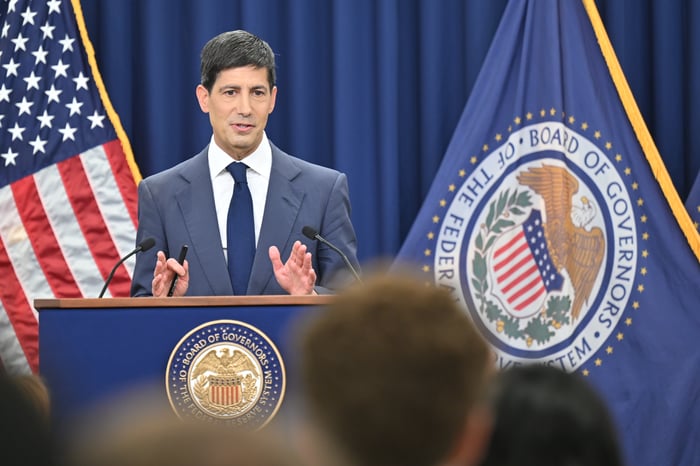
Fed Chair Kevin Warsh delivering remarks. Image source: Official Federal Reserve Photo.
Several traits associated with stagflation are coming together
To begin with, trailing 12-month (TTM) inflation has been tracking above the FOMC's long-term target of 2% for the last 65 months. Although headline inflation has eased from its three-year high of 4.2% in May, largely due to crude oil prices falling from their Iran war highs, it's still well above Fed Chair Warsh's and the FOMC's comfort level.
Worse yet, evidence is mounting that Trumpflation (inflation driven by President Donald Trump's policies) is becoming entrenched in the U.S. economy. The price stickiness of Core Personal Consumption Expenditures suggests it'll be challenging for the Fed to stabilize prices.
This is a bleak July jobs report:
-- Heather Long (@byHeatherLong) August 7, 2026
-23,000 jobs lost in July. (Losses occurred in retail, finance, hospitality, local gov't education)
-264,000 people leave the labor force
-Wage growth falls to 3.2% = lowest in 5 years (and totally wiped out by inflation right now)
***Lowest... pic.twitter.com/F4LTwjH8yJ
We're also seeing indications that the U.S. economy is weakening. The July jobs report featured 23,000 job losses, and wage growth of 3.2% is lagging TTM inflation. Further, annualized gross domestic product growth, as of the second quarter, is down to 1.5%.
Lastly, the unemployment rate actually fell to 4.1% in July... but there's a catch. We've observed a persistent decline in the labor participation rate, which has modestly reduced the unemployment rate even as job creation has weakened.
In several respects, the puzzle pieces for stagflation are starting to come together.

Image source: Getty Images.
Stagflation is the Federal Reserve's worst nightmare
The reason stagflation is such a frightening scenario for the Fed is that there's no ideal blueprint to combat it. Raising interest rates to stabilize prices risks further weakening the jobs market and can adversely impact economic growth. Meanwhile, lowering lending rates to boost economic growth can effectively pour gasoline on an inflation figure that's already running hot.
The lone silver lining for Warsh and his FOMC colleagues is that today's stagflation correlations look nothing like they did in the 1970s and early 1980s. The Misery Index, calculated by adding the unemployment rate and annual inflation rate, reached an all-time high of almost 22% in the summer of 1980. Today, it's less than 8%.
The US Misery Index is at a multi-year high of 8.5.
-- Mike Zaccardi, CFA, CMT 🍖 (@MikeZaccardi) June 13, 2026
But inflation is backward-looking (of course), while the unemployment rate is a snapshot.
Using forward inflation of 2.759%, the forward Misery Index is actually just 7.06 @yardeni pic.twitter.com/U6UOCUbhEz
But just because the dynamics of today's economy aren't nearly as awful as the early 1980s, it doesn't mean Warsh and his peers won't face some tough choices in upcoming FOMC meetings. The new Fed chair is trying to earn credibility with Wall Street and lower persistently high inflation, all while appeasing President Trump, who's repeatedly called for the Fed to slash interest rates.
If the job market and/or wage growth materially worsen in the coming months, and TTM inflation remains in the mid-3% range or higher, the Fed will be put on the hot seat, and a historically pricey stock market could pay the price.
Should you buy stock in S&P 500 Index right now?
Before you buy stock in S&P 500 Index, consider this:
The Motley Fool Stock Advisor analyst team just identified what they believe are the 10 best stocks for investors to buy now… and S&P 500 Index wasn’t one of them. The 10 stocks that made the cut could produce monster returns in the coming years.
Consider when Netflix made this list on December 17, 2004... if you invested $1,000 at the time of our recommendation, you’d have $403,337!* Or when Nvidia made this list on April 15, 2005... if you invested $1,000 at the time of our recommendation, you’d have $1,334,946!*
Now, it’s worth noting Stock Advisor’s total average return is 958% — a market-crushing outperformance compared to 214% for the S&P 500. Don't miss the latest top 10 list, available with Stock Advisor, and join an investing community built by individual investors for individual investors.
See the 10 stocks »
*Stock Advisor returns as of August 13, 2026.
Sean Williams has no position in any of the stocks mentioned. The Motley Fool has no position in any of the stocks mentioned. The Motley Fool has a disclosure policy.
Recommended Articles


