


Boomers Are Getting Rich and Retiring Early. 1 No-Brainer Stock To Buy Now
Key Points
The surging stock market and rising home prices are giving boomers enormous spending power.
According to Bank of America, the additional wealth is leading some to early retirement.
Companies that target this demographic could be big winners.
- 10 stocks we like better than Viking ›
Billionaire Ray Dalio spent his 77th birthday partying in Ibiza, and he's not the only one in his generation living it up.
I had a blast being out until 4am with my family and friends at UNVRS in Ibiza for my 77th birthday and thought I'd pass it along to turn you onto it, in case you're in the neighborhood. pic.twitter.com/sOpPZpSI0H
-- Ray Dalio (@RayDalio) August 10, 2026Missed Nvidia in 2009? This Rare Signal Is Flashing Again. In 2009, a "Double Down" signal flashed for a little-known chipmaker called Nvidia. For the first time in years, that same "Total Conviction" signal is flashing for a company 1/100th the size of Nvidia. Continue »
Boomers have more disposable income than ever, thanks to a soaring stock market and rising home prices, and many are now tapping out and taking an early retirement.
The labor participation rate among Americans 55 and older has fallen from 40% before the pandemic to just 36.9% in July, and, according to Bank of America, swelling 401(k)s are a big reason why.
Additionally, the population of Americans 65 and older has doubled since 1990 to 66 million, and it's projected to reach 78 million in 10 years, indicating this group will have even greater spending power.
For investors, this wealth effect represents a huge opportunity, as that disposable income will be put to use. One stock that looks well-positioned to take advantage of it is Viking Holdings (NYSE: VIK), the cruise line that operates river and ocean cruises under the Viking brand.
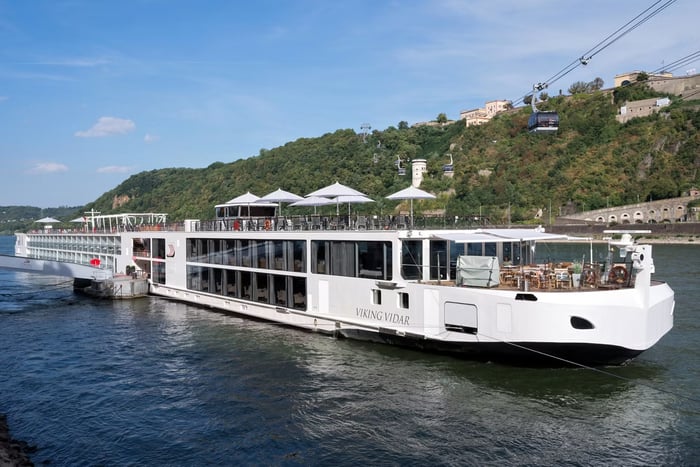
Image source: Viking Holdings.
What investors need to know about Viking Holdings
Viking went public in 2024, and the company has ridden a rising tide since then, climbing to over $100 a share from its IPO price of $24.
The company is differentiated from its oceanliner peers, Carnival, Royal Caribbean, and Norwegian Cruise Line, in a number of ways.
First, its cruises are adults only, ensuring a quiet and calm atmosphere on board. Viking also doesn't dabble in the typical cruise schlock like casinos, formal nights, photography sales, or art auctions.
Viking ships are smaller than typical cruise ships, have an understated Scandinavian design, and have windows in every room. The company also promises not to nickel-and-dime its customers, including things like Wi-Fi in the price. It also focuses on the European market, rather than traditional cruise lines that mainly operate in the Caribbean.
Viking bills itself as the thinking person's cruise, and onboard activities include lectures on history and art, cooking demonstrations, and menus featuring regional cuisine.
Not surprisingly, Viking has become popular with the boomer set as the average passenger age is roughly 65 to 70, and the growing wealth of that generation has been a tailwind for the company. In its IPO filing, the company said, "We are intently focused on our core demographic of curious affluent travelers aged 55 and older, which we believe is an attractive segment that has been and continues to be underserved by the travel market."
That strategy is clearly paying off, as evidenced by the stock's performance, and the growing wealth among boomers is a tailwind for Viking.
What the numbers say
In the first quarter, Viking reported revenue growth of 17.5% to $1.05 billion. Net yield was up 9.5% to $596, and adjusted earnings before interest, taxes, depreciation, and amortization (EBITDA) rose 43.9% to $104.8 million. Those numbers show strong growth on the top and bottom lines and an improvement in revenue per available berth day, representing increased productivity.
The company reported an adjusted loss per share of $0.12 in the quarter, but that reflects the seasonality of the business, which peaks in the summer months.
Why it's a buy
As reports from its cruise-line peers and travel stocks like Airbnb show, travel demand continues to boom despite broader economic concerns.
Viking is well-positioned to capitalize on the discretionary income boomers have to spend, it continues to add new ships, and it's outgrowing its peers. Finally, the company benefits from a differentiated business model, and it's the best-known provider of river and luxury ocean cruises in the world.
Viking trades at a price-to-earnings ratio of 37, which isn't cheap, but looks like a good price for a company expected to grow EPS by a compound annual rate of close to 30% over the next two years.
The river cruise specialist has a long runway in front of it, and retiring boomers should only accelerate its growth.
Should you buy stock in Viking right now?
Before you buy stock in Viking, consider this:
The Motley Fool Stock Advisor analyst team just identified what they believe are the 10 best stocks for investors to buy now… and Viking wasn’t one of them. The 10 stocks that made the cut could produce monster returns in the coming years.
Consider when Netflix made this list on December 17, 2004... if you invested $1,000 at the time of our recommendation, you’d have $411,427!* Or when Nvidia made this list on April 15, 2005... if you invested $1,000 at the time of our recommendation, you’d have $1,335,252!*
Now, it’s worth noting Stock Advisor’s total average return is 965% — a market-crushing outperformance compared to 215% for the S&P 500. Don't miss the latest top 10 list, available with Stock Advisor, and join an investing community built by individual investors for individual investors.
See the 10 stocks »
*Stock Advisor returns as of August 11, 2026.
Bank of America is an advertising partner of Motley Fool Money. Jeremy Bowman has positions in Airbnb and Bank of America. The Motley Fool has positions in and recommends Airbnb and Viking. The Motley Fool recommends Carnival Corp. The Motley Fool has a disclosure policy.
Recommended Articles


