


CoreWeave Shares Surge 16% as Second-Quarter Revenue Soars 112%, Buoying Market
TradingKey - AI cloud computing service provider CoreWeave (CRWV) reported second-quarter results that exceeded Wall Street expectations. Driven by continued spending on computing power from enterprises, tech giants, and AI labs, the company's quarterly revenue surged 112% year-over-year, reaching a record high for the fifth consecutive quarter. A strong order backlog and an upgraded full-year outlook boosted market confidence, sending CoreWeave's share price up about 16% in after-hours trading.
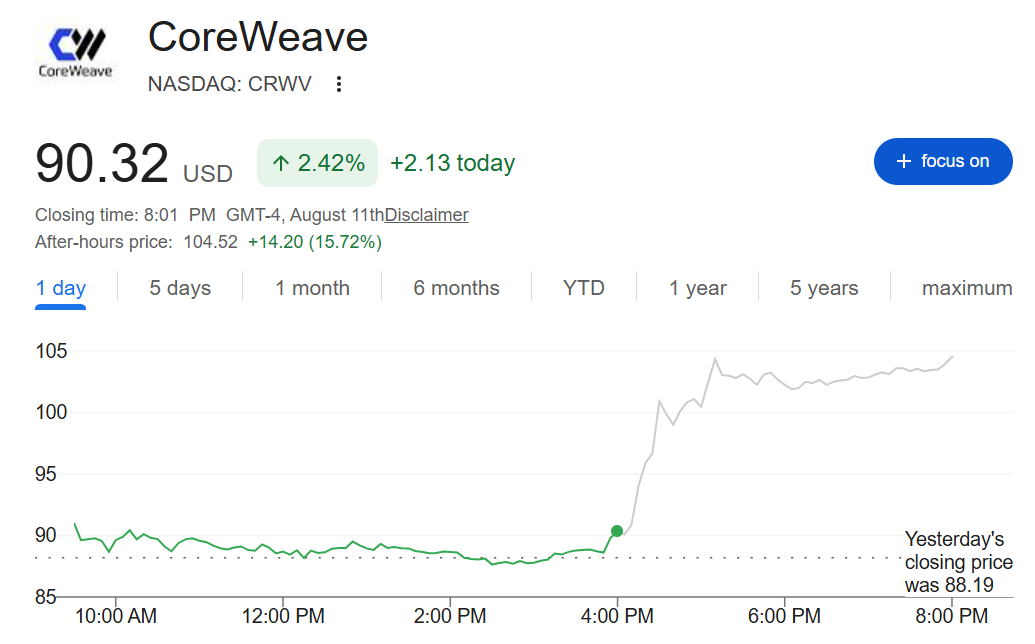
Source: Google Finance
However, rapid expansion has also brought higher capital expenditures and financing costs. CoreWeave remains unprofitable, and whether it can build data centers as planned, convert orders into revenue, and manage its debt burden remains a central concern for investors.
Revenue Beats Expectations But Net Loss Continues to Widen
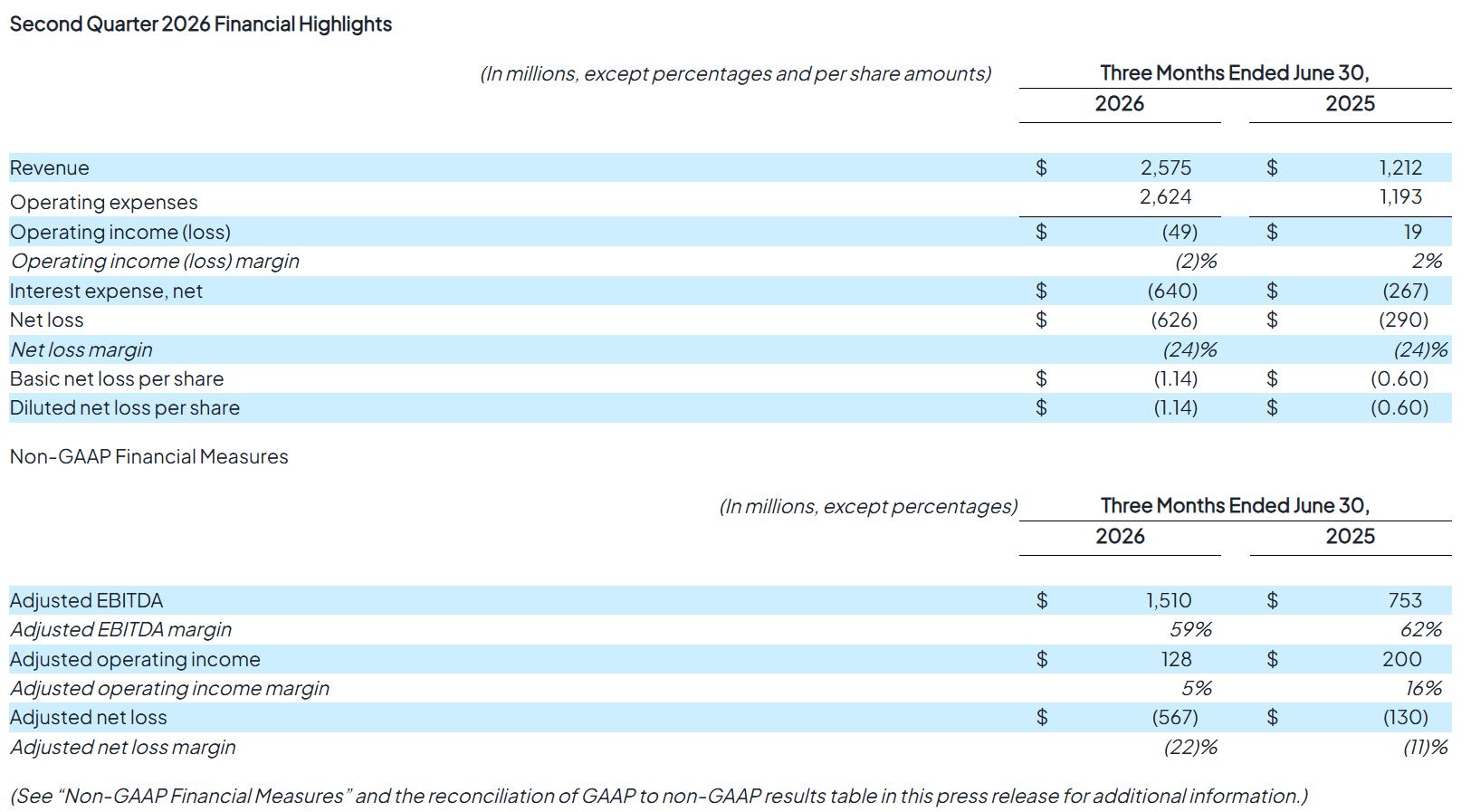
CoreWeave's second-quarter revenue reached $2.575 billion, beating Wall Street expectations of around $2.555 billion and up 112% from $1.212 billion in the same period last year.
The company reported a loss per share of $1.14 for the quarter, narrower than the market expected loss of $1.20. Adjusted net loss came in at $567 million, also below the $677 million projected by analysts. However, due to rapidly rising infrastructure and financing costs, GAAP net loss expanded to $626 million from $290 million in the prior-year period.
Operational improvements were even more pronounced. Second-quarter adjusted EBITDA reached $1.51 billion, up about 100% year-over-year, though the margin declined to 59% from 62% in the year-ago period. Adjusted operating income was $128 million, yielding a 5% margin, up from 1% in the first quarter.
Source: CoreWeave
Company CEO Michael Intrator stated that as the business scales, the margin pressure caused by new data centers during their initial phase of operation is diminishing, and CoreWeave has begun to demonstrate a degree of operating leverage.
Order Backlog Swells to $104 Billion as AI Demand Shows No Sign of Cooling
At the end of the second quarter, CoreWeave's backlog reached approximately $104 billion, up 246% year-over-year. This figure does not yet include over $25 billion in new customer commitments from early in the third quarter, demonstrating that market demand for AI computing power remains robust.
CoreWeave is essentially an AI-focused cloud computing company. The company purchases Nvidia (NVDA) GPUs and deploys them to data centers, then rents computing power to OpenAI, Microsoft (MSFT), Meta (META), and other enterprises. Compared with traditional cloud computing providers, CoreWeave is more focused on high-performance computing scenarios such as model training, inference, and AI agents.
During the quarter, the company added new customers including Bentley Systems, Caterpillar, Grammarly, and Isomorphic Labs, and expanded partnerships with enterprises such as Databricks, Cognition, and Runway. Meta also added approximately $21 billion in business commitments, and CoreWeave reached a multi-year partnership with Anthropic.
Management stated that contracts signed in the second quarter are expected to deliver contribution margins 5 to 10 percentage points higher than in previous quarters. Tight capacity has boosted CoreWeave's pricing power, and the company is passing on price increases for chips and other components to customers.
Meanwhile, CoreWeave is gradually expanding beyond simple GPU rentals into storage, networking, CPUs, software, and managed inference services. The annualized revenue of the company's managed inference business rose from about $1 million to $100 million in a single quarter, showing that enterprise demand for deploying AI applications is beginning to translate into actual revenue.
These businesses generally offer higher added value than basic GPU leasing. If customers purchase compute, storage, networking, and software services on the same platform, CoreWeave is expected to increase revenue per customer and gradually improve overall profit margins.
High Debt Remains CoreWeave's Main Risk
CoreWeave operates on an expansion model driven by high capital expenditures and heavy debt financing. The company needs to borrow upfront to purchase GPUs, build data centers, and secure power resources, subsequently recovering its investment through multi-year customer contracts.
As of the end of the second quarter, CoreWeave had approximately $35 billion in interest-bearing debt. Net interest expense for the quarter reached $640 million, up significantly from $267 million in the prior-year period, becoming one of the primary drivers behind its widening net loss.
To support its expansion, CoreWeave completed a $3.1 billion term loan while raising over $10 billion through unsecured and convertible bonds, alongside securing a $1 billion strategic investment from Jane Street. The company also recently completed new loan financing to purchase chips and other AI infrastructure.
A massive backlog enhances future revenue visibility, but orders do not equal realized revenue. CoreWeave still needs to secure chips, power, and construction resources, as well as ensure that data centers become operational on schedule. Any construction delays, equipment shortages, or rising financing costs could affect the pace of order fulfillment.
CoreWeave Raises Full-Year Revenue Guidance
CoreWeave expects third-quarter revenue to be between $3.45 billion and $3.6 billion. Based on the midpoint of the range, revenue growth is approximately 158% year-over-year, overall higher than Wall Street's expectation of around $3.43 billion.
The company also raised its full-year 2026 revenue guidance from the previous range of $12 billion to $13 billion to $12.4 billion to $13.2 billion; adjusted operating profit is expected to reach $960 million to $1.15 billion, higher than the previous forecast of $900 million to $1.1 billion.
Management expects that as newly built capacity is gradually brought online, the adjusted operating margin will continue to improve in the second half of the year and may rise to around 10% in the fourth quarter.
However, higher revenue targets require larger-scale infrastructure investment. CoreWeave's second-quarter capital expenditures reached approximately $9.4 billion, exceeding market expectations of $8.2 billion; the full-year capital expenditure forecast was also raised from $31 billion to $35 billion to $35 billion to $39 billion.
As one of the few publicly traded emerging cloud service providers, CoreWeave's order backlog and capacity data are viewed by the market as an important bellwether for observing AI infrastructure demand.
Microsoft previously reported its fastest cloud business growth in four years, and Google Cloud's backlog also grew from approximately $460 billion to $514 billion. Now, CoreWeave's backlog has reached $104 billion, with over $25 billion in new customer commitments added at the start of the third quarter, further illustrating that demand for AI computing power has yet to cool down significantly.
However, competition is also heating up. Aside from Amazon (AMZN), Microsoft, and Google (GOOGL), SpaceX (SPCX) has begun selling a portion of its excess compute capacity, while Meta is also evaluating providing cloud computing services to external customers. CoreWeave will need to rely on its partnership with Nvidia, deployment speed, and specialized platform to maintain its competitive advantage.
Recommended Articles


