


Arm Stock Forecast: ARM Tests $267 After 34% Growth and DreamBig Deal
TradingKey - In Q2 for FY2026, Arm Holdings (ARM) released results showing a massive 34% increase in revenue with license and royalty revenue also posting all-time records. Arm Holdings continues to profit from the AI infrastructure buildout, and their Q2 results showed that trend. The buildout has led to huge spikes in royalty revenue and licensing for semiconductors. In particular, Arm Holdings stated that the year over year increase for their Neoverse CPU royalties has doubled. To boot, they announced the strategic acquisition of DreamBig Semiconductor for $265M. This is indicative of Arm Holdings' intent to move past semiconductor licensing to hyperscalers to dominating the networking layer that connects semiconductor computing infrastructure.
Arm Holdings CEO Rene Haas stated during their earnings call that power is fast becoming the most critical bottleneck in data centers. The ARM platform is 50% more efficient compared to x86, driving massive adoption by NVIDIA, Amazon, Google, and Microsoft. While all this is great, ARM stock has trended downward following their recent earnings. The share price has also weighted support in the $267.30 zone. Asian traders opening on the 11th of August will have to decide if this is a short term rebound, or if this is the beginning of yet another downward trend for the shares. Buy-side sentiment has improved drastically on their latest results, despite ARM’s promising fundamentals, they are technically looking more attractive.
The Numbers Validate the Data Center Narrative
Q2 FY2026 was a stellar quarter for Arm. Every line item blew past expectations, most notably, revenue, which came in at $1.14 billion, an eye-popping 34% from last year’s number. Royalty revenue, Arm’s high-margin segment, came in at $620 million, a 21% increase year over year. Meanwhile, licensing revenue, which tends to be more lumpy but high value, came in at $515 million, an even higher 56% year over year. Gross margins came in at a stunning 97.4% with non-GAAP operating income coming in at $467 million, resulting in a 41.1% margin.
Royalties from Arm’s Neoverse CPU designs doubled year over year. Neoverse is a CPU architecture designed specifically for workloads in the data center, including AI workloads accelerated by NVIDIA GPUs. The doubling indicates a shift in purchasing behavior from hyperscalers and enterprises. GPU accelerator purchases are not the only items in the buying cart. Full system purchases now include the CPU, memory, and networking, and the Arm CPUs align to the full system purchasing the orchestration stack.
The DreamBig Acquisition Is the Real Strategic Signal
Although the $265 million acquisition of a networking chip maker may appear mildly interesting, in this case, it's the main event. While DreamBig Semiconductor may not ring many bells, they possess deep knowledge in two of the most relevant networking chips, particularly Ethernet and RDMA (Remote Direct Memory Access). These networking IPs connect GPUs, CPUs, and memory in high-speed data center clusters. Their Mercury AI-SuperNIC accelerator contains 800 Gb/s and supports integrated networking with 12.8 Tb/s.
What does all of this mean?
As back-end AI models hit the trillions of parameters, the AI communication bottleneck has shifted from computation to networking. For AI chips, the bottleneck of latency will be determined by how fast data is transferred from memory to processors. Arm acquiring DreamBig secures them an opportunity to sell a complete compute-communication solution. This solution utilizes Arm Neoverse compute cores along with Arm designed networking IP, all of which will be integrated in an Arm system, resulting in significant savings in system cost and improvement of efficiency.
Arm's acquisition strategy closely resembles what NVIDIA did when they purchased Mellanox in 2019. By 2027 we should see 1.6 Tbps networking integrated into their solutions along with Arm branded compute-connect solutions as Arm enters the AI system market.
Physical AI Is the Next Frontier
Arm sees opportunities for physical AI beyond data center CPUs with robotics, autonomous vehicles, and edge AI systems. Several projects/partners (i.e Boston Dynamics' Atlas, NVIDIA's Jetson Thor, Nuro, etc.) use Arm architecture. At CES 2026, Arm announced its first AGI CPU targeting agentic AI workloads and began production of the silicon. These CPUs can have up to 136 Neoverse V3 cores per CPU, with 6 GB/s memory bandwidth per core and a 300-watt TDP, allowing over 45,000 cores per rack with liquid cooling.
Meta's decision to adopt Arm for a complete co-design practice from smart glasses to data centers also shows that enterprise AI workloads are an Arm-first architecture. With the 22+ million developers in the Arm ecosystem, and a proven track record of software compatibility, the decrease in switching costs is a win for Arm.
The Valuation Tension: Exceptional Growth Meets Rich Multiples
At approximately $267.30 per share, Arm is trading at a forward P/E multiple of 100 on a market consensus EPS of $2.67 for the FY ending 2027. This is an extremely rich valuation, still, for a company that is YoY growing revenues by 34% with a 41% operating margin. The valuation is justifiable, however, if the company is able to maintain 30%+ yearly revenue growth, the adoption of Neoverse continues to double, and the DreamBig initiative opens additional revenue streams for AI networking.
The primary risk is that forecasted guidance for the Q3 FY closing period indicates a growth rate of 25% from a YoY basis. This suggests that the 34% growth rate that was experienced in the Q2 closing period may now be unsustainable. Operational expenses also grew aggressively by 31% to $648 million from a YoY basis, mainly due to R&D investments for new segment growth in areas such as chiplets and SoCs. If growth continues to slow and margins contract, the stock price may retest lower trading ranges.
Technical Setup: Rebound Failed, Support Under Pressure
From a technical perspective, the failure to breakout above the $294 resistance zone points to an extremely bullish selling climax. The stock has now retreated to a key pivot support level of $267.30. The 50 day EMA is currently at $279.58, and the 100 day EMA is at $284.41, both currently outer resistance. The RSI has fallen back to.
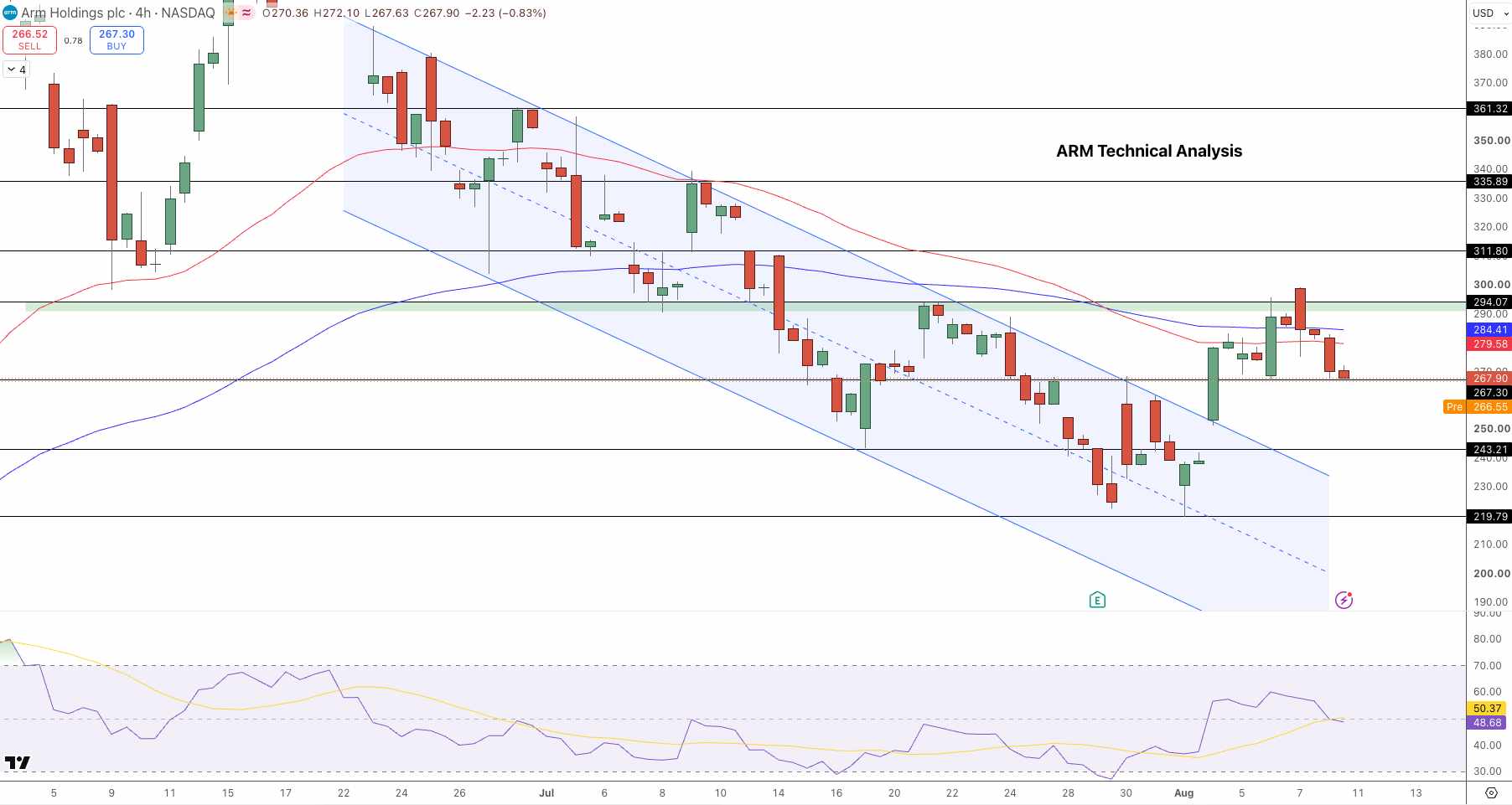
Arm Stock Price Chart - Source: Tradingview
A move below $267.30 could see the major support level drop to $243.21 with $219.79 coming up next. The bulls are looking for a recovery above the $279.58 to $284.41 EMA zone. Breaking $294.07 can open up a recovery to $311.80, but RSI on 49 and the failed $294 move suggest the path of least resistance is still to the downside.
Key Levels (Asian Session Aug 11)
- Immediate resistance: $279.58 (50 EMA, critical zone)
- Extended targets: $284.41 (100 EMA), $294.07, $311.80
- Critical support: $267.30 (pivot, must hold)
- Secondary support: $243.21, $219.79
- Current price: $267.90 (testing pivot support)
- RSI: 49 (momentum fading, just below neutral)
The Bottom Line
Q2 FY2026 was impressive for Arm. Revenue growth was at 34% and record royalties were set. With the doubling of Neoverse royalties, gross margins were at 97.4% and operating margins were at 41%. The DreamBig acquisition is a big deal as Arm is shifting its strategy from a licensing model to a full system solution model. Fundamentals look solid with the Meta partnership and the growth of Physical AI.
That said, the technical picture is concerning. After the rebound from support failed at $294, the stock has been pulled back to $267.30, a key pivot. Momentum has fallen, RSI has fallen below 50 and the bias has shifted to bearish. The bias will shift to bullish only on the price crossing $279.58.
From a tactical standpoint, with the breakdown that has occurred, the support at $267.30 must hold. Failure to do so will result in a drop to the $243-$220 range. Investors bullish on the 34% revenue growth, Neoverse royalties, DreamBig networking IP, and Physical AI should take advantage of the pullback in the $243-$250 range instead to buy the dip at $277–279.
Recommended Articles


