


SpaceX Stock Is Down 17% Since Its IPO. Here's What a $10,000 Investment Could Look Like in 5 Years.
Key Points
SpaceX raised $85.7 billion in the largest IPO in history, but shares have fallen 17% from their debut price in just two months.
Starlink is the company's financial bright spot, generating $4.3 billion in revenue last quarter and $1.65 billion in operating profit.
- 10 stocks we like better than Space Exploration Technologies ›
Space Exploration Technologies (NASDAQ: SPCX) went public on June 12 in one of the highest-profile debuts ever. That's due in large part to the record-setting numbers: The company raised $85.7 billion, making it the largest initial public offering (IPO) in history by a country mile.
Shares rocketed up in the days that followed, but things haven't been so rosy since. The stock closed its IPO day at $160.95. It's now down more than 17% to roughly $133 as of Aug 8.
Missed Nvidia in 2009? This Rare Signal Is Flashing Again. In 2009, a "Double Down" signal flashed for a little-known chipmaker called Nvidia. For the first time in years, that same "Total Conviction" signal is flashing for a company 1/100th the size of Nvidia. Continue »
That's a rocky two months. But many investors see it as a major opportunity -- a chance to snag shares at a steep discount. So, is this the time to buy in? What might $10,000 invested today turn into in five years?
SpaceX by the numbers: What the financials actually show
Let's start with what the company actually looks like today. In the second quarter, SpaceX brought in $7.8 billion in revenue -- up 92% year over year -- while narrowing its operating loss to just $143 million. Its net loss came in at $541 million.
Most of the good news, financially speaking, still comes from one source: Starlink. The company's Connectivity segment did $4.3 billion in revenue -- up 66% year over year -- and brought in a healthy operating profit of $1.65 billion, up 79%.
Of course, that's a bit rosier view than reality. When SpaceX launches its own Starlink satellites, the rocket business doesn't book any revenue for the launch. Instead, the launch costs are capitalized within the Connectivity segment and depreciated over time.
That makes the Space segment look considerably worse on paper. It brought in just $962 million in revenue during the quarter and posted a $542 million operating loss. These numbers would look much better if it were charging Starlink at market rate -- of course, that means Starlink wouldn't look quite like the financial unicorn many people see it as.
The AI segment, on the other hand, is still bleeding money -- a lot -- though the picture has improved thanks to new compute contracts with Anthropic and Alphabet. Revenue more than tripled year over year to $2.56 billion, while its operating loss narrowed to roughly $1.26 billion. But that is because it is spending at an eye-watering rate: $15.8 billion on AI capital expenditures in Q2 alone.
The bull case for buying SpaceX stock
The bull case really rests on Starlink, which is growing incredibly fast and operates with fantastic margins. If management can continue to scale up the service globally and meaningfully disrupt the telecom market, it would be a huge moneymaker.
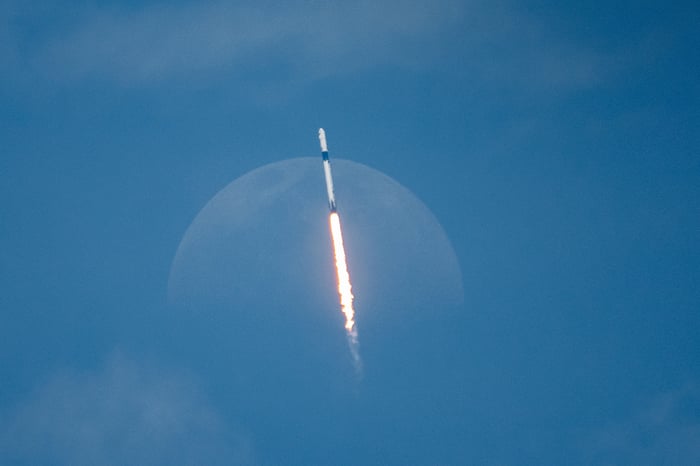
Image source: Getty Images.
On the launch side, SpaceX is likely to continue to dominate. If it manages to make the business profitable and opens up new revenue streams beyond the current opportunities, then once again, the upside is quite large. This is very much contingent on the success of its Starship program, the company's massive, reusable rocket currently in development.
SpaceXAI is certainly more of a crapshoot, but if the company manages to catch up to the competition in model quality and makes major inroads with enterprise customers, there is certainly a big revenue opportunity, though profitability remains an unknown.
The risks investors need to consider
On the flip side, a whole bunch of "ifs" are baked into the SpaceX narrative. The company's own S-1 document says that much of its plans depends on "unproven technologies or technologies that do not exist," and that timelines for things like orbital AI computing and manufacturing on the moon "may be difficult or impossible to determine."
The fact is, xAI is well behind on model quality and market penetration against competitors like OpenAI and Anthropic. And while providing computing capacity to competitors can stem the tide and provide some financial breathing room, it's hardly a business worth a meaningful part of its $1.75 trillion price tag (the company's current market capitalization).
Three scenarios lead to very different outcomes
Here is how I see a reasonable bull, bear, and base case for SpaceX and what that would mean for a $10,000 investment.
Bull
Starlink keeps growing rapidly while Starship dramatically lowers launch costs and opens new markets, and the AI business proves that its massive capital spending can produce equally massive revenue.
Base
Starlink remains the company's financial engine. Subscriber growth slows somewhat, but revenue and profits continue to climb. The AI business keeps growing rapidly and gradually approaches operational profitability, but massive spending on data centers continues. Starship continues progressing, but full commercialization is still just around the corner.
Bear
Starlink's growth slows as the easiest subscriber additions are exhausted, while SpaceXAI's spending balloons without generating enough profit to justify it. At the same time, Starship development remains expensive and behind schedule.
| Scenario | Market Cap | Implied Share Price | $10,000 Becomes | Annualized 5-Year Return (Loss) |
|---|---|---|---|---|
| Bear | $750 billion | $57 | $4,300 | (15.6%) |
| Base | $1.25 trillion | $95 | $7,100 | (6.5%) |
| Bull | $3 trillion | $228 | $17,100 | 11.3% |
Is SpaceX stock a buy right now?
My take is that we end up somewhere closer to the bear case. Even after its 17% fall, I still think SpaceX is overvalued. So, to answer the question at hand, no, I don't think it's a buy.
Should you buy stock in Space Exploration Technologies right now?
Before you buy stock in Space Exploration Technologies, consider this:
The Motley Fool Stock Advisor analyst team just identified what they believe are the 10 best stocks for investors to buy now… and Space Exploration Technologies wasn’t one of them. The 10 stocks that made the cut could produce monster returns in the coming years.
Consider when Netflix made this list on December 17, 2004... if you invested $1,000 at the time of our recommendation, you’d have $399,832!* Or when Nvidia made this list on April 15, 2005... if you invested $1,000 at the time of our recommendation, you’d have $1,374,595!*
Now, it’s worth noting Stock Advisor’s total average return is 968% — a market-crushing outperformance compared to 215% for the S&P 500. Don't miss the latest top 10 list, available with Stock Advisor, and join an investing community built by individual investors for individual investors.
See the 10 stocks »
*Stock Advisor returns as of August 10, 2026.
Johnny Rice has no position in any of the stocks mentioned. The Motley Fool has no position in any of the stocks mentioned. The Motley Fool has a disclosure policy.
Recommended Articles


