


Sundar Pichai's Alphabet Has Grown Google Cloud Revenue 82% Year Over Year. Here's Why That Growth Rate Justifies the Company's Capex Bet.
Key Points
Alphabet is aggressively investing hundreds of billions of dollars annually into its AI road map.
AI adoption is driving Google Cloud's rapid scale.
Google Cloud is highly profitable, which helps justify Alphabet's accelerating AI infrastructure spend.
- 10 stocks we like better than Alphabet ›
Artificial intelligence (AI) has become the defining force reshaping cloud computing, with platforms from Microsoft Azure, Amazon Web Services (AWS), and Google Cloud embedding generative models, custom accelerators, and agentic tools directly into their ecosystems.
These hyperscalers compete not only on storage and compute, but also on how AI can be deployed at enterprise scale. Although Google Cloud trails its rivals in overall market share, the platform's trajectory stands apart: Sustained acceleration far outpaces other industry leaders, providing clear validation for Alphabet's (NASDAQ: GOOGL) (NASDAQ: GOOG) aggressive capital expenditure (capex) plans.
Missed Nvidia in 2009? This Rare Signal Is Flashing Again. In 2009, a "Double Down" signal flashed for a little-known chipmaker called Nvidia. For the first time in years, that same "Total Conviction" signal is flashing for a company 1/100th the size of Nvidia. Continue »

Alphabet CEO Sundar Pichai. Image source: Alphabet.
Breaking down Google Cloud's explosive growth
During the second quarter, Google Cloud revenue reached $24.8 billion -- up 82% year over year. Operating income more than tripled to $8.8 billion, lifting the segment margin from 20.6% to 35.5%. Google Cloud ended the quarter with $514 billion in backlog, with over half expected to be recognized as revenue over the next two years.
A distinctive development during the second quarter was Alphabet's first recognition of revenue from its custom silicon, called Tensor Processing Units (TPU). During the earnings call, Alphabet CEO Sundar Pichai stated that Google Cloud's "momentum is driven by our integrated AI portfolio consisting of chips, models, data, security, and agent platforms, all designed to work together."
By designing its own chips, integrating Gemini models across analytics, security, and enterprise services, Google Cloud is able to generate "diversified demand across products, customers, geographies, and industries."
What is Alphabet spending AI capex on?
Alphabet raised its 2026 capex guidance to $195 billion to $205 billion, up from a prior range of $180 billion to $190 billion. Roughly 60% of Alphabet's quarterly capex outlay went to servers, while the remainder was allocated toward data centers and networking equipment.
Management made it clear that demand for more capacity still exceeds available supply, even after years of successive increases to infrastructure spend. For this reason, Alphabet expects further capex growth throughout 2027. Notably, temporary reliance on third-party capacity will likely continue to pressure profit margins.
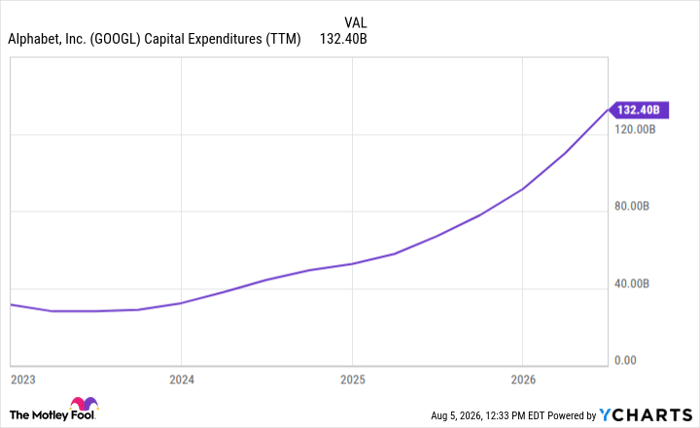
Data by YCharts.
Why Alphabet's capex budget is justified
Despite free cash flow turning negative to $5.9 billion in the second quarter, Alphabet still generated $39.1 billion in operating cash flow and $185.7 billion over the trailing 12 months. In addition, Alphabet's overall operating income rose 30% to $40.8 billion -- demonstrating ample capacity to self-fund its AI build-out while maintaining a resilient balance sheet supported by cash and diversified financing.
In my eyes, the long-run payoff remains visible: Google Cloud's margin expansion and backlog surge validate that the AI infrastructure investments are translating directly into high-margin, high-growth revenue. Against this backdrop, Alphabet's robust profitability provides both the financial means and the necessary proof that its capital intensity is not only justified but essential to capture the next phase of cloud leadership.
Should you buy stock in Alphabet right now?
Before you buy stock in Alphabet, consider this:
The Motley Fool Stock Advisor analyst team just identified what they believe are the 10 best stocks for investors to buy now… and Alphabet wasn’t one of them. The 10 stocks that made the cut could produce monster returns in the coming years.
Consider when Netflix made this list on December 17, 2004... if you invested $1,000 at the time of our recommendation, you’d have $399,832!* Or when Nvidia made this list on April 15, 2005... if you invested $1,000 at the time of our recommendation, you’d have $1,374,595!*
Now, it’s worth noting Stock Advisor’s total average return is 968% — a market-crushing outperformance compared to 215% for the S&P 500. Don't miss the latest top 10 list, available with Stock Advisor, and join an investing community built by individual investors for individual investors.
See the 10 stocks »
*Stock Advisor returns as of August 9, 2026.
Adam Spatacco has positions in Alphabet, Amazon, and Microsoft. The Motley Fool has positions in and recommends Alphabet, Amazon, and Microsoft. The Motley Fool has a disclosure policy.
Recommended Articles


