


Amazon Stock Price Forecast: Can Shares Keep Rising After Market Cap Hits $3 Trillion for First Time?
TradingKey - Amazon ( AMZN) officially joins the $3 trillion market capitalization club.
Driven by better-than-expected second-quarter 2026 results, accelerating growth in its AWS cloud business, and strong AI demand, Amazon's stock price surged following its earnings release. On August 3, Amazon's stock price closed at $284.02, pushing the company's market capitalization past $3 trillion for the first time and making it another public company to reach this milestone, following Nvidia, Apple, Microsoft, and Alphabet.
Meanwhile, JPMorgan ( JPM) raised its price target for Amazon from $330 to $365 and reiterated its "Overweight" rating.
An increase from $277.42 to $365 implies that Amazon's stock price still needs to rise by about 32%. Based on the current number of outstanding shares, if the stock price reaches $365, Amazon's market capitalization will approach $4 trillion.
Why Amazon’s Market Cap Hit $3 Trillion
Amazon's market capitalization topped $3 trillion, with the most direct catalyst being second-quarter financial results that significantly exceeded market expectations, particularly as AWS re-emerged with robust growth.
According to data released by Amazon, total revenue in the second quarter of 2026 increased by 20% year-on-year to $200.6 billion, and operating profit grew by 43% to $27.5 billion. AWS revenue grew by 37% year-on-year to $42.2 billion, marking its fastest growth rate in 18 quarters.
Financial Metrics | Q2 2026 Data | YoY Change |
Total Revenue | $200.6 billion | Up 20% |
Operating Profit | $27.5 billion | Up 43% |
AWS Revenue | $42.2 billion | Up 37% |
AWS Operating Profit | $16.6 billion | Up about 63% |
North America Revenue | $116.2 billion | Up 16% |
Advertising | $19.8 billion | Up 26% |
Although AWS accounts for only about one-fifth of Amazon's total revenue, it contributed $16.6 billion in operating profit, representing around 60% of the company's overall operating profit. This means that AWS is not only accelerating its growth, but its profitability is also improving simultaneously.
The growth of AWS was primarily driven by the migration of traditional enterprise workloads to the cloud and the new computing demand generated by generative AI. Amazon stated that the annualized revenue for both AWS's AI and chip businesses has surpassed $25 billion, maintaining triple-digit growth.
Self-developed chips such as Trainium and Graviton have also become key competitive tools for Amazon's cloud business. Through in-house chip design, Amazon can lower some computing costs while boosting the price competitiveness and profit margins of its cloud services.
In addition to AWS, Amazon's retail and advertising businesses are also improving. Second-quarter advertising revenue grew by 26% year-on-year, operating profit for the North America retail business rose to $9.1 billion, and the international segment continued to remain profitable. Simultaneous efficiency gains in cloud computing, advertising, and retail have further bolstered market confidence in Amazon's long-term profitability.
Can Amazon Stock Continue to Rise?
Whether Amazon's stock price can sustain its upward momentum crucially depends on whether AWS can maintain high growth and whether its AI capital expenditures can continue to yield returns.
JPMorgan raised Amazon's price target to $365, primarily citing accelerating AWS growth, increasing cloud contracts, and expanding AI demand. In the second quarter, AWS's remaining performance obligations (RPO) reached $496 billion, up 36% quarter-on-quarter, which is approximately 2.5 times the level of the same period last year.
This massive backlog enhances the visibility of AWS's future revenue. As enterprises accelerate their deployment of AI applications, cloud customers not only need to train models but also run inference, data analytics, and smart office services over the long term. The persistent nature of these applications is expected to provide AWS with a more stable revenue stream.
JPMorgan also expects AWS's margin improvements to continue driving Amazon's overall earnings growth. In the second quarter, AWS's operating margin was approximately 39.4%. If it can sustain a level near 40% going forward while revenue growth remains around 30%, there is still room for further upward revisions to Amazon's earnings per share (EPS).
However, Amazon is also spending heavily to meet AI demand. The company has raised its 2026 capital expenditure plan from approximately $200 billion to $220 billion, primarily to construct data centers, procure servers, expand network infrastructure, and develop proprietary chips.
While these investments are driving AWS's growth, they are also significantly squeezing free cash flow. Over the trailing 12 months, Amazon's operating cash flow grew 33% to $161.4 billion, but free cash flow reversed from an inflow of $18.2 billion in the prior-year period to an outflow of $7.6 billion, primarily due to a $66.1 billion increase in expenditures for property and equipment.
Consequently, investors will look beyond just AWS revenue, focusing also on the utilization rates of new data centers, the growth rate of capital expenditure, and the recovery of free cash flow. If AWS's growth slows while depreciation, energy, and server costs continue to rise, the room for expansion in Amazon's stock valuation could be constrained.
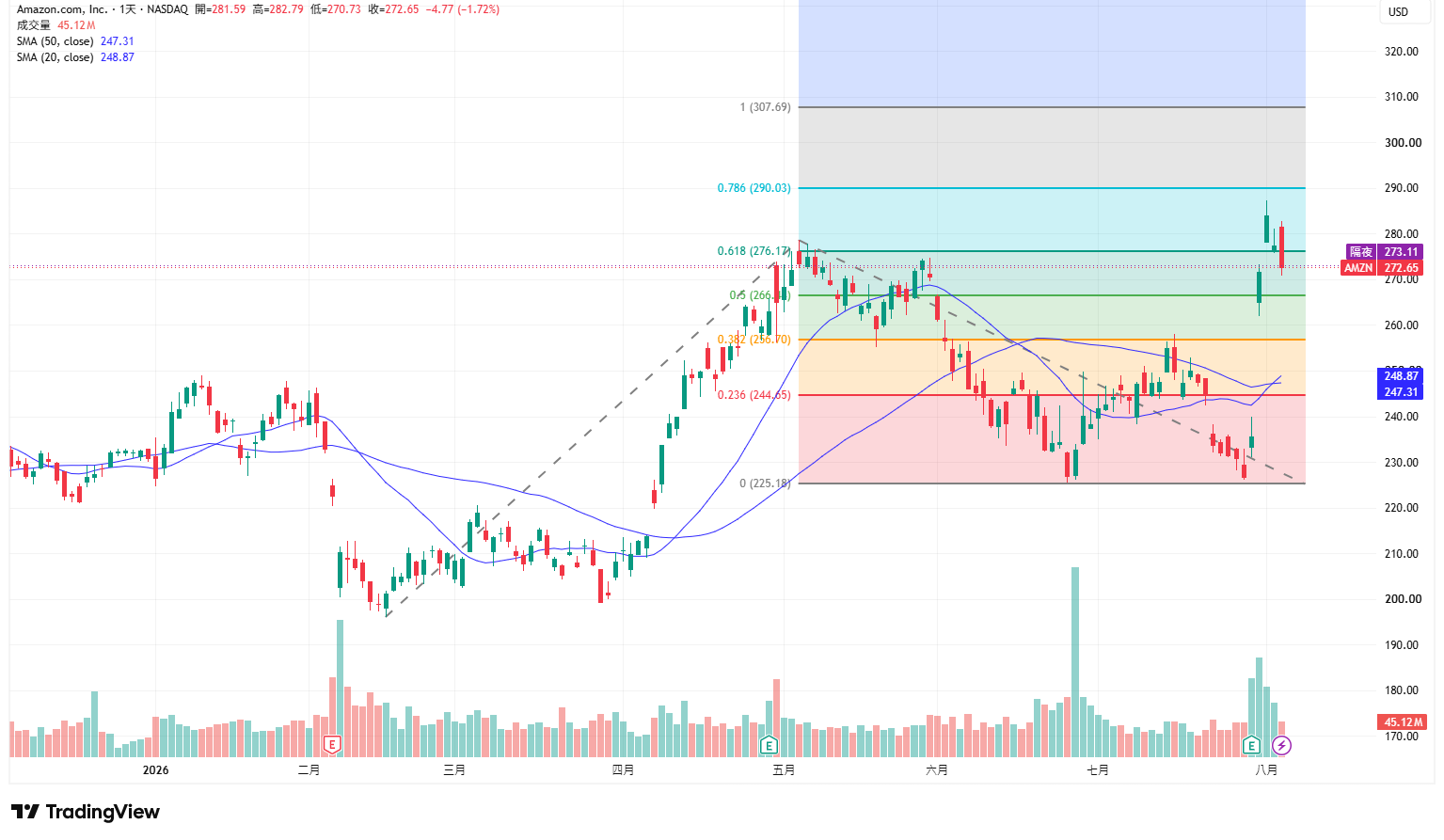
Source: TradingView
From a technical perspective, Amazon has rebounded from its low of $225.19 and broken above its downward trendline on high volume. As of August 5, the stock was trading at $272.65, holding above both its 20-day moving average of $248.87 and its 50-day moving average of $247.31, indicating a bullish bias in the short-to-medium term.
Resistance levels to the upside stand at $276.17, $290.03, and $307.69, respectively; key downside support levels are at $266.44, $256.70, $244.65, and $225.19.
If Amazon's closing price reclaims $276.17 and breaks above $290.03, it would confirm the upward trend, paving the way to potentially challenge $307.69. Conversely, if the stock drops below $266.44, it could retest the $256.70 level.
Recommended Articles


