


Why SanDisk Stock Dropped 50% From June Peak Amid AI CapEx Doubts, Rising Chinese Competition
TradingKey - After experiencing a significant rally in the first half of the year, SanDisk ( SNDK )'s stock price has recently entered a deep correction phase.
SanDisk's stock price hit an all-time high of $2,354.39 on June 25, but fell to around $1,096 at one point on July 29, a pullback of over 50%. Since entering August, the stock price has rebounded somewhat. As of August 4, the stock price rebounded to $1,427.62, still down about 40% from its all-time high.
In the first half of 2026, capital flooded into the memory chip sector, but in recent weeks investor sentiment has turned cautious. The memory sector has faced successive sell-offs, and the overall semiconductor chip market has weakened in tandem.
What Are the Main Reasons for SanDisk’s Stock Price Plummet?
The recent decline in SanDisk's stock price is first and foremost related to profit-taking. In the first half of 2026, driven by AI data centers expanding enterprise SSD procurement, tight NAND supply, and rising product prices, SanDisk's stock price had surged several-fold.
When a cyclical stock accumulates massive gains in a short period, even if fundamentals remain strong, a shift in market sentiment can easily trigger concentrated sell-offs.
Unlike Micron, SanDisk's business is highly concentrated in NAND flash and solid-state drives (SSDs), lacking DRAM and HBM businesses to serve as a cushion. Therefore, SanDisk's revenue and profits are more sensitive to NAND average selling prices (ASPs), enterprise SSD orders, and changes in industry inventory. When the market begins to worry that the NAND price cycle may be nearing its peak, SanDisk's stock price also typically exhibits greater volatility.
The development of China's memory chip industry has further amplified market concerns over future supply growth.
CXMT mainly focuses on DRAM and is not a direct competitor of SanDisk in the NAND sector. The impact of its IPO and fundraising progress on SanDisk is reflected more in market sentiment; investors worry that after Chinese memory companies obtain more funding, they will accelerate technological upgrades and capacity expansion, thereby altering the global memory chip supply and demand landscape.
By contrast, YMTC is SanDisk's more direct Chinese competitor in the NAND market. If YMTC continues to increase product layer counts, yields, and enterprise market penetration, competition in the global NAND market could intensify. Meanwhile, progress in Chinese domestic semiconductor equipment has also bolstered market expectations for the long-term growth of domestic memory capacity.
Why AI CapEx Sustainability Impacts SanDisk Stock Price
The key logic behind SanDisk's previous surge was that the AI industry is gradually shifting from model training to large-scale inference.
AI applications require long-term preservation and rapid retrieval of massive amounts of data, where enterprise SSDs offer advantages in read speeds, power consumption, and performance. As cloud computing companies build more AI data centers, demand for high-capacity NAND and enterprise SSDs is growing rapidly, transforming SanDisk from a traditional cyclical storage stock into a beneficiary of AI infrastructure in the eyes of the market.
However, after Alphabet ( GOOGL ), Microsoft ( MSFT ), Meta ( META) and Amazon ( AMZN) continuously increased their capital expenditures, investors began to examine whether these investments could translate into sufficient revenue and cash flow. If cloud computing companies slow down the pace of server or data center construction in the future, demand for enterprise SSDs may fall short of previous optimistic expectations.
As a stock highly sensitive to AI storage demand, SanDisk's share price has consequently faced more pronounced valuation pressure than megacap tech stocks.
The emergence of highly efficient AI models such as Kimi K3 has also prompted the market to rediscuss the investment intensity of AI infrastructure. While higher model efficiency is expected to lower the cost per inference, the market is concerned in the short term that a drop in unit compute and storage demand could impact the procurement of GPUs, servers, and enterprise SSDs.
SanDisk Stock Price Technical Analysis
Source: TradingView
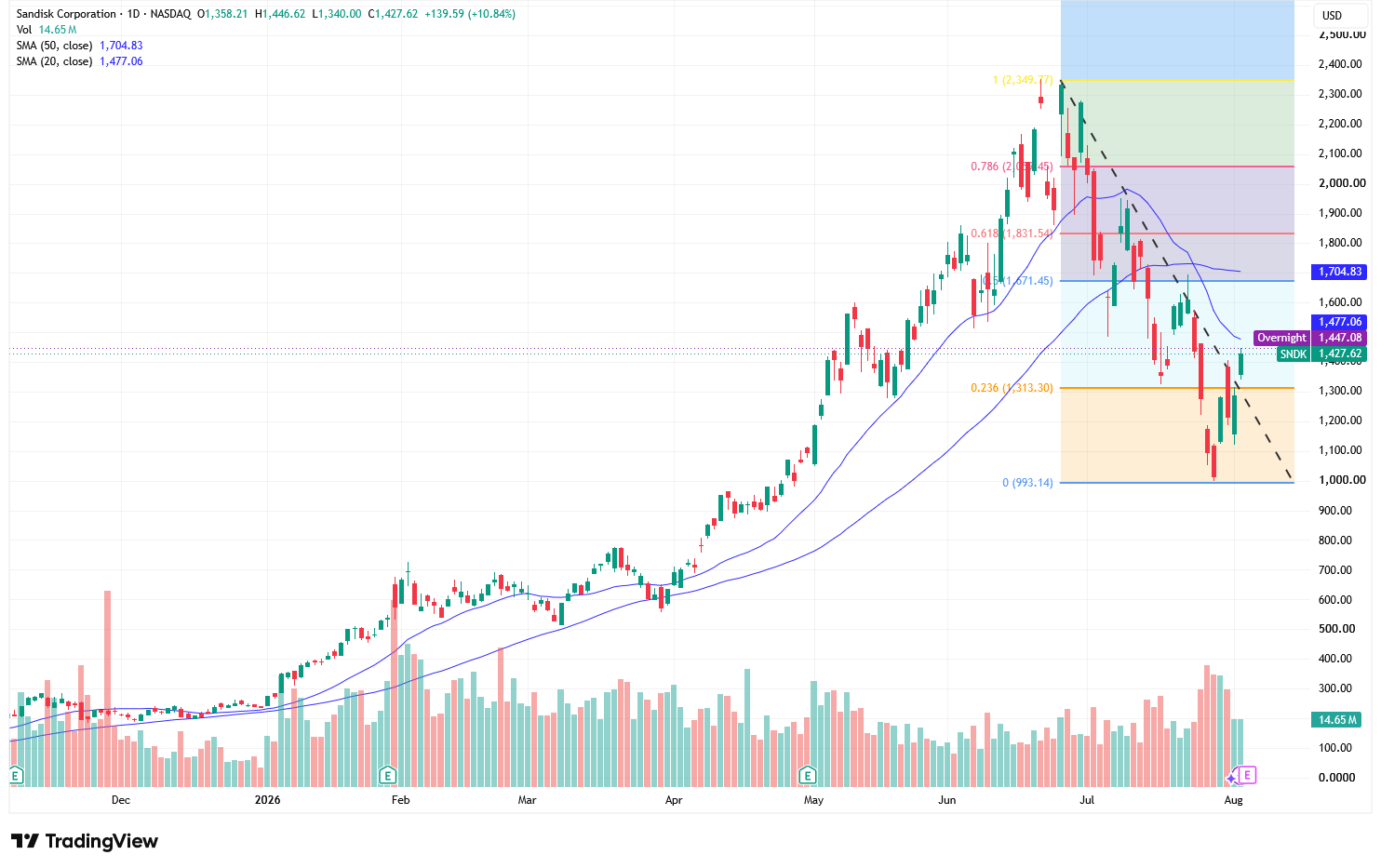
Looking at the daily chart, SanDisk's stock price entered a rapid correction after rising to a periodic high of $2,349.77, dropping to a low of $993.14 at one point, with a maximum decline of nearly 58%. The original upward structure has shifted into a downward trend characterized by lower highs and lower lows.
Although the stock price surged 10.84% on August 4 to close at $1,427.62 and reclaimed the 23.6% Fibonacci retracement level of $1,313.30, a reversal cannot yet be confirmed. The overhead $1,450–$1,480 zone presents combined resistance from the downward trendline and the 20-day moving average. Moreover, the 20-day moving average ($1,477.06) remains below the 50-day moving average ($1,704.83), with both moving averages sloping downward, indicating that the medium-term trend remains weak.
In the short term, if SanDisk can break above the downward trendline on heavy volume and consistently hold above $1,480, further upside room for a rebound could open up, with the next targets at $1,600 and the $1,671–$1,705 zone. Specifically, $1,671 represents the 50% Fibonacci retracement level, and the area around $1,705 is the 50-day moving average; together, they form a key resistance zone that will determine whether the trend can reverse. Only an effective breakout above this zone would allow the market to transition from an oversold rebound to a medium-term recovery. A further break above the 61.8% retracement level near $1,831 would indicate that the bulls have regained more distinct control.
However, the trading volume during the latest rebound has not significantly exceeded the elevated volume levels seen during the previous decline, indicating that the momentum of capital chasing the rally remains to be seen. If the stock price encounters resistance in the $1,450–$1,480 zone and falls back below the $1,313 support level, the short-term rebound could be declared a failure. In that case, attention would need to turn to the level around $1,200 and the previous low zone of $993–$1,000.
Summary
SanDisk's stock price once fell by more than 50% from its June peak. This was not caused by a single negative factor, but was rather driven by a combination of factors, including excessive prior gains, profit-taking, questioned returns on AI capital expenditures, and the accelerated expansion of Chinese memory manufacturers. Meanwhile, because SanDisk's business is highly concentrated in NAND and enterprise SSDs, its stock price is more sensitive to changes in memory prices and datacenter demand.
However, SanDisk's current operating data remains strong, and the stock price decline more reflects the market revising down overly optimistic growth expectations. Looking ahead, investors should closely monitor enterprise SSD orders, NAND prices, gross margins, AI customers' capex, and the capacity progress of Chinese manufacturers, as these factors will determine whether SanDisk's stock price can truly stabilize and rebound.
Recommended Articles


