


AUD/USD (AUDUSD) Surges 0.51% on Aug 4: What You Need to Watch
AUD/USD (AUDUSD) is up 0.51% at Aug 4 06:50(ET), now at $0.70339, with a 7-day up of 0.87%.
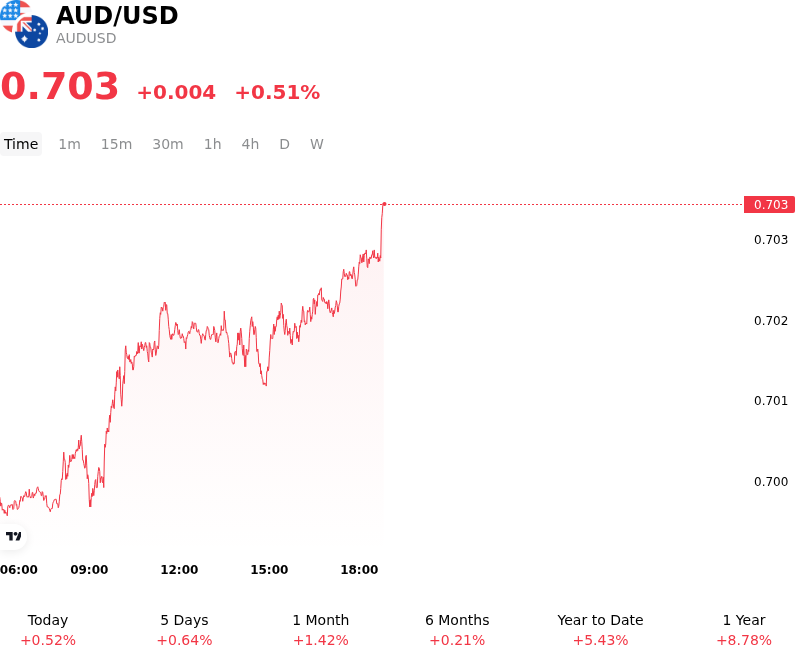
What is driving AUD/USD (AUDUSD)’s stock price up today?
The appreciation of the Australian dollar against the U.S. dollar was primarily driven by the Reserve Bank of Australia’s policy decision and its accompanying hawkish forward guidance. By maintaining a restrictive monetary policy stance and signaling that interest rates may need to remain elevated for an extended period to ensure inflation returns to the target range, the RBA diverged from the more neutral or dovish shifts observed in other major G10 central banks. This policy divergence has reinforced the yield advantage of Australian government bonds over U.S. Treasuries, attracting institutional capital inflows into the AUD.
Domestic economic resilience, particularly in the labor market and services sector, has supported the RBA’s cautious approach toward easing. Investors have repriced the probability of near-term rate cuts, shifting expectations further into the future, while the U.S. Federal Reserve is perceived to be closer to a localized easing cycle. This widening of the interest rate differential serves as a fundamental pillar for the AUDUSD advance, as the carry-trade appeal of the Australian dollar improves relative to the greenback.
The move was further supported by a constructive shift in global risk sentiment and a stabilization in commodity markets. As a high-beta currency, the Australian dollar benefited from a broader risk-on environment and positive signals regarding industrial demand from China, Australia’s primary trading partner. Strengthening prices for iron ore and base metals provided additional tailwinds, improving Australia’s terms of trade and bolstering the currency’s fundamental valuation during the session.
On the other side of the pair, the U.S. dollar faced downward pressure as cooling U.S. economic indicators led to a moderate retreat in Treasury yields. While the U.S. economy remains relatively robust, the lack of upside surprises in recent inflation data has capped the dollar’s strength, allowing the AUD to capitalize on the RBA-induced momentum. The combination of a hawkish domestic central bank and a softening U.S. yield environment created a favorable backdrop for the pair’s intraday strength.
Despite the move, market participants continue to monitor the risks associated with global growth slowdowns and potential shifts in Chinese industrial policy. However, the current price action suggests that the Australian dollar is being driven by a fundamental repricing of interest rate paths, where the RBA’s commitment to tackling persistent inflation outweighs the broader U.S. dollar trend. The upward movement reflects a market that is increasingly viewing the AUD as a preferred vehicle for yield-seeking behavior within the current macro environment.
Technical Analysis of AUD/USD (AUDUSD)
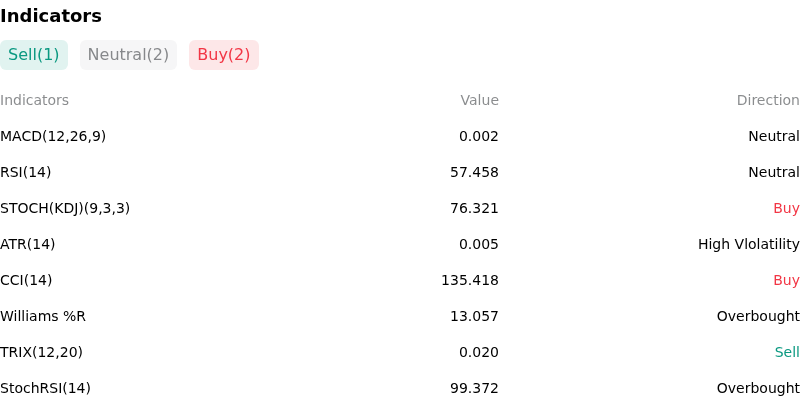
Technically, AUD/USD (AUDUSD) shows a MACD (12,26,9) value of 0.002, indicating a neutral signal. The RSI at 57.458 suggests neutral condition and the Williams %R at 13.057 suggests overbought condition. Please monitor closely.
More details about AUD/USD (AUDUSD)
Recent Events and Risks:
- Chinese Macroeconomic Headwinds: Persistent concerns over China’s sluggish property sector and the lack of aggressive fiscal stimulus from Beijing continue to weigh on the Australian Dollar, which functions as a liquid proxy for Chinese growth and demand for industrial metals.
- US Yield Divergence: Renewed strength in US Treasury yields, fueled by resilient domestic retail and labor data, has narrowed the interest rate differential advantage for the Aussie, exerting significant downward pressure on the AUDUSD pair as the market recalibrates the Fed's easing timeline.
- Commodity Price Volatility: Recent declines in iron ore and base metal prices, driven by global manufacturing slowdowns and high inventory levels, have directly impacted Australia’s terms of trade and reduced the fundamental support for the currency during intraday trading.
- Risk-Off Sentiment and Liquidity Shocks: Heightened geopolitical instability and volatility in global equity markets have triggered defensive flows into the US Dollar, disproportionately penalizing high-beta currencies like the AUD as investors unwind carry trade positions and seek safe-haven assets.
Recommended Articles


