


Experts Are Sounding the Alarm Over an AI Bubble. Here's What History Says Investors Should Do Right Now.
Key Points
The AI industry has been wavering lately, as fears around a bubble grow.
A bear market is coming eventually, and now is the ideal time to prepare.
History offers a clear answer as to how investors can protect their portfolios.
- These 10 stocks could mint the next wave of millionaires ›
The AI sector has experienced unprecedented growth in recent years, lifting the rest of the stock market with it. The catch, though, is that these stocks can also drag the market down if they falter.
The top 10 largest AI-related stocks now make up over 40% of the S&P 500 (SNPINDEX: ^GSPC), according to research from Bank of America, which is similar to the levels of tech stock concentration during the dot-com bubble of the early 2000s.
Where to invest $1,000 right now? Our analyst team just revealed what they believe are the 10 best stocks to buy right now, when you join Stock Advisor. See the stocks »
While AI bubble fears have been circulating for years, recent volatility within the tech sector has led to renewed concerns. More experts are beginning to sound the alarm, and history offers a clear answer as to what investors should do right now.
Image source: Getty Images.
AI spending is causing concern among investors
Many companies have ramped up their AI-related expenditures in recent years. Amazon, Microsoft, Meta Platforms, and Google parent company Alphabet spent a combined $410 billion on data centers in 2025. Globally, organizations are expected to spend around $4 trillion on AI infrastructure by 2030.
While many investors are hopeful that the AI build-out will pay off eventually, experts are beginning to warn that we're in potential bubble territory.
According to Bank of America's most recent Global Fund Managers Survey, 61% of managers don't expect hyperscalers to cut back on spending this year. While none reported being short on the technology sector, they still identified an AI bubble as the most pressing tail risk facing the market right now.
Is history repeating itself?
The incredible rise of AI stocks has given some investors flashbacks to the dot-com bubble, when hundreds of internet companies soared in value over a few short years -- only to crash hard when the bubble popped.
While it's impossible to say whether the AI boom will go down a similar path, there are some similarities. The S&P 500 Shiller CAPE Ratio measures long-term trends in the S&P 500's valuation, and it's nearing levels not seen since the dot-com bubble.
There are only two points in history when this ratio consistently stayed above 40. The first was in 1999, leading up to the dot-com bear market. The second is right now, as this metric has hovered just above 40 since May.
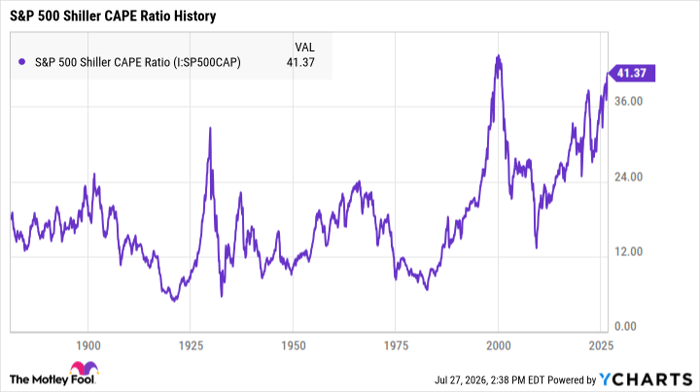
S&P 500 Shiller CAPE Ratio data by YCharts
To be clear, no stock market indicator is 100% correct, as past performance can't predict future returns. What investors can take away from this signal, however, is that it's more important than ever to invest in quality stocks.
The best move investors can make right now
History may not be able to predict future bear markets, but it does prove time and time again that overhyped and overvalued stocks will struggle the most over the long term.
During the dot-com bubble, for instance, the companies that failed were those with unsustainable business models, poor financial health, or weak competitive advantages. Despite many of those stocks skyrocketing in price, shaky fundamentals can cripple even the hottest investments.
It's equally important, however, to keep a long-term outlook. Even healthy stocks are often pummeled during bear markets, but the companies built on solid foundations will eventually recover. Amazon, for instance, lost around 95% of its value between 1999 and 2001. The investors who reaped the biggest rewards were those who stayed the course and continued investing.
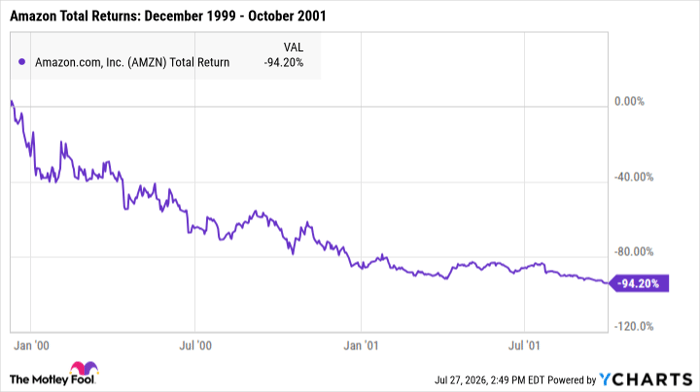
AMZN Total Return Level data by YCharts
Regardless of whether we're in an AI bubble, we'll face a market downturn eventually. Right now is the ideal time to review your portfolio and ensure you're investing only in quality stocks.
Again, no stock will be immune to short-term market volatility. The best investments, however, are those that can withstand turbulence and go on to earn positive long-term returns. The more of these stocks you own, the more prepared you'll be for any bear market.
Where to invest $1,000 right now
When our analyst team has a stock tip, it can pay to listen. After all, Stock Advisor’s total average return is 886%* — a market-crushing outperformance compared to 206% for the S&P 500.
They just revealed what they believe are the 10 best stocks for investors to buy right now, available when you join Stock Advisor.
See the stocks »
*Stock Advisor returns as of July 29, 2026.
Bank of America is an advertising partner of Motley Fool Money. Katie Brockman has no position in any of the stocks mentioned. The Motley Fool has positions in and recommends Alphabet, Amazon, Meta Platforms, and Microsoft. The Motley Fool has a disclosure policy.
Recommended Articles


