


Prediction: Under Greg Abel, Berkshire Hathaway Will Hold This Warren Buffett Stock for Decades for This Remarkably Simple Reason
Key Points
American Express pays significantly more in card member rewards expenses than it collects in membership fees.
American Express makes up for the shortfall through merchant fees.
- 10 stocks we like better than American Express ›
Berkshire Hathaway (NYSE: BRKA) (NYSE: BRKB) has held American Express (NYSE: AXP) for nearly 40 years, making it a staple holding under former CEO Warren Buffett. I predict Berkshire will continue to hold American Express under Warren Buffett's hand-picked successor, Greg Abel, because the company is attracting new cardholders from younger generations through its highly appealing rewards program.
Here's why the value stock is a great buy now.
Missed Nvidia in 2009? This Rare Signal Is Flashing Again. In 2009, a "Double Down" signal flashed for a little-known chipmaker called Nvidia. For the first time in years, that same "Total Conviction" signal is flashing for a company 1/100th the size of Nvidia. Continue »
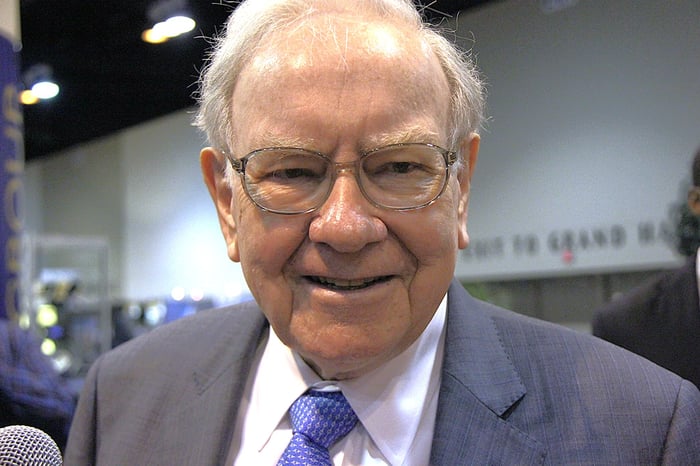
Former Berkshire Hathaway CEO Warren Buffett. Image source: The Motley Fool.
American Express is winning with millennials and Gen Zers
In the second quarter of 2026, as American Express reported on July 24, Gen Xers accounted for 36% of spending volumes among individual consumers, followed by 31% from millennials, 27% from baby boomers and older, and 7% from Gen Zers.
However, Gen Zers showed 40% year-over-year spending growth, followed by 14% from millennials, 10% from Gen Xers, and 5% from baby boomers. Although Gen Xers and baby boomers account for the majority of consumer spending, the fastest-growing cohorts are younger generations.
American Express's secret sauce
Cross-generational engagement is the holy grail of consumer brands. It's how fellow Berkshire core holding Coca-Cola became a beverage enjoyed across age groups and geographies, and how Apple built an ecosystem that incentivizes families to adopt the next generation of Apple products.
To achieve cross-generational adoption, a brand has to offer something above and beyond the competition. And for American Express, that's a rewards program unlike any other. For the six months ended June 30, American Express raked in $5.61 billion in net card fees but spent a staggering $9.94 billion on card member rewards.
So even though its annual Gold Card membership now costs $325 and the Platinum Card costs $895, members are still getting a good deal based on the value of their rewards.
The beauty of American Express's business is that it can afford these ultra-generous card member perks because its main revenue stream is what's known as discount revenue, which is the fees it collects from merchants each time an American Express card is swiped, inserted, tapped, or entered digitally. For the six months ended June 30, American Express generated $19.68 billion in discount revenue.
Anchor your portfolio with a high-quality stock
American Express has built an ecosystem that can endure for generations to come. It starts with a network of 155.1 million cards in force, which creates network effects that incentivize merchants to accept American Express even though the cards tend to have higher fees than Visa and Mastercard.
In turn, American Express generates substantial discount revenue, which it can use to offer generous perks to card members that cost nearly twice what members pay in annual fees. Because members are getting such a good deal, they are incentivized to rack up as many reward points as possible, which boosts discount revenue from merchant fees -- and the cycle repeats.
American Express is attracting new card members and guiding for double-digit revenue growth and record earnings in 2026, even though consumer spending has been under pressure. The results and forecast show that the business can thrive regardless of the economic cycle.
Add it all up, and American Express stands out as arguably the single best Berkshire Hathaway stock to buy now.
Should you buy stock in American Express right now?
Before you buy stock in American Express, consider this:
The Motley Fool Stock Advisor analyst team just identified what they believe are the 10 best stocks for investors to buy now… and American Express wasn’t one of them. The 10 stocks that made the cut could produce monster returns in the coming years.
Consider when Netflix made this list on December 17, 2004... if you invested $1,000 at the time of our recommendation, you’d have $379,662!* Or when Nvidia made this list on April 15, 2005... if you invested $1,000 at the time of our recommendation, you’d have $1,206,116!*
Now, it’s worth noting Stock Advisor’s total average return is 886% — a market-crushing outperformance compared to 206% for the S&P 500. Don't miss the latest top 10 list, available with Stock Advisor, and join an investing community built by individual investors for individual investors.
See the 10 stocks »
*Stock Advisor returns as of July 29, 2026.
American Express is an advertising partner of Motley Fool Money. Daniel Foelber has positions in American Express. The Motley Fool has positions in and recommends American Express, Apple, Berkshire Hathaway, Mastercard, and Visa. The Motley Fool has a disclosure policy.
Recommended Articles


