


Delta's Profits vs. GE's Premiums: Is the Market Mispricing These 2 Stocks?
Key Points
GE Aerospace trades at a premium due to recurring revenue expectations, while Delta is priced as a highly cyclical stock.
Delta Air Lines has diversified its revenue beyond main cabin ticketing, and in doing so made its revenue streams a lot less cyclical.
- 10 stocks we like better than Delta Air Lines ›
The valuation discrepancy between GE Aerospace (NYSE: GE) and Delta Air Lines (NYSE: DAL) speaks volumes about how investors view the commercial aerospace industry. While that view has historical precedent, I think the industry has changed, and the market is at least mispricing Delta Air Lines.
How the market thinks about the commercial aerospace industry
The chart below goes a long way to explaining matters. Network airlines like Delta and United Airlines are trading on very attractive valuations relative to aerospace equipment supplier GE Aerospace. The interesting thing is that GE, and its joint venture with Safran, CFM International, are leading players in the commercial engine market that powers airlines' flight departures, so why the valuation discrepancy between the main users of aircraft engines and the key supplier of them?
Where to invest $1,000 right now? Our analyst team just revealed what they believe are the 10 best stocks to buy right now, when you join Stock Advisor. See the stocks »
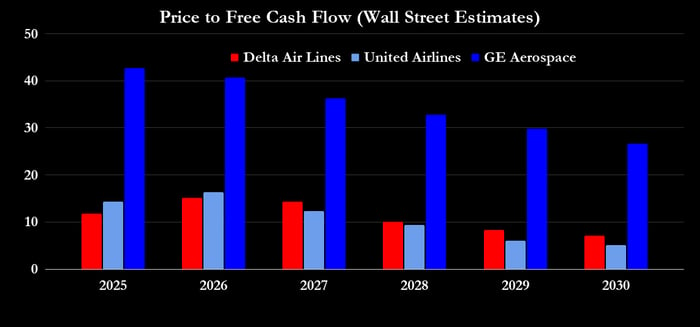
Data source: Visible Alpha. Chart by author.
The commercial aerospace market in history
The answer lies in the traditional cyclicality of commercial airlines and their historical inability to generate the return on invested capital necessary to cover their cost of capital, due to the industry's continuous boom-and-bust cycles. When the going is good, airlines traditionally rush to build capacity and expand routes, only to eventually walk into a slowdown, burdened with relatively high fixed costs that push them to maintain capacity while hoping for a rebound.
Unfortunately, these dynamics have led to wild swings in profitability. While you might think the capital markets would be wary of the industry, the reality is that the debt is backed by credible assets: the aircraft.

Image source: Getty Images.
As such, it's traditionally been a great market for bondholders and equipment suppliers, who benefit from the transfer of capital from bond and equity markets to airline industry assets, but a lousy one for equity holders. Warren Buffett himself is on record decrying investing in airlines, although interestingly, Berkshire Hathaway has taken a stake in Delta since Buffett handed over control to Greg Abel.
Why the market prices in a premium for GE Aerospace over Delta Air Lines
As such, the market accords GE Aerospace a premium valuation as it believes its growing installed base of aircraft engines will generate highly lucrative recurring services revenue, as aircraft engines can be used for over 40 years. In contrast, Delta Air Lines is rated lower because the market is pricing in the traditional volatility and cyclicality of its earnings.
Delta Air Lines' stock is attractive
While GE Aerospace's valuation arguably bakes in positive assumptions about long-term growth, Delta Air Lines' valuation looks too generous, not least because the airline has made great strides in diversifying its income streams away from an overreliance on main cabin ticketing.
For example, in the recently reported quarter, Delta's premium cabin revenue of $6.92 billion exceeded its main cabin revenue of $6.85 billion. In addition, its loyalty travel awards revenue of $1.25 billion and travel-related services revenue (ancillary and non-ticket) of $589 million meant that less than 44% of its $15.6 billion in passenger revenue came from the main cabin. Throw in "other" revenue (which contains a significant portion of co-branded credit card remuneration), which grew a whopping 50% to $3.9 billion in the quarter.
Whichever way you look at it, Delta is no longer an airline reliant on cyclical main cabin revenue. Therefore, it deserves a valuation closer to the long-term growth potential the market believes in for GE Aerospace.
Should you buy stock in Delta Air Lines right now?
Before you buy stock in Delta Air Lines, consider this:
The Motley Fool Stock Advisor analyst team just identified what they believe are the 10 best stocks for investors to buy now… and Delta Air Lines wasn’t one of them. The 10 stocks that made the cut could produce monster returns in the coming years.
Consider when Netflix made this list on December 17, 2004... if you invested $1,000 at the time of our recommendation, you’d have $379,662!* Or when Nvidia made this list on April 15, 2005... if you invested $1,000 at the time of our recommendation, you’d have $1,206,116!*
Now, it’s worth noting Stock Advisor’s total average return is 886% — a market-crushing outperformance compared to 206% for the S&P 500. Don't miss the latest top 10 list, available with Stock Advisor, and join an investing community built by individual investors for individual investors.
See the 10 stocks »
*Stock Advisor returns as of July 29, 2026.
Lee Samaha has no position in any of the stocks mentioned. The Motley Fool has positions in and recommends Berkshire Hathaway, GE Aerospace, and Safran. The Motley Fool recommends Delta Air Lines. The Motley Fool has a disclosure policy.
Recommended Articles


