


SpaceX Stock Price Forecast: Will Shares Fall Further After Value Loss Equivalent to Tesla’s Entire Market Cap?
TradingKey - As of July 27, Eastern Time, SpaceX ( SPCX) shares stood at $113.50, down 1.4%, hitting an intraday low of $108.66 to set another new low since its listing. Compared to the all-time high of $225.64 set on June 16, SPCX has experienced a cumulative drawdown of nearly 50%, and has fallen about 16% from its IPO price of $135. SpaceX's market capitalization has also dropped from a peak of around $3 trillion to about $1.5 trillion, erasing nearly $1.5 trillion in market value, which already exceeds the current total market capitalization of Tesla ( TSLA )'s current total market capitalization of approximately $1.09 trillion.
Why SpaceX Stock Price Continues to Fall
The direct cause of the continued decline in SpaceX's stock price is that although Starship's 13th test flight was near-successful, it has not yet resolved the core issue of full reusability.
During this mission, Starship successfully deployed 20 upgraded Starlink V3 test satellites, completed a space engine reignition, and showed significantly improved heat shield performance after atmospheric re-entry, with the spacecraft ultimately completing its flip maneuver and making a soft landing in the Indian Ocean. For SpaceX, this proves that the next-generation Starship already possesses the capability to transport large satellites, withstand the high temperatures of re-entry, and complete controlled returns.
However, five engines on the Super Heavy booster failed to reignite during its return, causing it to descend too quickly and make a hard landing in the Gulf of Mexico. This means that Starship has not yet completed the full closed loop of "stable booster recovery - stable spacecraft return - rapid relaunch," which is precisely the key to reducing launch costs, increasing launch frequency, and supporting SpaceX's long-term valuation.
For investors, in the early stages of the listing, they were willing to pay a higher valuation premium for Starship's future; however, after SpaceX's market capitalization once approached $3 trillion, merely completing a relatively successful test flight was no longer enough to drive the stock price higher. MarketWatch noted that although some analysts described the 13th test flight as near-perfect, SPCX still hit a new post-listing low, indicating that engineering progress has not yet translated into financial data sufficient to change its valuation.
In addition, it is worth noting that SpaceX will release its first quarterly earnings report since listing on August 4. The market is waiting for the company's first full disclosure of revenue, profits, cash flow, and whether Starlink can provide sufficient funding for Starship's development. The potential expiration of stock lock-up periods may also increase the supply of shares in circulation. Before these two uncertainties—the earnings report and the lock-up period—are resolved, capital is more inclined to reduce positions.
Will SpaceX Shares Continue to Fall?
In the short term, SpaceX's stock price has not yet fully shaken off downside risks. Although Starship's 13th test flight made significant progress, it failed to drive a rebound in the stock price, indicating that the positive technical news has been partially priced in by the market. Going forward, the stock price needs new catalysts, such as achieving stable booster recovery, proving the spacecraft can be rapidly reused, or demonstrating in financial reports that Starlink generates enough cash flow to cover Starship investments.
If the August 4 financial report shows that SpaceX remains deeply in the red, Starship R&D expenses continue to rise, or Starlink's revenue and profits miss expectations, the market may continue to lower its valuation. Especially with the lock-up period nearing its end, potential selling pressure from insider shareholders could push the stock price to further test the key $100 psychological level.
However, in the medium to long term, Wall Street has not completely dismissed SpaceX's growth prospects. The average analyst target price compiled by Visible Alpha exceeds $293, significantly higher than the current stock price. Meanwhile, Morgan Stanley has set a target price of $300, arguing that after SPCX fell below $120, its current valuation primarily reflects more mature core businesses such as rocket launches and Starlink satellite communications, while the valuation premium assigned by the market to long-term businesses like space AI has contracted significantly.
This means that the current stock price has become more cautious in pricing SpaceX's long-term growth potential. If Starship can achieve stable recovery and rapid reuse in the future, and further reduce Starlink satellite deployment costs, the potential value of businesses such as Starship, lunar missions, and orbital AI infrastructure could be priced back into the stock, thereby driving the stock price higher.
SpaceX Stock Technical Analysis
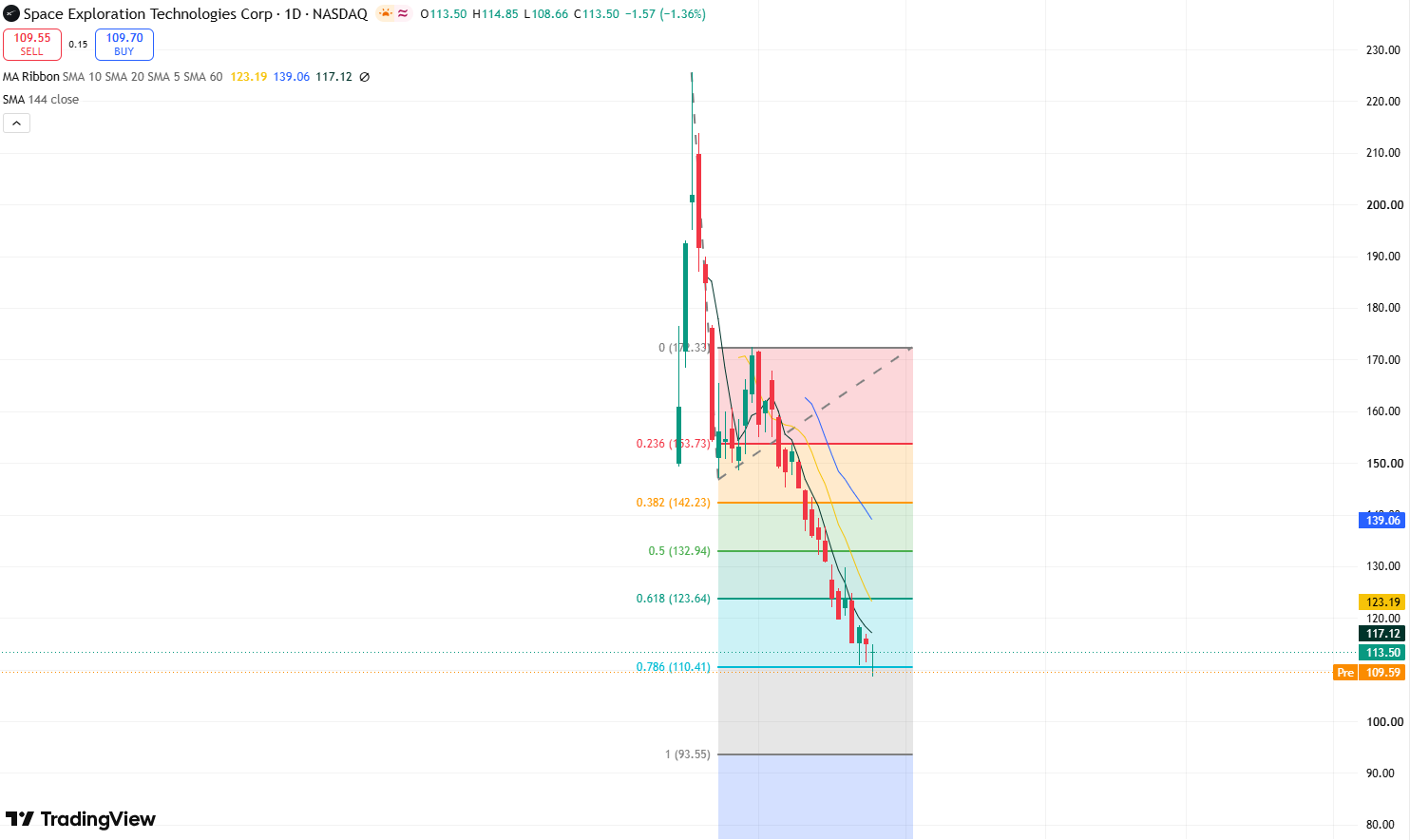
SPCX daily price chart, Source: TradingView
According to the daily chart of SPCX's stock price, the price has fallen near the key support level of $110. Although it temporarily broke below this level during Monday's intraday trading, the closing price still stood firmly above it, indicating strong support at this level and some strengthening of bullish momentum in the short term. However, the moving average system still maintains a bearish alignment, indicating that the overall trend of the stock price is still skewed to the downside, and the downward trend has strong persistence.
Currently, the candlestick has formed a doji pattern with a long lower shadow above $110, indicating a possibility that the stock price may stop falling and stabilize, and a short-term rebound may be on the way. However, the overall trend of the stock price remains bearish, and the room for a rebound may be limited. The primary target for a rebound will be to test the $120-$123 resistance level upward. If the stock price stands firmly above $123, it will open up upside potential toward $130-$132.
Conversely, if the stock price loses the key support level of $110, it may further fall to test the $100 mark, with the next support level down at $93-$90.
Recommended Articles


